The IoT Technology Ecosystem is redefining how businesses, cities, and industries connect devices, capture data, and drive intelligent decision-making. By integrating sensors, processors, software, and platforms, the ecosystem enables real-time monitoring, predictive analytics, and automated control across diverse applications. From smart manufacturing floors to connected healthcare devices, the IoT Technology Ecosystem is a cornerstone of digital transformation.
The IoT technology industry is expected to grow from USD 959.30 billion in 2025 to USD 1,148.62 billion by 2030, registering a CAGR of 3.7% during the forecast period. This growth is primarily driven by the increasing adoption of connected devices across industries, enabling real-time monitoring, automation, and improved operational efficiency. Advancements in 5G, cloud computing, and artificial intelligence are further expanding IoT capabilities and broadening its applications. Rising demand for smart homes, wearables, and industrial IoT solutions is fueling large-scale deployments, while government initiatives supporting digital infrastructure and smart city development are accelerating IoT adoption globally.
Node Components: The Building Blocks of Connectivity
At the foundation of the IoT Technology Ecosystem are its node components, which form the physical layer of connected devices. Sensors are critical, capturing environmental, mechanical, and operational data from industrial machines, smart homes, and wearable devices. Memory devices store data locally, supporting rapid access and temporary processing at the edge. Connectivity ICs ensure seamless communication across wireless protocols such as Wi-Fi, Bluetooth, LPWAN, and 5G, enabling devices to transmit data efficiently. Processors drive computations and local analytics, while logic devices manage signal control and system-level decision-making. Together, these components create a robust and scalable network of interconnected devices that fuel the broader IoT Technology Ecosystem.
Download PDF Brochure @ https://www.marketsandmarkets.com/pdfdownloadNew.asp?id=258239167
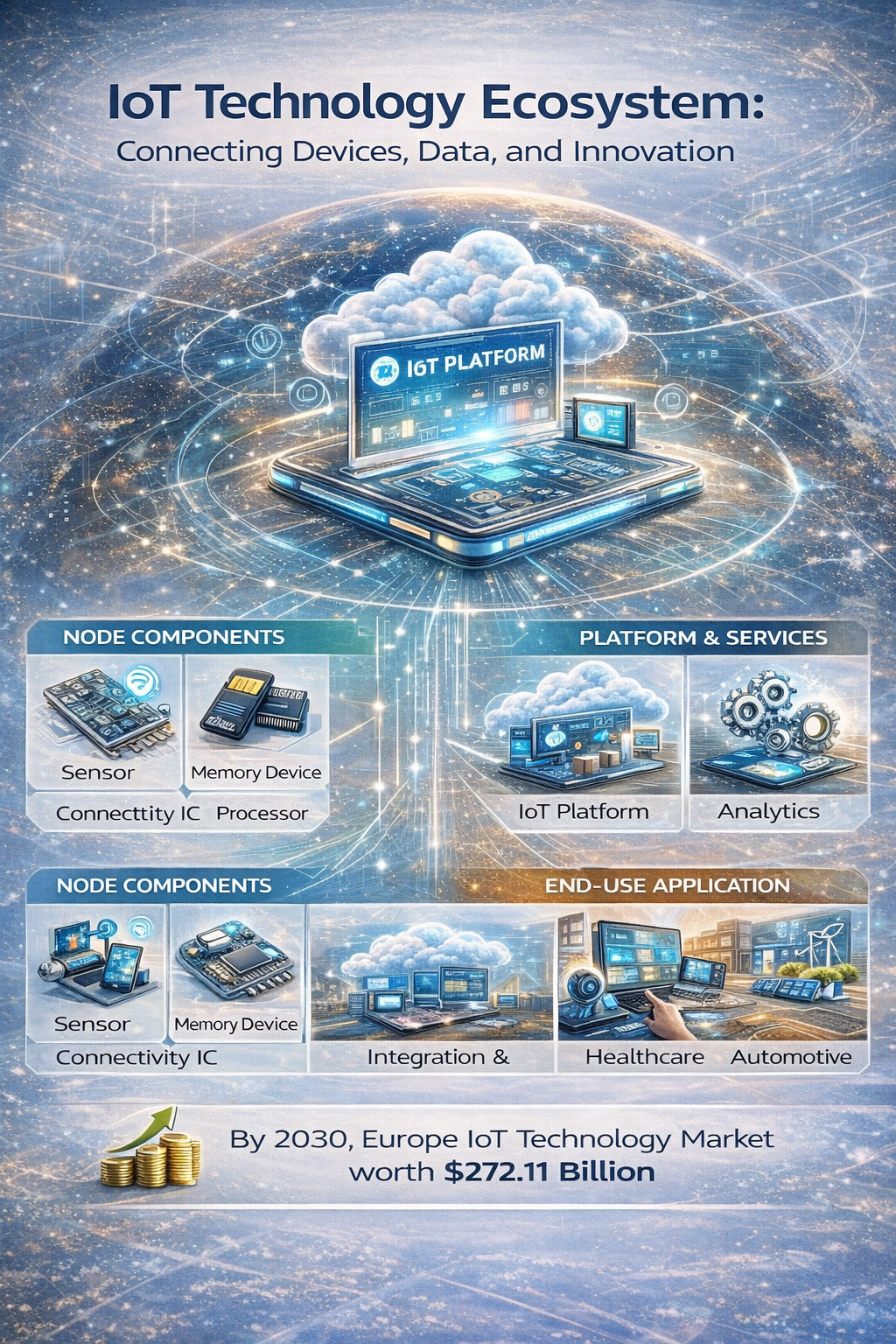
The Europe IoT technology market is estimated to reach USD 272.11 billion by 2030 from the estimated USD 246.63 billion in 2025, at a CAGR of 2.0%.
Software Solutions: From Data Capture to Insight
Software solutions are a key pillar of the IoT Technology Ecosystem, bridging raw data and actionable insights. Remote monitoring software allows organizations to track device performance, operational status, and environmental conditions in real time, ensuring reliability and reducing downtime. Data management solutions organize, process, and visualize large volumes of IoT-generated data, providing decision-makers with accurate, timely insights. These software solutions enable enterprises to leverage the full potential of the IoT Technology Ecosystem, supporting predictive maintenance, energy optimization, and operational efficiency.
Platforms: Integrating Devices and Applications
The IoT Technology Ecosystem relies heavily on platforms that unify device management, connectivity, analytics, and application deployment. IoT platforms serve as a centralized hub, enabling developers to integrate new devices, deploy applications, and manage data flows securely. By providing standard APIs, security protocols, and analytics capabilities, platforms streamline the adoption of IoT across industries, from smart cities to industrial automation. They are the connective tissue that transforms isolated sensors and devices into a cohesive, intelligent ecosystem.
Services: Ensuring Seamless Implementation
Services play a critical role in the IoT Technology Ecosystem, ensuring smooth deployment and ongoing operation. Consulting services help organizations identify opportunities for IoT integration and develop strategic roadmaps. Integration and managed services support system deployment, data orchestration, and device connectivity, while ongoing maintenance ensures scalability, security, and optimal performance. Together, these services enable enterprises to leverage the IoT Technology Ecosystem without the complexities of managing diverse hardware, software, and platform layers.
End-Use Applications: Driving Real-World Impact
The IoT Technology Ecosystem powers applications across multiple industries. In manufacturing, connected machines enable predictive maintenance and process optimization. Smart cities leverage sensors, connectivity, and platforms to monitor traffic, manage energy, and improve public safety. Healthcare devices track patient vitals and enable remote monitoring, while retail and logistics use IoT for inventory tracking, supply chain visibility, and customer experience enhancement. Energy management, agriculture, and automotive applications further demonstrate the versatility and transformative impact of the IoT Technology Ecosystem.
The Future of the IoT Technology Ecosystem
As connectivity standards, edge computing, and AI integration continue to evolve, the IoT Technology Ecosystem is expected to grow exponentially. Organizations are increasingly adopting IoT solutions to drive operational efficiency, improve decision-making, and unlock new business models. With robust node components, intelligent software, integrated platforms, and professional services, the ecosystem is positioned to accelerate digital transformation across industries, connecting devices, data, and innovation like never before.
FAQ: IoT Technology Ecosystem
Q1: What is the IoT Technology Ecosystem?
The IoT Technology Ecosystem is the interconnected network of devices, software, platforms, and services that enable the Internet of Things. It connects sensors, processors, and other node components to capture, transmit, and analyze data, driving real-time insights and automation across industries.
Q2: What are the key components of the IoT Technology Ecosystem?
The ecosystem consists of node components like sensors, memory devices, connectivity ICs, processors, and logic devices. These physical elements are complemented by software solutions for remote monitoring and data management, platforms that integrate devices and applications, and services such as consulting, system integration, and maintenance. Together, they enable a fully functional, scalable IoT network.
Q3: How are IoT solutions deployed?
Deployment in the IoT Technology Ecosystem can be on-premises, cloud-based, or hybrid. On-premises deployment offers control and security for sensitive data, while cloud solutions provide scalability and remote accessibility. Hybrid models combine the advantages of both approaches, allowing organizations to balance control, cost, and flexibility.
Q4: What applications are supported by the IoT Technology Ecosystem?
The ecosystem supports a wide range of applications. In manufacturing, it enables predictive maintenance and process optimization. Smart cities use it for traffic management, energy monitoring, and public safety. Healthcare applications include remote patient monitoring, while retail and logistics benefit from inventory tracking, supply chain visibility, and operational efficiency. Energy management, agriculture, and automotive sectors also leverage IoT solutions.
Q5: Why is the IoT Technology Ecosystem important?
The ecosystem is critical because it transforms raw data into actionable insights, enabling organizations to improve efficiency, reduce costs, and innovate faster. It provides the infrastructure and tools necessary for digital transformation, connecting devices, platforms, and analytics into a seamless system.
About MarketsandMarkets™
MarketsandMarkets™ has been recognized as one of America’s Best Management Consulting Firms by Forbes, as per their recent report.
MarketsandMarkets™ is a blue ocean alternative in growth consulting and program management, leveraging a man-machine offering to drive supernormal growth for progressive organizations in the B2B space. With the widest lens on emerging technologies, we are proficient in co-creating supernormal growth for clients across the globe.
Today, 80% of Fortune 2000 companies rely on MarketsandMarkets, and 90 of the top 100 companies in each sector trust us to accelerate their revenue growth. With a global clientele of over 13,000 organizations, we help businesses thrive in a disruptive ecosystem.
The B2B economy is witnessing the emergence of $25 trillion in new revenue streams that are replacing existing ones within this decade. We work with clients on growth programs, helping them monetize this $25 trillion opportunity through our service lines – TAM Expansion, Go-to-Market (GTM) Strategy to Execution, Market Share Gain, Account Enablement, and Thought Leadership Marketing.
Built on the ‘GIVE Growth’ principle, we collaborate with several Forbes Global 2000 B2B companies to keep them future-ready. Our insights and strategies are powered by industry experts, cutting-edge AI, and our Market Intelligence Cloud, KnowledgeStore™, which integrates research and provides ecosystem-wide visibility into revenue shifts.
To find out more, visit www.MarketsandMarkets™.com or follow us on Twitter , LinkedIn and Facebook .
Contact:
Mr. Rohan Salgarkar
MarketsandMarkets™ INC.
1615 South Congress Ave.
Suite 103, Delray Beach, FL 33445
USA: +1-888-600-6441
