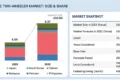
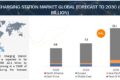
The global e-motorcycle market is estimated to grow from USD 0.37 billion in 2026 to USD 1.09 billion by 2032 at a CAGR of 12.7% from 2026 to 2032. The growth of the market is expected to be driven by increasing demand for high-efficiency urban mobility, rising fuel cost volatility, and tightening emission regulations across major economies. Electric motorcycles provide immediate torque delivery, lower drivetrain complexity, and reduced routine maintenance compared to ICE counterparts. Continuous improvements in lithium-ion battery chemistry, battery management systems (BMS), and thermal control architectures are enhancing vehicle range, cycle life, and safety performance. The expansion of DC fast-charging networks and standardized charging protocols is improving operational feasibility for private and commercial users. In addition, OEMs are expanding product portfolios across commuter (3–7 kWh), mid-range (8–15 kWh), and performance (16–30 kWh) categories to address differentiated demand profiles. These structural factors are supporting steady market expansion across Asia Pacific, Europe, and North America.
The global electric motorcycle ecosystem has strengthened proportionately with OEM investment, supplier integration, and platform standardization. Established e-motorcycle manufacturers such as Zero Motorcycles, Energica Motor Company, and NIU Technologies are scaling up modular battery platforms and integrated power electronics to improve manufacturing efficiency and product scalability. Advancements in high-output permanent magnet motors, inverter efficiency, and regenerative braking systems are improving overall drivetrain performance and energy utilization. Digital integration, including ride-by-wire systems, multi-mode traction control, smartphone connectivity, and over-the-air diagnostics, is increasing product differentiation and lifecycle management capability. At the same time, improvements in structural frame design and optimized battery placement are enhancing weight distribution and vehicle stability. Collectively, drivetrain efficiency gains, charging infrastructure expansion, and product premiumization are reinforcing long-term growth in the electric motorcycle market.
Download PDF Brochure @ https://www.marketsandmarkets.com/pdfdownloadNew.asp?id=230430186
By drive type, the chain drive segment is expected to account for the largest share of the global e-motorcycle market during the forecast period. This growth is due to their dominance in high-volume commuter and mid-capacity motorcycles (3–15 kWh). Chain systems offer high torque transfer efficiency, simple sprocket ratio adjustments, and lower component cost compared to belt alternatives. These advantages are particularly relevant in emerging markets, such as Asia Pacific, where service infrastructure favors familiar mechanical systems. OEMs targeting mass adoption prioritize chain drives to maintain cost competitiveness and mechanical robustness under varied road conditions. As commuter-oriented models represent the bulk of annual shipments, chain drive retains leadership in overall unit volume.
By battery capacity, the 16–30 kWh segment is expected to register the highest CAGR in value terms through 2032, supported by increasing demand for performance-oriented and highway-capable electric motorcycles. These motorcycles provide extended riding range, higher sustained power output, and stronger acceleration. And this positions them as alternatives to mid- and high-displacement internal combustion models. OEMs such as Zero Motorcycles, Energica Motor Company, and Lightning Motorcycle are concentrated in this capacity range, targeting premium and sport-performance segments. Premium offerings such as the Zero SR/F and the Energica Experia indicate the strategic transition toward long-range touring and high-output electric platforms. Although unit volumes remain lower than commuter categories, elevated average selling prices substantially increase revenue contribution. Adoption is accelerating in North America and Europe, where buyers prioritize range capability, performance specifications, and advanced electronic integration. Continued improvements in battery energy density and DC fast-charging infrastructure are expected to further support expansion of this segment over the forecast period.
North America is a significant market for electric motorcycles, supported by strong purchasing power, regulatory backing for zero-emission vehicles, and steady demand for performance-focused models. The US contributes the majority of regional sales, driven by federal and state incentives, emission standards, and expanding charging infrastructure. Companies such as Zero Motorcycles and Harley-Davidson, through their LiveWire division, position the region as a key base for premium electric motorcycle offerings. Demand is concentrated in mid- to high-power segments, particularly above 7 kW, aligned with consumer preference for highway-capable motorcycles. Fleet use in delivery and institutional applications is increasing gradually; however, private ownership remains the primary demand source. Ongoing improvements in battery technology, power electronics, and connectivity continue to support the region’s premium, innovation-driven market structure rather than a high-volume model.
Key Market Players:
Major players in the e-motorcycles market include Zero Motorcycles (United States), NIU Technologies (China), Energica Motor Company (Italy), Lightning Motorcycle (United States), and Super Soco (China).
Request Free Sample Report @ https://www.marketsandmarkets.com/requestsampleNew.asp?id=230430186