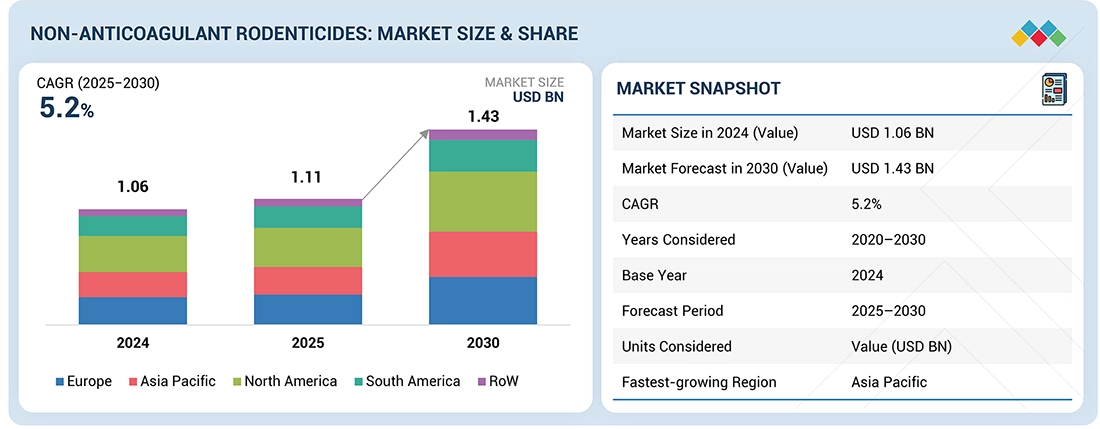
The non-anticoagulant rodenticides market is projected to grow from USD 1.11 billion in 2025 to reach USD 1.43 billion by 2030, at a Compound Annual Growth Rate (CAGR) of 5.2% during the forecast period. The non-anticoagulant rodenticide market is experiencing rising demand driven by rodent resistance to anticoagulants and stricter regulatory restrictions on traditional rodenticides. Growth in urbanization, food-processing, and agriculture is increasing the need for fast-acting, effective rodent control solutions. Products such as zinc phosphide, bromethalin, and cholecalciferol are preferred for their rapid action and lower risk of secondary poisoning. Additionally, food safety and environmental regulations are accelerating the adoption of low-residue, eco-friendly formulations. Market expansion is further supported by technological innovations such as microencapsulation, high-palatability baits, and sensor-integrated smart baiting systems, which enhance effectiveness while minimizing non-target exposure. These factors collectively drive growth across urban, industrial, and agricultural sectors globally.
Download PDF Brochure: https://www.marketsandmarkets.com/pdfdownloadNew.asp?id=13299457
The Cholecalciferol segment holds a significant market share in the type segment.
Cholecalciferol commands a respectable lead in the non-anticoagulant rodenticides by type, firstly due to its favorable efficacy profile, and secondly, regulatory acceptance is on the rise. With its mode of action based on vitamin D3, cholecalciferol provides efficient rodent control while minimizing the risks of secondary poisoning compared to many traditional anticoagulant products. This mode of action can aid in resistance management programs, particularly in regions where anticoagulant resistance is increasing. Furthermore, cholecalciferol rodenticides are widely used in urban, commercial, and agricultural settings because they mesh well with integrated pest management practices and comply with more stringent food-safety and public-health legislation, further consolidating their strong market position. Key players in the non-anticoagulant rodenticide market include Sumitomo Chemical (Japan), UPL Ltd./Arysta LifeScience (India), Bell Laboratories, Inc. (US), PCT Rural (Australia), and other players in the North American rodenticides market.
The spray segment holds a significant market share in the mode of application segment in the Non-Anticoagulant Rodenticides market during the forecasted period.
Spray holds a significant market share in the mode of application segment of the Non-Anticoagulant rodenticide market due to its ease of application, rapid surface coverage, and effectiveness in controlling rodent infestations in both agricultural and non-crop areas. Spraying ensures that active ingredients are uniformly distributed over vast areas: field crops, perimeter treatments, and high-risk infestation sites. It offers compatibility with fast-acting actives, such as zinc phosphide and bromethalin, in application modes ranging from manual to mechanical, which is a key factor in acceptance. The fact that spray applications can be integrated with other strategies within an integrated pest management program only strengthens their position in the market.
Request Sample Pages: https://www.marketsandmarkets.com/requestsampleNew.asp?id=13299457
Based on region, Asia Pacific holds a significant share in the non-anticoagulant rodenticides market.
The Asia Pacific is a major contributor to the global non-anticoagulant rodenticides market, driven by high levels of rodent infestation in agricultural landscapes, rapid urbanization, and growth in food storage and logistics infrastructure. Large-scale cultivation of cereals, rice, and other staple crops generates a continuous demand for effective rodent control solutions, particularly in countries such as China, India, and Southeast Asian markets. Moreover, the increasing adoption of modern pest-control practices, rising awareness of crop-loss prevention, and supportive governmental initiatives for food security are accelerating the use of non-anticoagulant rodenticides. These two things, too-the presence of cost-sensitive markets and the extensive use of zinc phosphide-are really strengthening the market position of the Asia Pacific.
Leading Non-Anticoagulant Rodenticides Companies:
The report profiles key players such as Bayer AG (Germany), Sumitomo Chemical (Japan), UPL Ltd (India), Bell Laboratories, Inc. (US), PCT Rural (Australia), Animal Control Technologies (Australia), Imtrade CropScience (Australia), Rentokil Initial plc (UK), AG Schilling & Co. (Germany), 4Farmers Australia (Australia), Farmalynx Pty Ltd. (Australia), Zagro (Malaysia), JT Eaton & Co., Inc. (USA), Neogen Technologies (USA), and Liphatech, Inc. (US). These companies are actively engaged in manufacturing and supplying zinc phosphide, bromethalin, cholecalciferol, and other non-anticoagulant rodenticides across agricultural, urban, and industrial sectors globally.