The global microdisplays market is entering a phase of accelerated expansion, fueled by the rapid adoption of augmented reality (AR) and virtual reality (VR) technologies. As industries and consumers increasingly embrace immersive digital experiences, the demand for compact, high-resolution display solutions is surging. Microdisplays—tiny screens used in devices such as head-mounted displays (HMDs), smart glasses, and electronic viewfinders—are becoming a critical component in enabling next-generation visualization. The global microdisplay market is expected to grow from USD 1.65 billion in 2025 to USD 5.33 billion by 2030, growing at a CAGR of 26.4%
Understanding Microdisplays
Microdisplays are miniature display panels, typically less than two inches in diagonal size, designed to deliver high pixel density and exceptional image clarity. These displays are commonly integrated into near-eye devices, allowing users to experience immersive visuals in a compact form factor.
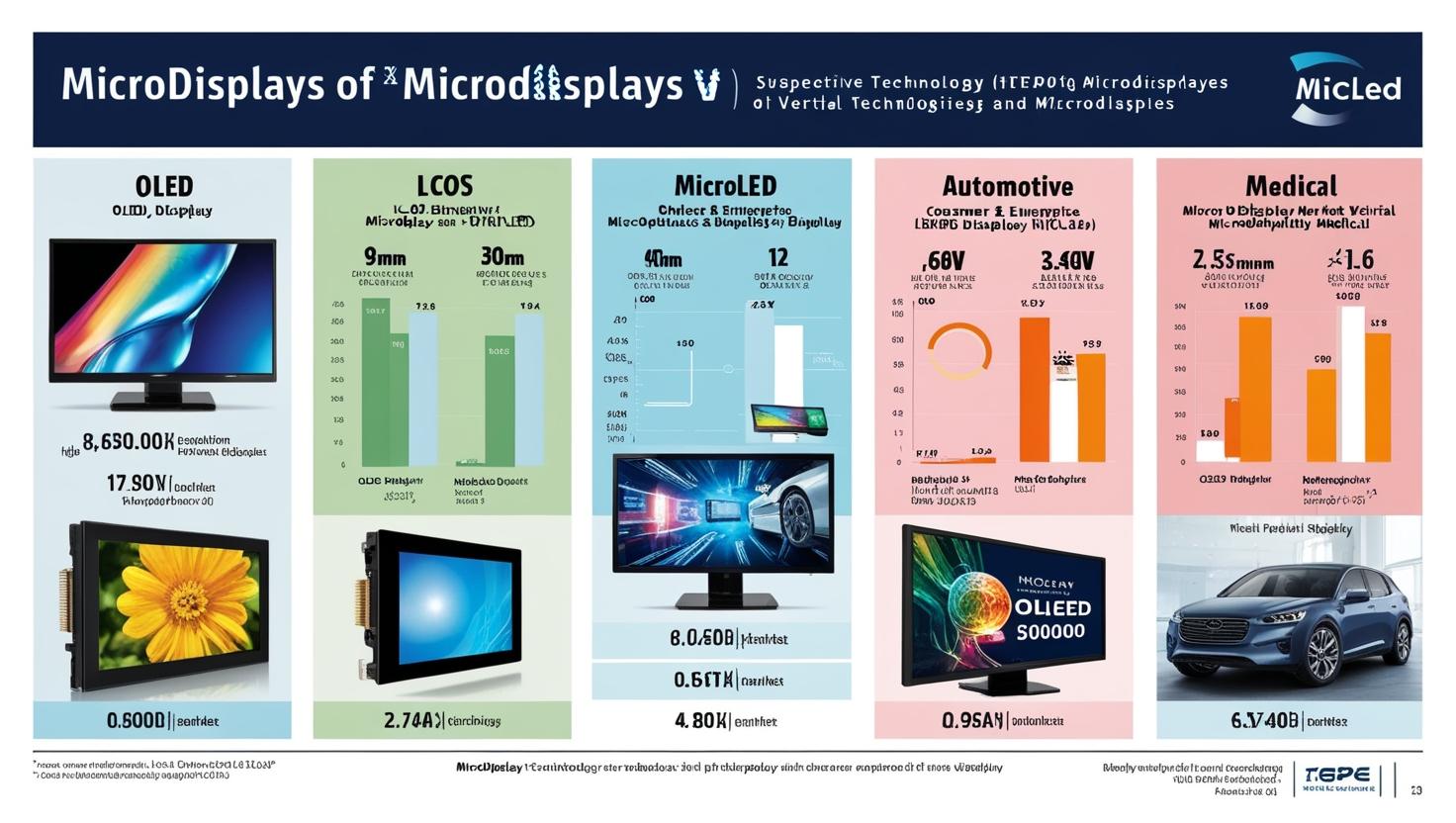
Key technologies in the microdisplays market include:
- Liquid Crystal on Silicon (LCoS)
- Organic Light-Emitting Diodes (OLED)
- Digital Light Processing (DLP)
- Each technology offers distinct advantages in terms of brightness, contrast, power consumption, and response time, making them suitable for different applications.
Market Growth Drivers
1. Surge in AR/VR Adoption
The growing popularity of AR and VR devices is the primary driver of the microdisplays market. From gaming and entertainment to enterprise applications such as training, simulation, and remote collaboration, AR/VR technologies are transforming user experiences.
Microdisplays are essential in these devices, providing high-resolution visuals with low latency—key requirements for immersive environments. As major tech companies invest heavily in AR/VR ecosystems, demand for advanced microdisplay solutions is expected to rise significantly.
2. Expansion of Wearable Technology
Smart glasses and other wearable devices are gaining traction across both consumer and industrial sectors. These devices rely on microdisplays to deliver real-time information in a compact, lightweight format.
Applications include:
Industrial maintenance and field service
Healthcare visualization and diagnostics
Navigation and real-time data overlays
The increasing use of wearables is further driving innovation in microdisplay design and performance.
Download PDF Brochure @ https://www.marketsandmarkets.com/pdfdownloadNew.asp?id=430
3. Growing Demand in Defense and Aerospace
Microdisplays are widely used in defense applications such as night vision systems, thermal imaging, and head-up displays (HUDs). Their ability to deliver high-quality visuals in compact and rugged environments makes them ideal for mission-critical operations.
In aerospace, microdisplays enhance pilot visibility and situational awareness, contributing to improved safety and operational efficiency.
4. Advancements in Display Technology
Continuous innovation in display technologies is significantly improving microdisplay performance. Developments in OLED and LCoS technologies are enabling higher brightness, better contrast ratios, and lower power consumption.
Emerging technologies such as microLED are also expected to revolutionize the market by offering superior efficiency, durability, and image quality.
Key Applications
Consumer Electronics
Microdisplays are widely used in VR headsets, AR glasses, and camera viewfinders. The gaming and entertainment industries are major contributors to demand, driven by the need for immersive experiences.
Healthcare
In medical applications, microdisplays support surgical visualization, diagnostic imaging, and training simulations. Their high resolution and compact size make them ideal for precision-based procedures.
Automotive
Automotive manufacturers are integrating microdisplays into head-up displays (HUDs) and advanced driver-assistance systems (ADAS), enhancing driver awareness and safety.
Industrial and Enterprise
Industries are leveraging AR-enabled smart glasses with microdisplays for training, maintenance, and workflow optimization.
Regional Insights
North America currently leads the microdisplays market, driven by strong investments in AR/VR technologies and the presence of major technology companies. The region’s focus on innovation and early adoption of advanced technologies contributes to its dominant position.
Asia Pacific is expected to witness the fastest growth, fueled by expanding consumer electronics manufacturing, increasing adoption of AR/VR devices, and rising investments in display technologies. Countries such as China, Japan, and South Korea are at the forefront of this growth.
Challenges in the Market
Despite strong growth prospects, the microdisplays market faces several challenges:
High Production Costs: Advanced display technologies can be expensive to manufacture.
Technical Limitations: Issues such as brightness, heat management, and field of view remain areas for improvement.
Integration Complexity: Designing compact devices with high-performance displays requires sophisticated engineering.
Addressing these challenges will be critical for widespread adoption.
Future Outlook
The future of the microdisplays market is closely tied to the evolution of immersive technologies. As AR/VR applications expand across industries, the need for high-performance, energy-efficient microdisplays will continue to grow.
Emerging trends such as the metaverse, spatial computing, and smart wearables are expected to further accelerate demand. Additionally, advancements in microLED and other next-generation display technologies will unlock new possibilities in performance and scalability.
The microdisplays market is poised for rapid growth, driven by the increasing adoption of AR/VR technologies and the rising demand for compact, high-resolution display solutions. As innovation continues and new applications emerge, microdisplays will play a pivotal role in shaping the future of immersive digital experiences.
From gaming and healthcare to defense and enterprise applications, these tiny displays are making a big impact—powering the next generation of visual technology.
FAQ
FAQ 1: What are microdisplays and where are they used?
Microdisplays are miniature display panels, typically less than two inches in size, that provide high-resolution visuals in a compact form factor. They are commonly used in AR/VR headsets, smart glasses, electronic viewfinders, medical devices, automotive HUDs, and defense equipment.
FAQ 2: What are the key technologies in the microdisplays market?
The primary technologies driving the microdisplays market include:
OLED (Organic Light-Emitting Diode) – high contrast and color quality
LCoS (Liquid Crystal on Silicon) – high resolution, suitable for near-eye applications
DLP (Digital Light Processing) – fast response and precise image projection
FAQ 3: How is AR/VR adoption driving microdisplay growth?
AR and VR devices require high-resolution, low-latency displays to create immersive experiences. As consumer and enterprise demand for AR/VR applications grows—such as gaming, training simulations, and remote collaboration—microdisplays are increasingly essential to deliver clear visuals in compact head-mounted devices.
FAQ 4: Which industries are the major adopters of microdisplays?
Major industries adopting microdisplays include:
Consumer Electronics – VR headsets, AR glasses, camera viewfinders
Healthcare – surgical visualization, diagnostic imaging
Automotive – head-up displays, advanced driver-assistance systems
Defense & Aerospace – night vision, thermal imaging, cockpit displays
About MarketsandMarkets™
MarketsandMarkets™ has been recognized as one of America’s Best Management Consulting Firms by Forbes, as per their recent report.
MarketsandMarkets™ is a blue ocean alternative in growth consulting and program management, leveraging a man-machine offering to drive supernormal growth for progressive organizations in the B2B space. With the widest lens on emerging technologies, we are proficient in co-creating supernormal growth for clients across the globe.
Today, 80% of Fortune 2000 companies rely on MarketsandMarkets, and 90 of the top 100 companies in each sector trust us to accelerate their revenue growth. With a global clientele of over 13,000 organizations, we help businesses thrive in a disruptive ecosystem.
The B2B economy is witnessing the emergence of $25 trillion in new revenue streams that are replacing existing ones within this decade. We work with clients on growth programs, helping them monetize this $25 trillion opportunity through our service lines – TAM Expansion, Go-to-Market (GTM) Strategy to Execution, Market Share Gain, Account Enablement, and Thought Leadership Marketing.
Built on the ‘GIVE Growth’ principle, we collaborate with several Forbes Global 2000 B2B companies to keep them future-ready. Our insights and strategies are powered by industry experts, cutting-edge AI, and our Market Intelligence Cloud, KnowledgeStore™, which integrates research and provides ecosystem-wide visibility into revenue shifts.
To find out more, visit www.MarketsandMarkets™.com or follow us on Twitter , LinkedIn and Facebook .
Contact:
Mr. Rohan Salgarkar
MarketsandMarkets™ INC.
1615 South Congress Ave.
Suite 103, Delray Beach, FL 33445
USA: +1-888-600-6441