The nature of modern warfare is evolving rapidly, driven by technological innovation, multi-domain operations, and increasingly complex threat environments. While advanced weapons systems, autonomous platforms, and network-centric warfare capabilities often dominate defense modernization discussions, battlefield sustainment remains the foundation upon which combat effectiveness is built. The ability to deliver fuel, ammunition, spare parts, medical support, and maintenance services to deployed forces determines whether military units can maintain operational momentum during prolonged engagements. As a result, next-generation battlefield sustainment solutions are emerging as critical enablers of combat readiness, resilience, and mission success.
Military organizations worldwide are investing in advanced sustainment technologies that leverage artificial intelligence, autonomous systems, predictive analytics, digital logistics networks, and smart inventory management. These innovations are transforming traditional logistics operations into agile, data-driven ecosystems capable of supporting highly mobile and dispersed forces operating across land, air, maritime, cyber, and space domains.
Get Detailed Market Size & Forecast Data: https://www.marketsandmarkets.com/pdfdownloadNew.asp?id=155479010
The Growing Importance of Modern Battlefield Sustainment
Modern military operations demand rapid responsiveness and sustained operational endurance. Forces deployed in contested environments often face disrupted supply routes, cyber threats, electronic warfare interference, and increasingly sophisticated adversaries capable of targeting logistics infrastructure. In such conditions, traditional supply chain models may struggle to maintain the speed and flexibility required to support frontline units.
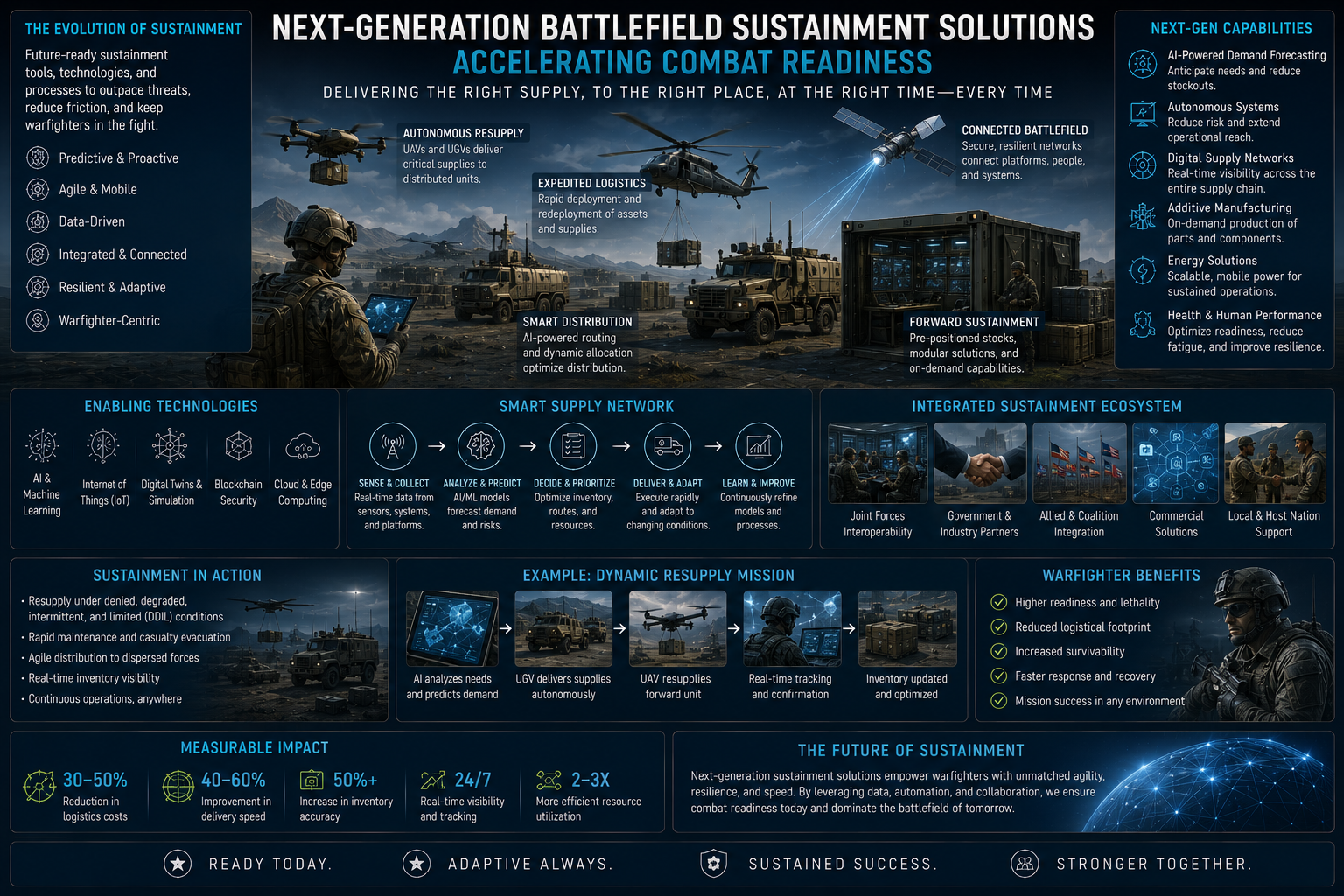
Next-generation sustainment solutions address these challenges by creating resilient logistics networks that provide real-time visibility into supply movements, equipment status, and resource availability. By integrating advanced technologies into sustainment operations, military organizations can improve decision-making, reduce logistical bottlenecks, and ensure critical resources reach warfighters when and where they are needed most.
The shift toward distributed operations and expeditionary warfare further increases the need for adaptive sustainment systems capable of functioning effectively in austere and rapidly changing environments.
Artificial Intelligence Enhancing Logistics Decision-Making
Artificial intelligence is becoming a cornerstone of modern battlefield sustainment. AI-powered logistics platforms can process vast amounts of operational data from supply chains, transportation networks, maintenance systems, and battlefield sensors to generate actionable insights in real time.
These systems help military planners forecast resource requirements, optimize transportation routes, and identify potential supply chain disruptions before they impact operations. Machine learning algorithms continuously analyze historical and real-time data to improve forecasting accuracy and enhance logistics planning.
AI-driven sustainment platforms can also automate many routine logistics functions, reducing administrative workloads and enabling personnel to focus on mission-critical activities. By accelerating decision-making and improving resource allocation, artificial intelligence significantly enhances combat readiness and operational efficiency.
As defense organizations continue to embrace digital transformation, AI-enabled sustainment systems are expected to become increasingly integral to military logistics architectures.
Predictive Maintenance Maximizing Equipment Availability
Combat readiness depends heavily on the availability and reliability of military equipment. Unexpected mechanical failures can disrupt operations, delay missions, and reduce force effectiveness. To address this challenge, defense organizations are increasingly adopting predictive maintenance technologies that enable proactive equipment management.
Advanced sensors embedded within military vehicles, aircraft, naval platforms, and support equipment continuously monitor performance indicators such as vibration, temperature, pressure, fuel consumption, and component wear. This data is analyzed using predictive analytics and machine learning models that identify early signs of potential failures.
By detecting maintenance issues before they become critical, predictive sustainment systems reduce unplanned downtime, improve asset utilization, and extend equipment service life. These capabilities are particularly valuable for high-value platforms where operational availability is essential for mission success.
Predictive maintenance also supports more efficient spare parts management by forecasting component replacement needs and aligning inventory levels with anticipated demand.
Autonomous Resupply Systems Supporting Frontline Operations
Autonomous logistics technologies are revolutionizing battlefield sustainment by enabling safer and more efficient resupply operations. Unmanned aerial systems, autonomous ground vehicles, and robotic delivery platforms are increasingly being deployed to transport critical supplies to frontline forces operating in contested environments.
Cargo drones can rapidly deliver ammunition, medical supplies, food, water, and communications equipment to remote locations while minimizing risks to personnel. These systems are especially useful in areas where traditional transportation methods may be vulnerable to enemy attacks or difficult terrain.
Autonomous ground vehicles are also supporting logistics convoys by reducing manpower requirements and enhancing transportation efficiency. Equipped with advanced navigation systems, obstacle avoidance technologies, and AI-driven route optimization capabilities, these vehicles can operate with minimal human intervention.
The integration of autonomous resupply solutions improves battlefield mobility, increases logistical flexibility, and helps sustain combat operations under challenging conditions.
Smart Supply Networks Strengthening Operational Resilience
The future battlefield requires logistics networks capable of adapting to rapidly changing operational conditions. Smart supply networks utilize interconnected digital systems, real-time data analytics, and intelligent automation to improve supply chain visibility and responsiveness.
Modern logistics platforms provide commanders with comprehensive insights into inventory levels, transportation assets, maintenance status, and supply chain performance across multiple operational theaters. This visibility enables faster decision-making and more effective resource allocation.
Smart supply networks can dynamically reroute shipments, prioritize critical deliveries, and adjust logistics plans based on evolving mission requirements. This adaptability enhances resilience against disruptions caused by adversarial actions, infrastructure damage, or environmental challenges.
Blockchain technologies, advanced cybersecurity frameworks, and secure communication networks are further strengthening the integrity and reliability of military supply chains.
Additive Manufacturing Accelerating Battlefield Support
Additive manufacturing, commonly known as 3D printing, is becoming an increasingly important component of next-generation sustainment strategies. Military organizations are exploring the deployment of mobile additive manufacturing systems capable of producing spare parts and repair components directly within operational environments.
This capability reduces dependence on lengthy supply chains and minimizes delays associated with traditional procurement processes. Units operating in remote locations can rapidly manufacture mission-critical components, improving equipment availability and reducing logistical burdens.
Additive manufacturing also supports customization and rapid prototyping, enabling defense organizations to develop specialized solutions for unique operational requirements. As material technologies continue to advance, the range of components that can be produced in the field is expected to expand significantly.
The ability to generate parts on demand represents a major step toward more self-sufficient and resilient battlefield sustainment operations.
Digital Twins and Real-Time Operational Awareness
Digital twin technology is providing new opportunities for enhancing battlefield sustainment and readiness. Digital twins create virtual representations of physical assets, logistics networks, and operational environments, enabling continuous monitoring and analysis.
These virtual models receive real-time data from deployed systems, allowing military planners to assess equipment health, simulate logistics scenarios, and identify potential vulnerabilities before they affect operations. Digital twins support more informed decision-making by providing a comprehensive understanding of sustainment performance across the battlefield.
In addition to maintenance planning, digital twin technology can assist with inventory management, transportation optimization, and infrastructure resilience assessments. As digital ecosystems become more integrated, digital twins are expected to play a central role in future military sustainment architectures.
Supporting Multi-Domain Operations Through Integrated Sustainment
Modern military campaigns increasingly involve coordinated operations across multiple domains, including land, air, sea, cyber, and space. Supporting these complex missions requires sustainment systems capable of integrating logistics activities across diverse operational environments.
Next-generation battlefield sustainment solutions utilize advanced command-and-control platforms that synchronize supply, maintenance, transportation, and medical support functions within a unified operational framework. This integration improves coordination between combat units, logistics organizations, and strategic command centers.
Real-time data sharing and secure communications enable commanders to maintain situational awareness and respond rapidly to changing operational conditions. These capabilities are essential for sustaining distributed forces engaged in high-tempo operations across geographically dispersed theaters.
Explore In-Depth Industry Analysis: https://www.marketsandmarkets.com/Market-Reports/military-vehicle-sustainment-market-155479010.html
Future Outlook for Battlefield Sustainment
The future of battlefield sustainment will be defined by greater automation, intelligence, connectivity, and operational adaptability. Emerging technologies such as artificial intelligence, autonomous logistics platforms, advanced robotics, additive manufacturing, and predictive analytics will continue transforming how military organizations support deployed forces.
As defense forces prepare for increasingly contested and technologically sophisticated operational environments, investments in next-generation sustainment capabilities will remain a strategic priority. The ability to maintain equipment readiness, deliver resources efficiently, and sustain operational momentum will be critical determinants of military effectiveness.
By embracing data-driven logistics, autonomous support systems, and intelligent supply networks, armed forces can enhance combat readiness, improve resilience, and ensure warfighters have the resources necessary to succeed across future battlefields. Next-generation battlefield sustainment solutions will serve as a vital force multiplier, enabling military organizations to project power, sustain operations, and maintain strategic advantage in the evolving landscape of modern warfare.