The global agriculture utility adjuvants market is projected to grow from USD 1.77 billion in 2026 to USD 2.31 billion by 2031, registering a CAGR of 4.8% during the forecast period. The growing emphasis on maximizing spray efficiency, improving crop protection performance, and reducing chemical wastage is driving demand for utility adjuvants in modern farming systems.
Farmers worldwide are increasingly focusing on optimizing spray water quality, tank-mix compatibility, and the effectiveness of crop protection products. At the same time, stricter environmental regulations related to pesticide application, spray drift reduction, and sustainable farming practices are accelerating the adoption of advanced utility adjuvants.
These products play a crucial role in enhancing spray solution performance by conditioning water, regulating pH levels, controlling foam formation, and improving compatibility among multiple agrochemicals. As precision agriculture continues to gain momentum, utility adjuvants are becoming essential tools for improving operational efficiency while supporting sustainable crop production.
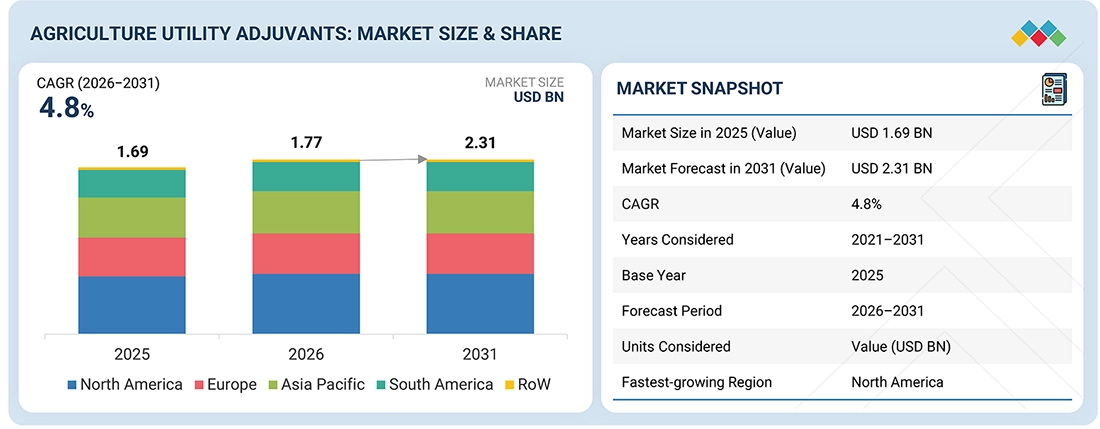
Growing Importance of Utility Adjuvants in Modern Agriculture
Utility adjuvants are designed to improve the physical and chemical properties of spray solutions without directly affecting biological activity. Their primary functions include:
- Neutralizing hard water minerals that reduce pesticide effectiveness
- Maintaining optimal pH levels in spray solutions
- Reducing excessive foam during tank mixing
- Enhancing compatibility among different agrochemicals
- Improving spray solution stability and consistency
The increasing adoption of precision farming technologies has created greater demand for reliable spray systems capable of delivering consistent results. Utility adjuvants help farmers achieve accurate application rates while minimizing waste and preserving the integrity of active ingredients.
Download PDF Brochure: https://www.marketsandmarkets.com/pdfdownloadNew.asp?id=131568926
Emulsifiable Concentrates Dominate the Formulation Segment
Among formulation types, Emulsifiable Concentrates (ECs) account for a significant share of the agricultural utility adjuvants market. Their widespread adoption can be attributed to their superior compatibility with crop protection products and their ability to effectively blend oil-soluble ingredients with water-based spray solutions.
EC formulations offer several advantages:
- Uniform distribution of active and performance-enhancing ingredients
- Excellent stability across varying water qualities
- Improved mixing performance and tank compatibility
- Reduced risk of separation during application
- Easy handling and application through standard spraying equipment
These benefits make emulsifiable concentrates highly suitable for large-scale agricultural operations. Their versatility across herbicides, fungicides, and insecticides further strengthens their position in the market.
Additionally, growing demand for ready-to-use liquid formulations that can perform efficiently under diverse climatic conditions continues to support the dominance of this segment.
Herbicide Applications Drive Fastest Market Growth
The herbicide application segment is expected to witness the fastest growth within the global agricultural utility adjuvants market.
Increasing weed resistance, combined with the growing adoption of conservation tillage practices, has significantly increased the use of herbicides worldwide. Utility adjuvants improve herbicide performance by enhancing:
- Spray coverage
- Droplet retention
- Leaf surface penetration
- Rainfastness
- Active ingredient efficiency
As precision spraying technologies become more common, farmers increasingly rely on utility adjuvants to optimize herbicide applications and improve weed control outcomes.
Request Sample Pages: https://www.marketsandmarkets.com/requestsampleNew.asp?id=131568926
Europe Emerges as a Key Regional Market
Europe holds a substantial share of the global agricultural utility adjuvants market and is expected to remain a leading region throughout the forecast period.
The region’s strong focus on sustainable agriculture and stringent regulatory framework governing pesticide use, environmental protection, water conservation, and spray drift management has increased demand for high-performance utility adjuvants.
European farmers are increasingly adopting:
- Water conditioners
- Buffering agents
- Compatibility enhancers
- Anti-foaming agents
These solutions help ensure responsible agrochemical use while maximizing application efficiency.
The widespread implementation of precision agriculture technologies, including variable-rate sprayers and digital spray monitoring systems, further strengthens market demand. These advanced systems require stable, well-conditioned spray solutions to deliver optimal performance.
Strong Agricultural Base Supports Market Expansion
Major agricultural economies such as France, Germany, Spain, and Italy continue to drive regional demand for utility adjuvants.
Large-scale farming operations across these countries have increased the use of crop protection products and complex tank-mix applications. Consequently, demand for products that improve spray solution stability and compatibility has grown substantially.
Additional factors supporting market growth include:
- Rising adoption of precision farming practices
- Increased focus on sustainable crop management
- Growing demand for bio-based and environmentally friendly adjuvants
- Continuous innovation in specialty chemicals and formulation technologies
- Government initiatives promoting sustainable agricultural practices
Europe’s well-established agrochemical sector and ongoing investments in research and development further reinforce its leadership position in the global utility adjuvants market.
Leading Agriculture Utility Adjuvants Companies:
The agricultural utility adjuvants market is characterized by several global and regional players focused on product innovation, sustainability, and formulation performance.
Key companies operating in the market include:
- BASF SE
- Corteva Agriscience
- Croda International Plc
- Evonik Industries AG
- Solvay SA
- Nufarm Ltd.
- Dow Inc.
- Clariant AG
- Huntsman Corporation
- Helena Agri-Enterprises LLC
- Wilbur-Ellis Company LLC
- Stepan Company
- Brandt Consolidated Inc.
- Akzo Nobel N.V.
- Adjuvant Plus Inc.