Microirrigation Systems Market Size and Growth Outlook
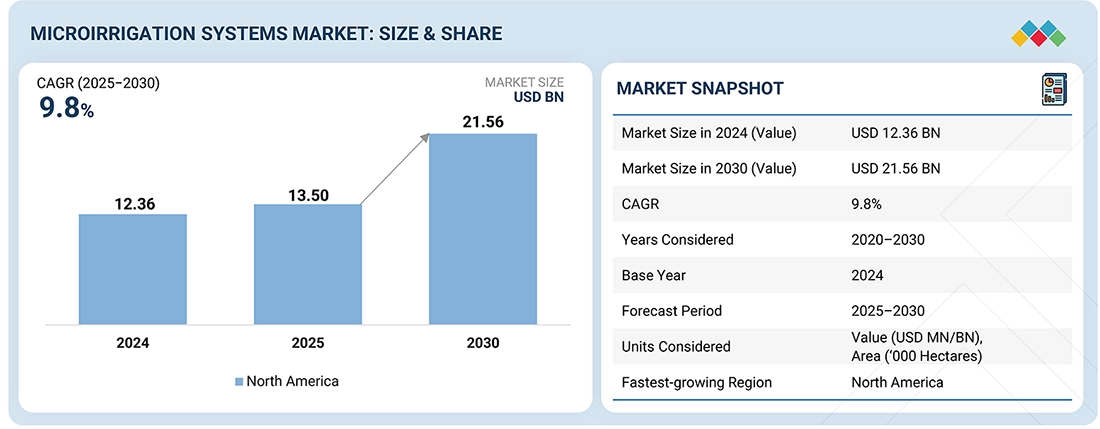
The global microirrigation systems market is witnessing remarkable growth as agriculture increasingly adopts precision farming technologies to address water scarcity, improve crop productivity, and enhance resource efficiency. The market is projected to grow from USD 13.50 billion in 2025 to USD 21.56 billion by 2030, registering a CAGR of 9.8% during the forecast period.
Growing concerns over water conservation, climate variability, and the need for sustainable farming practices are accelerating the adoption of advanced microirrigation solutions worldwide. Technological innovations in irrigation equipment, automation, sensors, and digital platforms are transforming traditional irrigation methods into intelligent, data-driven systems that optimize agricultural productivity while minimizing resource consumption.
Smart Irrigation Technologies Driving Market Expansion
The rapid advancement of irrigation hardware, software, and service solutions is one of the primary factors fueling market growth. Modern microirrigation systems increasingly incorporate automation, smart controllers, and IoT-enabled technologies that allow farmers to precisely manage water application.
These advanced systems provide:
- Real-time flow monitoring and regulation
- Automated irrigation scheduling
- Precise water distribution
- Reduced labor requirements
- Lower energy consumption
- Improved operational efficiency
With the integration of soil moisture sensors, weather monitoring systems, and data analytics tools, growers can make informed irrigation decisions based on actual field conditions rather than estimates. This proactive approach helps reduce water waste, improve crop health, stabilize yields, and increase resilience against droughts and changing climate conditions.
Download PDF Brochure: https://www.marketsandmarkets.com/pdfdownloadNew.asp?id=566
Digital Agriculture and Fertigation Enhancing Efficiency
The combination of fertigation systems with digital irrigation platforms is creating new opportunities for agricultural productivity. Fertigation enables the simultaneous delivery of water and nutrients directly to plant root zones, improving nutrient uptake efficiency while reducing fertilizer losses and environmental runoff.
Cloud-based management platforms, mobile applications, and connected IoT devices provide farmers with:
- Remote monitoring capabilities
- Performance tracking dashboards
- Automated alerts and notifications
- Resource optimization insights
- Improved decision-making support
These innovations are delivering higher returns on investment for growers and driving widespread adoption of microirrigation systems, particularly in high-value crop cultivation, greenhouse operations, and water-stressed agricultural regions.
Micro Sprinkler Segment Expected to Witness Fastest Growth
Among irrigation types, the micro sprinkler segment is anticipated to register the fastest growth during the forecast period due to its ability to combine precision irrigation with broad coverage and operational flexibility.
Micro sprinklers offer uniform water distribution across fields, orchards, vineyards, nurseries, and plantation crops. Their targeted application ensures plants receive optimal moisture levels, reducing both under-irrigation and over-irrigation while supporting healthier crop development.
Key Benefits of Micro Sprinkler Systems
- Uniform water application
- Lower operating pressure requirements
- Reduced energy consumption
- Lower pumping costs
- Suitable for uneven terrain
- Effective in low-infiltration soils
- Ideal for orchards, vineyards, and nurseries
Compared with conventional sprinkler systems, micro sprinklers operate at significantly lower flow rates and pressures, making them a cost-effective and environmentally sustainable irrigation solution. These advantages are expected to accelerate adoption across diverse agricultural applications.
Request Sample Pages: https://www.marketsandmarkets.com/requestsampleNew.asp?id=566
Industrial Users Emerging as a High-Growth End-User Segment
The industrial user segment is projected to be the fastest-growing end-user category in the microirrigation systems market.
Industrial users, including commercial agribusinesses, plantation operators, institutional growers, and food processing companies with captive farming operations, are increasingly investing in advanced irrigation technologies to meet sustainability goals and improve operational efficiency.
Microirrigation systems help these organizations:
- Minimize water wastage
- Reduce fertilizer and pesticide runoff
- Improve resource utilization
- Lower environmental impact
- Maintain consistent crop productivity
Furthermore, IoT-enabled irrigation systems allow industrial users to remotely manage irrigation schedules, monitor flow rates, and control fertigation operations through mobile devices and centralized dashboards. This capability is particularly valuable for large-scale operations spread across multiple locations, reducing dependence on manual labor and enhancing operational control.
Asia Pacific Leads Growth Opportunities
The Asia Pacific region is expected to be the fastest-growing market for microirrigation systems during the study period.
Agricultural sectors across the region are increasingly facing challenges associated with climate change, including:
- Unpredictable rainfall patterns
- Extended drought conditions
- Rising temperatures
- Increased water scarcity
Microirrigation systems provide a practical solution by delivering water directly to plant root zones in precise quantities, reducing water stress and improving crop resilience under challenging environmental conditions.
Precision Irrigation Supporting Climate Adaptation
Advanced microirrigation technologies enable farmers to customize irrigation schedules based on:
- Crop type
- Growth stage
- Soil characteristics
- Weather conditions
- Moisture availability
This precision helps improve crop survival rates, stabilize yields, and enhance overall farm productivity despite changing climatic conditions.
Additionally, water quality remains a concern in many agricultural regions where irrigation sources may contain excessive salts, heavy metals, or other contaminants. Modern microirrigation systems can incorporate filtration and purification technologies that improve water quality before distribution, supporting healthier crops, better soil conditions, and long-term agricultural sustainability.
Leading Microirrigation Systems Companies:
The global microirrigation systems market is highly competitive, with leading companies focusing on product innovation, digital irrigation technologies, automation solutions, and geographic expansion strategies.
Major players operating in the market include:
- Jain Irrigation Systems Ltd.
- The Toro Company
- Netafim
- Nelson Irrigation
- Rain Bird Corporation
- Finolex Plasson
- Mahindra EPC Irrigation Limited
- T-L Irrigation
- Hunter Industries
- Rivulis
- Chinadrip Irrigation Equipment Co., Ltd.
- Elgo Irrigation Ltd.
- Antelco
- Microjet
- Irritec S.p.A.
These companies continue to invest in smart irrigation technologies, sustainable water management solutions, and precision agriculture innovations to strengthen their market positions and meet the evolving needs of modern agriculture.