The military robots market size was valued at USD 18.19 billion in 2024 and is projected to reach USD 26.49 billion by 2029, growing at a CAGR of 7.8% from 2024 to 2029. The rapid advancement of artificial intelligence (AI), autonomous systems, and advanced robotics is fundamentally reshaping the nature of modern warfare. Military organizations worldwide are increasingly investing in AI-powered robotic platforms to enhance operational effectiveness, reduce risks to personnel, and strengthen decision-making capabilities across land, air, sea, and cyber domains. As geopolitical tensions rise and defense modernization programs accelerate, AI-enabled military robots are emerging as a critical force multiplier for future combat operations.
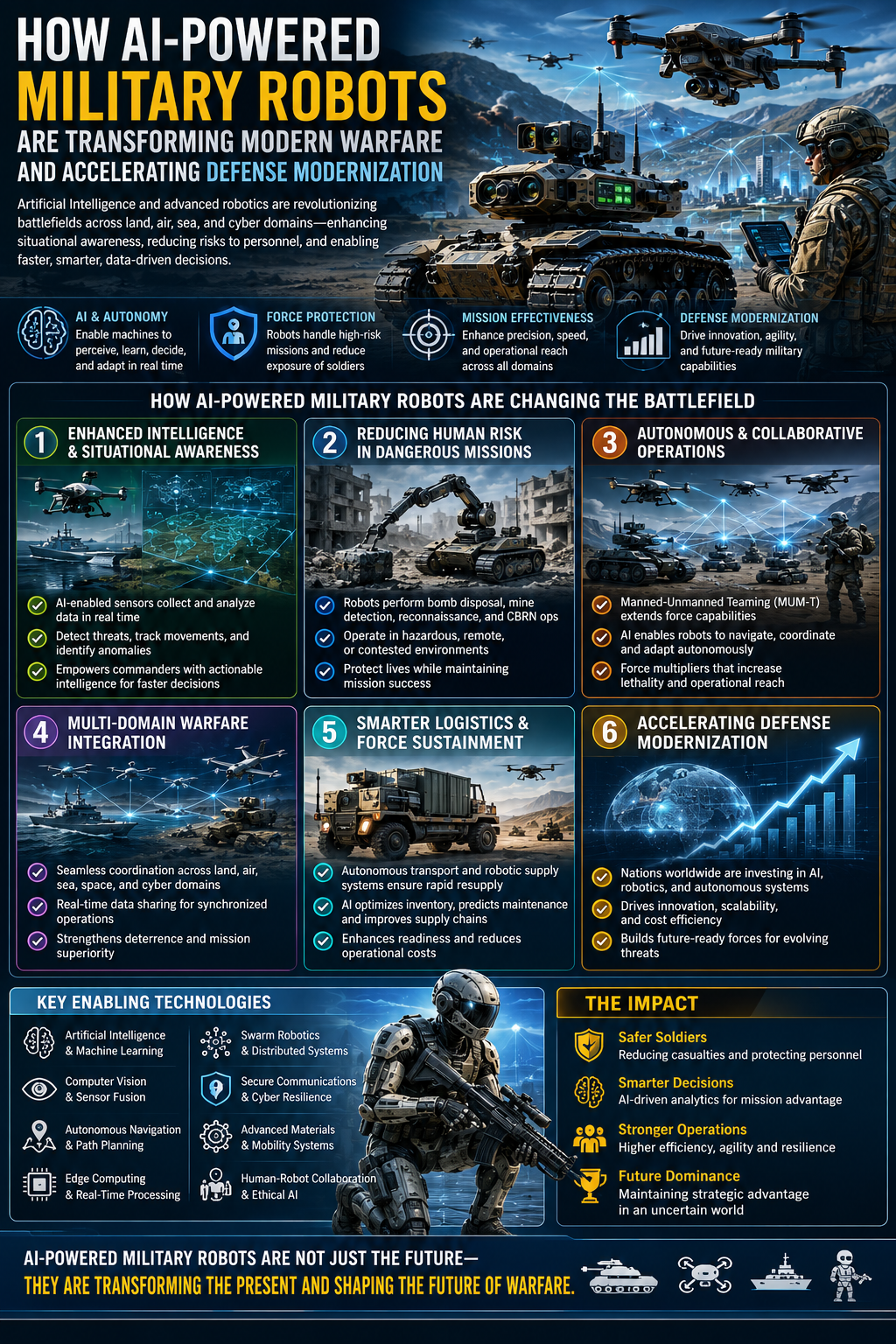
Enhancing Battlefield Intelligence and Situational Awareness
One of the most significant contributions of AI-powered military robots is their ability to gather, process, and analyze vast amounts of battlefield data in real time. Autonomous ground vehicles, aerial drones, and maritime robotic systems equipped with advanced sensors can conduct intelligence, surveillance, and reconnaissance (ISR) missions in contested environments with minimal human intervention.
AI algorithms enable these platforms to identify targets, track enemy movements, detect anomalies, and provide actionable intelligence faster than traditional systems. This enhanced situational awareness allows commanders to make informed decisions quickly, improving mission success rates while minimizing operational risks.
Download Brochure Analyst-Verified Insights @ https://www.marketsandmarkets.com/pdfdownloadNew.asp?id=245516013
Reducing Human Risk in High-Threat Environments
Modern military robots are increasingly deployed in hazardous missions where human exposure would be dangerous or impractical. AI-enabled unmanned systems can perform bomb disposal, mine detection, urban reconnaissance, tunnel exploration, and chemical, biological, radiological, and nuclear (CBRN) monitoring operations.
By assuming these high-risk tasks, robotic platforms significantly reduce casualties among military personnel while maintaining operational effectiveness. This capability is particularly valuable in asymmetric warfare environments where hidden threats and improvised explosive devices pose substantial risks to soldiers.
Enabling Autonomous and Collaborative Combat Operations
Artificial intelligence is driving the development of autonomous combat systems capable of operating with limited human oversight. Advanced military robots can navigate complex terrain, coordinate with other unmanned platforms, adapt to changing battlefield conditions, and execute mission objectives autonomously.
Collaborative autonomy, often referred to as manned-unmanned teaming (MUM-T), enables military robots to work alongside soldiers, armored vehicles, aircraft, and naval assets. These systems enhance force effectiveness by extending operational reach, improving reconnaissance capabilities, and providing additional firepower without increasing personnel requirements.
Accelerating Multi-Domain Warfare Capabilities
Future conflicts are expected to occur simultaneously across land, air, maritime, space, and cyber domains. AI-powered military robots play a crucial role in supporting multi-domain operations by facilitating seamless data sharing and coordinated responses across various military assets.
Autonomous drones can provide real-time targeting information to artillery units, robotic ground vehicles can support infantry maneuvers, and unmanned surface vessels can conduct maritime surveillance while sharing intelligence with command centers. This interconnected operational approach enhances battlefield synchronization and increases mission effectiveness.
Strengthening Logistics and Force Sustainment
Beyond combat missions, AI-powered robots are transforming military logistics and sustainment operations. Autonomous transport vehicles, robotic supply systems, and AI-driven warehouse management solutions are improving the efficiency of military supply chains.
These technologies enable armed forces to automate resupply missions, optimize inventory management, predict equipment maintenance requirements, and ensure the timely delivery of critical resources to frontline units. Enhanced logistics efficiency contributes directly to operational readiness and long-term force sustainability.
Supporting Defense Modernization Initiatives Worldwide
Governments across North America, Europe, Asia-Pacific, and the Middle East are prioritizing investments in AI-enabled defense technologies as part of broader military modernization strategies. Defense agencies recognize that autonomous robotic systems offer substantial advantages in terms of operational flexibility, scalability, and cost-effectiveness.
As military doctrines evolve to address emerging threats such as drone swarms, electronic warfare, and contested operational environments, AI-powered robots are becoming integral components of next-generation defense architectures. Their ability to augment human capabilities while improving mission efficiency aligns closely with national security objectives and future force development plans.
Driving Innovation in the Military Robots Market
Technological advancements in machine learning, computer vision, edge computing, sensor fusion, and autonomous navigation are accelerating innovation within the military robotics sector. Defense contractors and technology companies are developing increasingly sophisticated robotic platforms capable of operating in complex and dynamic environments.
Growing demand for autonomous reconnaissance systems, combat support robots, logistics platforms, and unmanned combat vehicles is expected to fuel sustained market growth. As AI technologies continue to mature, military robots will play an increasingly important role in shaping the future of warfare and enabling defense forces to maintain strategic advantages in rapidly evolving security environments.
Access 100+ Data Tables & Charts: https://www.marketsandmarkets.com/Market-Reports/military-robots-market-245516013.html
AI-powered military robots are transforming modern warfare by enhancing intelligence gathering, reducing risks to personnel, enabling autonomous operations, and supporting multi-domain combat strategies. Their expanding role in logistics, surveillance, force protection, and battlefield decision-making is accelerating defense modernization efforts worldwide. As nations continue to invest in next-generation autonomous technologies, AI-enabled robotic systems will remain at the forefront of military innovation, redefining operational capabilities and shaping the future battlefield landscape.
