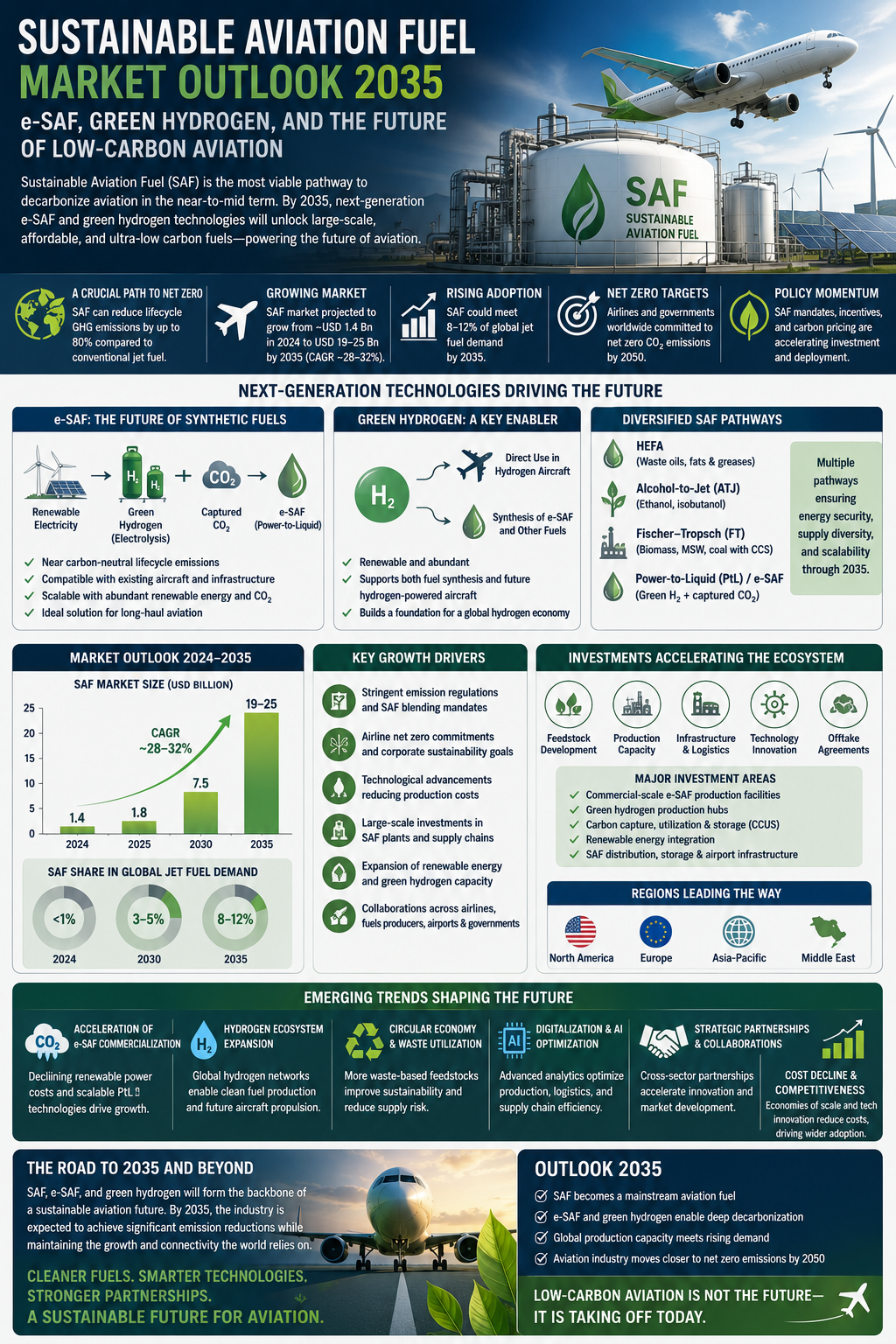
The global aviation industry is undergoing one of the most significant transformations in its history as governments, airlines, aircraft manufacturers, and fuel producers work toward achieving net-zero emissions targets. With aviation accounting for a growing share of global greenhouse gas emissions, Sustainable Aviation Fuel (SAF) has emerged as the leading near-term solution for reducing the sector’s carbon footprint. Looking toward 2035, next-generation technologies such as electro-Sustainable Aviation Fuel (e-SAF), green hydrogen, and advanced synthetic fuels are expected to redefine the future of low-carbon aviation, driving substantial growth across the Sustainable Aviation Fuel market.
Sustainable Aviation Fuel at the Center of Aviation Decarbonization
As airlines face increasing pressure to reduce emissions while maintaining operational efficiency, SAF has become a cornerstone of aviation sustainability strategies. Unlike conventional jet fuel derived from fossil resources, SAF is produced from renewable feedstocks and synthetic pathways that significantly lower lifecycle carbon emissions.
By 2035, SAF is expected to account for a substantially larger share of global aviation fuel consumption as regulatory mandates, corporate sustainability commitments, and passenger demand for greener travel continue to strengthen. The industry’s transition toward low-carbon aviation will increasingly depend on scaling SAF production capacity and improving fuel affordability.
Download PDF Brochure : https://www.marketsandmarkets.com/pdfdownloadNew.asp?id=70301163
e-SAF Emerging as a Game-Changing Technology
Electro-Sustainable Aviation Fuel (e-SAF), also known as synthetic aviation fuel or Power-to-Liquid (PtL) fuel, is expected to become one of the most promising segments of the SAF market through 2035.
e-SAF is produced by combining green hydrogen generated through renewable-powered electrolysis with captured carbon dioxide. The resulting synthetic fuel can be used in existing aircraft engines and fueling infrastructure while offering near-carbon-neutral lifecycle emissions.
As renewable energy deployment accelerates globally and carbon capture technologies mature, e-SAF is positioned to become a critical pathway for achieving deep decarbonization across long-haul aviation routes where alternative propulsion technologies face operational limitations.
Green Hydrogen Driving the Next Generation of Aviation Fuels
Green hydrogen is increasingly viewed as a foundational element of future aviation sustainability strategies. Produced using renewable electricity and water electrolysis, green hydrogen enables the production of synthetic aviation fuels while also supporting the development of hydrogen-powered aircraft.
By 2035, growing investments in hydrogen production facilities, transportation infrastructure, and storage technologies are expected to reduce costs and improve commercial viability. Aviation stakeholders are actively exploring hydrogen’s potential for both direct propulsion and fuel synthesis applications.
As governments expand hydrogen economy initiatives and renewable energy capacity continues to grow, green hydrogen will play a pivotal role in accelerating the transition toward low-carbon aviation systems.
Government Policies Accelerating Market Expansion
Regulatory support remains one of the strongest drivers of Sustainable Aviation Fuel market growth. Governments worldwide are introducing SAF blending mandates, tax incentives, emissions reduction frameworks, and clean energy funding programs designed to encourage production and adoption.
Regions such as North America, Europe, and Asia-Pacific are implementing ambitious aviation decarbonization roadmaps that prioritize SAF deployment. These policies are creating long-term market certainty for investors and fuel producers while encouraging innovation across the SAF value chain.
As emission regulations become more stringent through 2035, compliance requirements are expected to significantly increase demand for sustainable aviation fuels.
Scaling Production Capacity to Meet Future Demand
One of the greatest challenges facing the SAF industry is the need to dramatically expand production capacity. Current supply levels remain insufficient to meet projected aviation fuel demand, creating significant opportunities for investment in new production facilities and feedstock supply chains.
Industry participants are pursuing large-scale projects involving:
- Hydroprocessed Esters and Fatty Acids (HEFA)
- Alcohol-to-Jet (ATJ) conversion technologies
- Fischer-Tropsch synthetic fuel pathways
- Power-to-Liquid (PtL) e-fuel production
- Waste-to-fuel and biomass conversion technologies
Continued technological advancements and economies of scale are expected to reduce production costs and improve commercial competitiveness over the forecast period.
Airlines Increasing Long-Term SAF Commitments
Major commercial airlines are signing long-term SAF offtake agreements to secure future fuel supplies and support sustainability targets. These agreements provide producers with investment certainty while helping airlines reduce emissions from existing aircraft fleets.
Corporate travel programs and sustainability-focused customers are also influencing airline procurement strategies, encouraging greater adoption of low-carbon fuels. As SAF availability increases, airlines are expected to integrate higher blending ratios across domestic and international operations.
This growing demand from the aviation sector will serve as a major catalyst for market expansion through 2035.
Investment and Innovation Strengthening the SAF Ecosystem
Global investment activity across the SAF value chain continues to accelerate as stakeholders recognize the strategic importance of sustainable aviation fuels. Energy companies, fuel producers, aircraft manufacturers, airports, and financial institutions are allocating substantial resources toward SAF infrastructure development.
Key investment areas include:
- Green hydrogen production facilities
- Carbon capture and utilization technologies
- Synthetic fuel production plants
- Feedstock collection and logistics networks
- Renewable energy integration projects
- SAF storage and distribution infrastructure
These investments are expected to strengthen supply chain resilience and support long-term market growth.
Emerging Trends Shaping the Market Through 2035
Several transformative trends are expected to influence the Sustainable Aviation Fuel market over the coming decade:
Growth of e-SAF Production
Commercial-scale Power-to-Liquid facilities will expand significantly as renewable electricity costs decline and carbon capture technologies mature.
Expansion of Green Hydrogen Infrastructure
Hydrogen hubs, transportation networks, and storage systems will support both synthetic fuel production and future hydrogen-powered aviation applications.
Increasing Regulatory Mandates
Governments will continue introducing SAF blending requirements and emissions reduction targets to accelerate adoption.
Feedstock Diversification
The industry will increasingly utilize agricultural waste, forestry residues, municipal waste, captured carbon dioxide, and renewable hydrogen sources.
Public-Private Collaboration
Partnerships among governments, airlines, energy companies, and technology developers will drive innovation and infrastructure development.
Digital Optimization
Artificial intelligence and advanced analytics will improve production efficiency, feedstock management, and supply chain operations.
Explore In-Depth Industry Analysis: https://www.marketsandmarkets.com/Market-Reports/sustainable-aviation-fuel-market-70301163.html
Market Outlook Through 2035
The Sustainable Aviation Fuel market is expected to experience robust growth through 2035 as aviation stakeholders intensify efforts to reduce carbon emissions and comply with evolving environmental regulations. e-SAF and green hydrogen technologies are likely to emerge as key growth segments, complementing conventional bio-based SAF pathways and enabling deeper decarbonization across the aviation industry.
Growing investments, supportive government policies, technological advancements, and increasing airline commitments will continue to drive market expansion. As production capacity scales and costs decline, SAF is expected to become an increasingly mainstream component of global aviation fuel supply.
The future of low-carbon aviation will be shaped by the rapid evolution of Sustainable Aviation Fuel technologies, particularly e-SAF and green hydrogen-based solutions. These innovations offer a practical pathway toward significant emissions reductions while supporting the continued growth of global air travel. As governments, airlines, and fuel producers accelerate decarbonization efforts, the Sustainable Aviation Fuel market is poised for substantial expansion through 2035, positioning itself as a cornerstone of the aviation industry’s journey toward a more sustainable and climate-resilient future.
