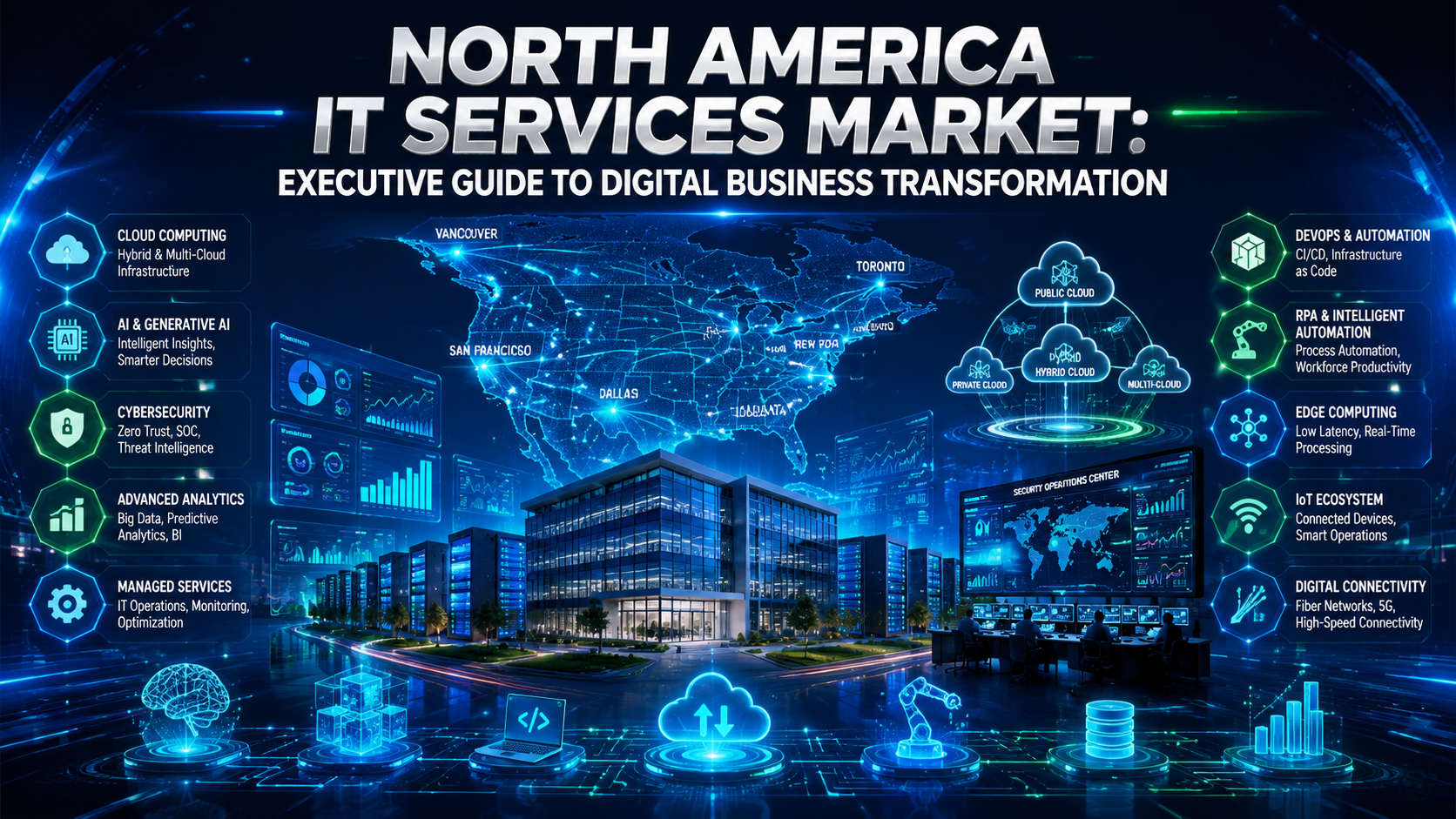
The North America IT Services Market has emerged as the foundation of enterprise digital transformation, enabling organizations to modernize legacy infrastructure, embrace cloud-native technologies, strengthen cybersecurity, and accelerate Artificial Intelligence (AI)-driven innovation. Across the United States and Canada, businesses are increasingly viewing IT services as strategic investments that improve operational agility, enhance customer experiences, and deliver long-term competitive advantage rather than simply supporting day-to-day technology operations.
Growing demand for managed services, cloud migration, application modernization, cybersecurity, advanced analytics, and AI-powered automation is reshaping enterprise technology strategies. Organizations are prioritizing scalable and secure digital ecosystems that reduce operational complexity while supporting innovation, regulatory compliance, and sustainable business growth. As hybrid work, multi-cloud environments, and intelligent automation become standard business practices, technology service providers are expanding their portfolios with integrated solutions that combine AI, machine learning, cloud computing, cybersecurity, and edge technologies.
The positive North America IT Services Market outlook is further supported by rising digital investments across financial services, healthcare, manufacturing, retail, telecommunications, government, and energy. These industries increasingly rely on experienced IT partners to modernize operations, strengthen cyber resilience, and accelerate enterprise-wide digital transformation. For technology leaders, investors, and decision-makers, the market continues to present significant opportunities to unlock innovation, improve business resilience, and achieve sustainable growth in an increasingly digital economy.
Digital transformation has become a defining business priority across North America as organizations respond to evolving customer expectations, rapid technological advancement, and intensifying market competition. Enterprises are modernizing their IT environments to improve agility, optimize costs, and build resilient digital operations capable of supporting long-term growth. In this environment, the North America IT Services Market has evolved into a critical enabler of enterprise innovation by delivering consulting, cloud migration, cybersecurity, infrastructure modernization, application development, and managed services that accelerate technology adoption while minimizing operational risk.
Unlike traditional outsourcing models focused primarily on infrastructure maintenance, modern IT services are increasingly aligned with measurable business outcomes. Service providers now deliver end-to-end digital transformation strategies that integrate AI, automation, cloud computing, data analytics, cybersecurity, Internet of Things (IoT), and enterprise applications into unified technology ecosystems. As organizations continue investing in intelligent operations, cloud modernization, and digital resilience, the long-term North America IT Services Market growth remains highly promising.
Market research indicates strong trends Download the PDF to uncover business insights.
History and Evolution of the North America IT Services Market
The evolution of the North America IT Services Market reflects the region’s broader technology transformation. During the 1980s and early 1990s, IT services primarily focused on hardware deployment, network management, software installation, and technical support for on-premises infrastructure. As enterprises expanded globally, managed infrastructure services and outsourcing gained momentum, enabling businesses to reduce costs while improving operational efficiency.
The widespread adoption of the internet during the late 1990s and early 2000s fundamentally transformed enterprise technology strategies. Organizations invested heavily in enterprise resource planning (ERP), customer relationship management (CRM), web-based applications, and systems integration, prompting IT service providers to expand into consulting, application development, and digital implementation services. This period established the foundation for sustained North America IT Services Market growth, driven by increasing demand for scalable, integrated technology solutions.
Cloud computing marked the next major milestone, fundamentally redefining enterprise IT operations. Public, private, and hybrid cloud environments enabled organizations to modernize legacy systems, improve scalability, reduce capital expenditure, and accelerate innovation. Consequently, demand surged for cloud consulting, migration, governance, disaster recovery, and managed cloud services, while subscription-based managed service models strengthened long-term customer relationships.
Today, Artificial Intelligence, machine learning, Generative AI, robotic process automation (RPA), and predictive analytics are reshaping the delivery of IT services. Technology providers are no longer limited to infrastructure management; they now help organizations automate workflows, enhance decision-making, optimize customer experiences, and accelerate digital innovation. AI-powered service management, intelligent monitoring, predictive maintenance, and real-time analytics continue to redefine enterprise technology strategies, positioning the North America IT Services Market as a key driver of business modernization and sustainable competitive advantage.
This Sample Report is designed to fuel your business growth download it today.
Current Market Landscape
The North America IT Services Market continues to gain momentum as enterprises accelerate digital transformation initiatives to improve operational resilience, business agility, and customer engagement. Organizations across financial services, healthcare, manufacturing, retail, telecommunications, government, and energy are increasing investments in IT consulting, managed services, cloud modernization, cybersecurity, and AI-powered business solutions to remain competitive in a rapidly evolving digital economy.
Hybrid work has significantly influenced enterprise technology priorities, driving demand for secure cloud infrastructure, digital workplace services, endpoint management, and collaboration platforms that support distributed workforces without compromising security or compliance. At the same time, organizations are moving beyond isolated technology deployments toward integrated digital transformation strategies that combine cloud computing, Artificial Intelligence (AI), automation, cybersecurity, enterprise applications, and advanced analytics into unified business ecosystems.
Artificial Intelligence has become one of the strongest forces shaping the North America IT Services Market, enabling enterprises to optimize software development, automate IT operations, strengthen cybersecurity, enhance customer service, and generate actionable business insights. In response, technology providers are expanding AI consulting, implementation, governance, and optimization services that help organizations maximize the value of intelligent technologies while improving operational efficiency.
Cybersecurity remains equally critical as ransomware attacks, supply chain vulnerabilities, insider threats, and evolving regulatory requirements continue to increase enterprise risk. Organizations are strengthening cyber resilience through managed security services, Zero Trust architectures, identity and access management, Security Operations Centers (SOC), and continuous threat monitoring. Simultaneously, cloud modernization initiatives are driving widespread adoption of hybrid and multi-cloud environments that improve scalability, flexibility, and application performance while reducing infrastructure complexity. These trends collectively reinforce the strong long-term North America IT Services Market outlook.
Key Growth Drivers Accelerating the North America IT Services Market
Several structural trends continue to fuel sustained expansion across the North America IT Services Market, with enterprises prioritizing technology investments that enhance efficiency, strengthen security, and accelerate innovation.
Artificial Intelligence has become a cornerstone of enterprise modernization. Organizations are integrating AI into customer engagement, software engineering, predictive analytics, cybersecurity, and IT operations to improve productivity and support data-driven decision-making. IT service providers are responding with AI consulting, machine learning implementation, Generative AI integration, governance frameworks, and intelligent automation solutions that streamline business processes and create measurable operational value.
Cloud transformation remains another major catalyst for market growth. Enterprises are migrating applications and workloads to public, private, and hybrid cloud environments to improve scalability, resilience, and cost efficiency. Modern IT service providers support every stage of this journey, including cloud strategy, migration, application modernization, multi-cloud management, cloud security, governance, disaster recovery, FinOps optimization, and managed cloud operations. As organizations expand cloud adoption, demand for specialized expertise continues to strengthen the North America IT Services Market.
Cybersecurity investments are also accelerating as executive leadership recognizes digital resilience as a strategic business priority. Managed security services, Managed Detection and Response (MDR), Zero Trust implementation, Identity and Access Management (IAM), Endpoint Detection and Response (EDR), cloud security, threat intelligence, and compliance services are becoming essential components of enterprise risk management. These capabilities enable organizations to protect critical assets while meeting increasingly complex regulatory requirements.
Application modernization further supports long-term market expansion. Many enterprises continue replacing legacy systems with cloud-native, API-driven, and microservices-based architectures that improve scalability, integration, and business agility. IT service providers deliver ERP and CRM modernization, DevOps implementation, containerization, application reengineering, and low-code development solutions that accelerate digital innovation while reducing technical debt.
Finally, the rapid expansion of managed services is reshaping enterprise IT operating models. Organizations are increasingly outsourcing infrastructure management, network operations, cloud administration, cybersecurity, database management, disaster recovery, and digital workplace services to trusted technology partners. Subscription-based managed service models provide predictable costs, improve service reliability, and allow internal IT teams to focus on innovation and strategic business initiatives. As enterprises continue pursuing operational efficiency and technology modernization, managed services will remain a key contributor to the sustained growth of the North America IT Services Market.
Emerging Technology Trends and Strategic Investment Opportunities
The next phase of the North America IT Services Market will be defined by intelligent technologies that enable enterprises to operate with greater speed, resilience, and efficiency. Generative AI, intelligent automation, advanced analytics, edge computing, and sustainable IT practices are transforming traditional service delivery into strategic value creation.
Generative AI is rapidly becoming an enterprise productivity engine, supporting software development, knowledge management, customer engagement, document processing, and decision support. Organizations are increasingly adopting AI assistants and intelligent automation to streamline workflows, improve employee productivity, accelerate application development, and enhance customer experiences. At the same time, Artificial Intelligence for IT Operations (AIOps) is enabling predictive maintenance, automated incident resolution, intelligent infrastructure monitoring, and real-time performance optimization, helping enterprises reduce downtime while improving service reliability.
Data has also become a critical business asset, prompting organizations to invest in modern data platforms, predictive analytics, business intelligence, and AI-powered reporting capabilities. Meanwhile, the rapid expansion of edge computing and Internet of Things (IoT) ecosystems is creating new opportunities for real-time analytics, smart manufacturing, connected healthcare, and intelligent logistics. Sustainability has emerged as another strategic priority, encouraging enterprises to adopt energy-efficient infrastructure, cloud optimization strategies, carbon reporting, and environmentally responsible digital operations that align technology investments with broader ESG objectives.
These technology shifts are creating attractive investment opportunities across AI consulting, intelligent automation, cloud modernization, cybersecurity, managed services, and advanced analytics. Organizations increasingly seek technology partners capable of delivering integrated, outcome-driven solutions that accelerate digital transformation while optimizing operational performance and long-term business value.
Market Challenges and Future Outlook
Despite strong growth prospects, several challenges continue to influence the evolution of the North America IT Services Market. Many organizations still operate complex legacy infrastructures that require significant investment and careful planning to modernize without disrupting business operations. At the same time, the growing shortage of skilled professionals in cybersecurity, cloud engineering, AI, and data science is increasing demand for managed services and automation-driven delivery models.
Rapid technological advancement presents another challenge, requiring enterprises to continuously update their digital strategies, strengthen workforce capabilities, and adapt to evolving innovation cycles. Additionally, increasingly stringent regulations surrounding cybersecurity, data privacy, financial governance, and industry compliance demand specialized expertise to ensure secure and compliant digital transformation initiatives.
Nevertheless, the long-term North America IT Services Market outlook remains exceptionally strong. Continued adoption of Generative AI, hybrid and multi-cloud architectures, intelligent automation, advanced analytics, managed digital services, edge computing, and sustainable IT infrastructure will drive sustained enterprise investment over the coming years. Technology providers that expand AI-enabled service delivery, strengthen cloud partnerships, pursue strategic acquisitions, and develop industry-specific solutions will be well positioned to capitalize on growing market demand and reinforce their competitive leadership.
Strategic Recommendations and Conclusion
As digital transformation becomes central to enterprise strategy, business leaders should position IT services as a catalyst for innovation rather than a traditional support function. Building AI-first operating models, accelerating cloud modernization, strengthening cybersecurity through Zero Trust frameworks, modernizing legacy applications, and investing in workforce upskilling will enable organizations to maximize technology investments while improving operational resilience and business agility.
The North America IT Services Market has evolved into one of the most dynamic segments of the global technology industry, enabling enterprises to modernize operations, strengthen cyber resilience, optimize customer experiences, and accelerate innovation. The convergence of Artificial Intelligence, cloud computing, intelligent automation, cybersecurity, managed services, and advanced analytics is fundamentally reshaping how organizations build competitive advantage in an increasingly digital economy.
Looking ahead, sustained investments in AI-driven consulting, cloud transformation, digital engineering, cybersecurity, and managed services will continue to fuel market expansion across every major industry. Enterprises that embrace intelligent technologies, foster strategic technology partnerships, and prioritize continuous innovation will be best positioned to achieve long-term growth, operational excellence, and sustainable competitive advantage in the rapidly evolving digital landscape.