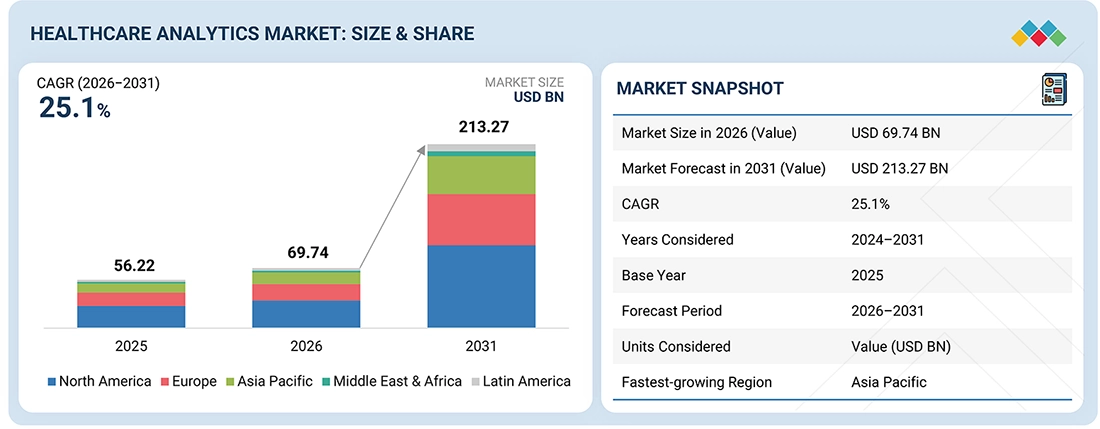
The global Healthcare Analytics Market is projected to grow from USD 69.74 billion in 2026 to USD 213.27 billion by 2031, registering a CAGR of 25.1% during the forecast period, according to a new market research report. The rapid adoption of artificial intelligence (AI), predictive analytics, real-world evidence (RWE), telemedicine, and remote patient monitoring is transforming how healthcare organizations use data to improve clinical outcomes, operational efficiency, and financial performance.
Download PDF Brochure:- https://www.marketsandmarkets.com/pdfdownloadNew.asp?id=905
AI and Data-Driven Healthcare Accelerate Market Growth
Healthcare organizations are under increasing pressure to reduce healthcare costs, improve patient outcomes, optimize resources, and strengthen financial performance. These pressures are driving demand for advanced analytics platforms capable of transforming large and complex healthcare datasets into actionable insights.
The growing adoption of electronic health records (EHRs), connected medical devices, wearable technologies, telemedicine platforms, and remote patient monitoring is generating increasing volumes of real-time healthcare data.
AI and machine learning are enabling healthcare organizations to analyze this data for risk prediction, early disease detection, fraud identification, personalized treatment planning, workforce optimization, and population health management.
Increasing investment in healthcare analytics startups is also supporting innovation across predictive, prescriptive, and AI-enabled analytics solutions.
Predictive Analytics Segment to Register Fastest Growth
The predictive analytics segment is projected to register the fastest growth during the forecast period.
Healthcare providers, payers, and life sciences organizations are increasingly using predictive analytics to identify high-risk patients, forecast healthcare utilization, optimize resource allocation, detect potential fraud, and support clinical decision-making.
The transition toward value-based care and population health management is further increasing demand for predictive capabilities that can identify patients at risk of complications, reduce avoidable hospitalizations, and improve healthcare outcomes.
The growing volume of data from EHRs, remote monitoring systems, telehealth platforms, and connected devices is creating additional opportunities for predictive analytics providers.
Providers Account for the Largest Market Share
Providers held the largest share of the healthcare analytics market in 2025.
Hospitals and health systems are increasingly deploying analytics platforms to improve clinical decision-making, patient risk management, operational planning, and financial performance.
Healthcare providers are using analytics for applications including:
- Patient risk prediction
- Readmission reduction
- Clinical decision support
- Workforce optimization
- Revenue cycle management
- Billing automation
- Scheduling optimization
- Population health management
- Resource allocation
The increasing integration of predictive analytics with EHR systems is further strengthening adoption among providers.
As hospitals move beyond clinical analytics toward financial, administrative, and operational use cases, healthcare analytics is becoming increasingly embedded across enterprise workflows.
Real-World Data and Remote Monitoring Create New Opportunities
The growing use of real-world data (RWD) and real-world evidence (RWE) is creating significant opportunities for healthcare analytics vendors.
Pharmaceutical companies, payers, providers, and researchers are increasingly using real-world data to evaluate treatment effectiveness, understand patient populations, support evidence generation, and inform healthcare decisions.
At the same time, the expansion of telemedicine and remote patient monitoring is generating continuous streams of patient data. Analytics platforms are increasingly required to process this information and identify meaningful clinical trends.
The convergence of AI, RWE, remote monitoring, and predictive analytics is expected to create new opportunities for technology providers across the healthcare ecosystem.
Speak To Analyst:- https://www.marketsandmarkets.com/speaktoanalystNew.asp?id=905
North America to Maintain Market Leadership
North America is expected to dominate the global healthcare analytics market during the forecast period.
The region’s leadership is supported by high healthcare expenditure, widespread EHR adoption, advanced digital infrastructure, large healthcare datasets, and strong adoption of AI and machine learning technologies.
Healthcare organizations in North America are facing persistent pressure to manage rising healthcare costs while improving quality and patient outcomes. This is encouraging hospitals, payers, and integrated delivery networks to invest in analytics solutions that can identify inefficiencies and optimize healthcare delivery.
The region also benefits from a mature ecosystem of claims data, clinical data, real-world data, cloud infrastructure, and healthcare technology vendors, creating favorable conditions for continued market growth.
Competitive Landscape
The Healthcare Analytics Market features several established technology and healthcare analytics companies competing through AI innovation, analytics platforms, strategic partnerships, acquisitions, and expansion of application capabilities.
Key players profiled in the market include Merative, Optum, SAS Institute, Oracle, CitiusTech, Inovalon, McKesson, MedeAnalytics, and Cotiviti, among others.
Market participants are increasingly focusing on AI-powered predictive analytics, cloud-based platforms, interoperability, real-world data integration, fraud detection, revenue cycle analytics, population health management, and precision health applications.
