The global Data Center Chip Market Analysis points to a rapidly expanding semiconductor landscape as artificial intelligence (AI), cloud computing, hyperscale infrastructure, and data-intensive applications reshape the architecture of modern data centers. According to MarketsandMarkets, the global data center chip market was valued at USD 229.48 billion in 2025 and is projected to reach USD 687.65 billion by 2032, registering a 15.9% CAGR from 2026 to 2032.
The accelerating adoption of generative AI, machine learning, high-performance computing, cloud services, and large-scale data processing is increasing demand for advanced processors, memory, networking components, sensors, power-management chips, and analog and mixed-signal integrated circuits. The Data Center Chip Market Analysis therefore highlights a transition from conventional computing architectures toward specialized, energy-efficient, and workload-optimized semiconductor solutions.
Data Center Chip Market Analysis: AI Becomes a Major Growth Engine
Artificial intelligence is emerging as one of the most important forces influencing the data center chip industry. AI workloads require enormous computational resources, particularly for model training, inference, real-time analytics, and generative AI applications.
Traditional CPUs remain important for general-purpose workloads, but AI applications increasingly require GPUs, AI accelerators, and other specialized processors capable of parallel computation. MarketsandMarkets identifies the AI application segment as a major part of the market because of its substantial compute requirements and increasing adoption of generative AI and real-time analytics.
As organizations deploy increasingly sophisticated AI models, data center operators need chips capable of delivering high throughput while maintaining acceptable power consumption and thermal performance. This is encouraging semiconductor manufacturers to develop processors and accelerators optimized for particular AI workloads.
The Data Center Chip Market Analysis consequently shows that the growth of AI is not simply increasing the number of chips deployed in data centers. It is also changing the types of chips being installed and accelerating innovation across processors, memory, networking, and power-management technologies.
Hyperscale Data Centers Accelerate Chip Demand
The rapid expansion of hyperscale data centers is another major growth driver. Hyperscale operators are expanding computing capacity to support cloud platforms, AI services, digital applications, enterprise workloads, and massive volumes of stored and processed data.
According to MarketsandMarkets, the expansion of hyperscale data centers is driving demand for high-performance CPUs, GPUs, and specialized accelerators. Continued capacity additions and infrastructure upgrades are also supporting adoption of next-generation and energy-efficient semiconductor technologies.
Hyperscale facilities require chips that can operate efficiently at enormous scale. Even relatively small improvements in processing performance or energy efficiency can have significant effects when deployed across thousands of servers.
This makes semiconductor efficiency a strategic consideration for data center operators. The Data Center Chip Market Analysis indicates that future demand will increasingly be influenced not only by computing performance but also by power consumption, thermal efficiency, scalability, and total infrastructure costs supporting market expansion. Cloud service providers continuously invest in servers, storage, networking infrastructure, and specialized computing.
Cloud Computing Creates Sustained Demand
Cloud computing remains another fundamental factor supporting market expansion. Cloud service providers continuously invest in servers, storage, networking infrastructure, and specialized computing platforms to support growing demand from enterprises and consumers.
MarketsandMarkets identifies cloud service providers as the leading end-user segment in the data center chip market. Their large-scale deployment of data center infrastructure and continued investments in high-performance and energy-efficient chips contribute significantly to overall demand.
Cloud platforms must support diverse workloads ranging from conventional enterprise applications to databases, streaming, analytics, machine learning, and generative AI. This diversity is increasing demand for different types of processors and accelerators.
As cloud architectures become increasingly optimized for specific workloads, chip manufacturers have opportunities to develop specialized solutions designed around particular computing requirements.
Download PDF Brochure @ https://www.marketsandmarkets.com/pdfdownloadNew.asp?id=39999570
Processors Continue to Represent a Critical Component
By component, processors account for the largest share of the data center chip market, according to MarketsandMarkets. Processors perform the core computational tasks required by data center workloads, including AI, cloud applications, analytics, virtualization, and general-purpose computing
The demand for higher processing performance is encouraging continued development of CPUs, GPUs, and specialized accelerators. At the same time, energy efficiency has become increasingly important because data center operators face rising electricity requirements and cooling challenges.
The competitive environment is therefore shifting toward chips that can provide greater performance per watt. Processor architectures designed to improve efficiency can help operators increase computational capacity without proportionally increasing power consumption.
Memory Segment Expected to Register Strong Growth
Memory is another important area highlighted in the Data Center Chip Market Analysis. MarketsandMarkets projects the memory segment to register a 16.7% CAGR, the highest among the component categories covered in its analysis.
The increasing complexity of AI models and high-performance computing workloads is driving demand for fast and high-capacity memory. AI systems frequently need to move large amounts of data between processors and largest share of the market by data center size, according to MarketsandMarkets. These facilities require high-performance processors, GPUs, accelerators, and other chips to process substantial data volumes and support demanding workloads. memory, making memory bandwidth and latency critical considerations.
Technologies such as high-bandwidth memory are therefore becoming increasingly relevant to AI-oriented data center architectures. The market is also seeing greater interest in advanced packaging and chiplet-based approaches that allow different computing and memory components to be integrated more efficiently.
Large Data Centers Maintain Strong Demand
Large data centers currently represent the largest share of the market by data center size, according to MarketsandMarkets. These facilities require high-performance processors, GPUs, accelerators, and other chips to process substantial data volumes and support demanding workloads.
Large-scale infrastructure is particularly important for cloud service providers and organizations operating AI-intensive workloads. The continuing construction and expansion of these facilities creates recurring demand for semiconductor components.
At the same time, MarketsandMarkets expects the medium-sized data center segment to grow at the fastest rate from 2025 to 2032. This reflects opportunities associated with organizations deploying more localized and workload-specific computing infrastructure
Custom Silicon and Specialized Accelerators Create Opportunities
One of the significant developments in the Data Center Chip Market Analysis is the increasing movement toward customized computing architectures. Hyperscale cloud providers are increasingly developing or deploying workload-specific silicon to improve performance, efficiency, and control over infrastructure costs.
MarketsandMarkets identifies the growing adoption of FPGAs and custom accelerators as an important opportunity in the market.
Custom chips can be optimized for specific workloads rather than being designed to handle every possible computing task. This can potentially improve performance and energy efficiency for applications such as AI inference, networking, security, and data analytics.
The development of custom silicon is also contributing to greater diversification in the competitive landscape, with cloud providers and semiconductor companies pursuing different approaches to workload acceleration.
Sovereign AI Infrastructure Opens New Market Opportunities
The emergence of sovereign AI infrastructure initiatives is creating another opportunity for the data center chip industry. Governments and organizations are investing in localized computing capabilities to support data security, regulatory requirements, technological independence, and domestic AI ecosystems.
MarketsandMarkets identifies sovereign AI infrastructure as a significant opportunity for data center chip providers. Such investments can increase demand for processors, memory, accelerators, and other semiconductor components required to build national and regional computing infrastructure.
These initiatives can also encourage investments in semiconductor manufacturing, regional data centers, technology partnerships, and domestic computing ecosystems.
Asia Pacific Expected to Be the Fastest-Growing Region
Regional developments are an important part of the Data Center Chip Market Analysis. MarketsandMarkets expects Asia Pacific to register the highest CAGR during the forecast period.
The region’s growth is supported by rapid development of data center infrastructure, semiconductor manufacturing investments, increasing cloud adoption, and expanding AI deployment. The presence of chip fabrication and assembly facilities across Asia Pacific also contributes to the region’s position in the semiconductor ecosystem.
North America remains a major market, accounting for 36.7% of global data center chip revenue in 2025, according to MarketsandMarkets. The region benefits from extensive hyperscale infrastructure, strong cloud adoption, AI investment, and the presence of major technology and semiconductor companies.
Energy Efficiency Becomes a Critical Market Requirement
Although AI and cloud computing are driving unprecedented demand, rising energy consumption represents a major challenge for data center operators.
Advanced GPUs and AI accelerators can consume significant amounts of power and generate considerable heat. As computing density increases, data centers must invest in more sophisticated cooling and power-management systems.
MarketsandMarkets identifies high energy consumption as a major challenge for the data center chip market. Increasing AI and high-performance workloads can raise operational costs and put pressure on sustainability objectives.
This challenge is simultaneously creating opportunities for chip manufacturers. Semiconductor companies are increasingly focused on performance-per-watt improvements, advanced architectures, power-management solutions, and more efficient computing technologies.
Supply Constraints Remain a Market Restraint
The availability and cost of advanced processors represent another important consideration. MarketsandMarkets identifies the high cost and limited supply of advanced GPUs and AI accelerators as a key market restraint.
Advanced semiconductor manufacturing involves significant capital investment and complex production processes. Supply constraints can affect deployment schedules and increase infrastructure costs, particularly when demand for AI accelerators rises rapidly.
The concentration of advanced semiconductor manufacturing capacity also creates supply-chain considerations for data center operators and technology companies.
Competitive Landscape
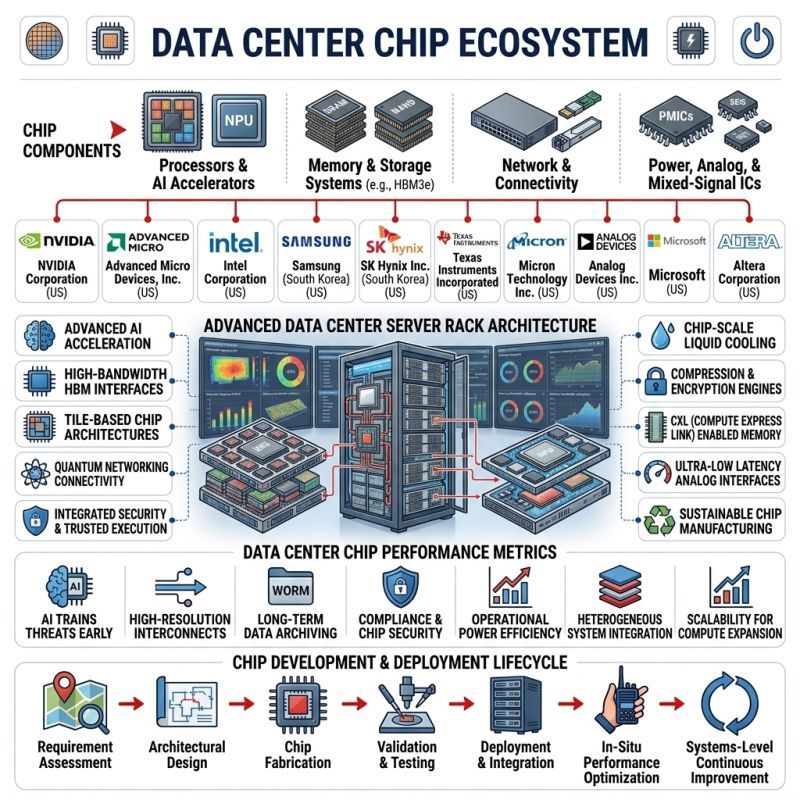
The competitive environment includes major semiconductor manufacturers and technology companies. MarketsandMarkets identifies NVIDIA, AMD, Intel, Samsung, SK Hynix, Google, Amazon Web Services, Micron Technology, Microsoft, Texas Instruments, Analog Devices, Monolithic Power Systems, and Altera, among others, as key companies associated with the market.
The competitive landscape spans multiple component categories, including processors, memory, networking, sensors, power management, and analog and mixed-signal ICs.
Meanwhile, specialized startups and emerging companies are also participating in areas such as AI acceleration and edge computing. MarketsandMarkets highlights companies including Blaize, Kneron, and Rebellions among startups and SMEs with positions in specialized market segments.
Future Outlook for the Data Center Chip Market
The global Data Center Chip Market Analysis indicates that the industry is moving toward a more specialized and heterogeneous computing environment. CPUs will continue supporting general-purpose workloads, while GPUs, AI accelerators, FPGAs, specialized memory, networking chips, and custom silicon will increasingly support workload-specific requirements.
The market is projected to rise from USD 229.48 billion in 2025 to USD 687.65 billion by 2032, representing a 15.9% CAGR during 2026–2032.
AI adoption, cloud computing, hyperscale infrastructure, edge computing, high-bandwidth memory, custom accelerators, and energy-efficient computing are expected to remain central themes shaping the industry.
At the same time, semiconductor supply constraints, high chip costs, power consumption, cooling requirements, and hardware security concerns will remain important considerations for market participants.
Overall, the Data Center Chip Market Analysis demonstrates that data center chips are becoming foundational components of the AI and cloud economy. As organizations process increasingly large datasets and deploy more computationally intensive applications, demand is shifting toward faster, specialized, scalable, and energy-efficient semiconductor technologies. The combination of AI expansion, hyperscale infrastructure investment, and cloud growth is expected to sustain significant market opportunities through 2032.
