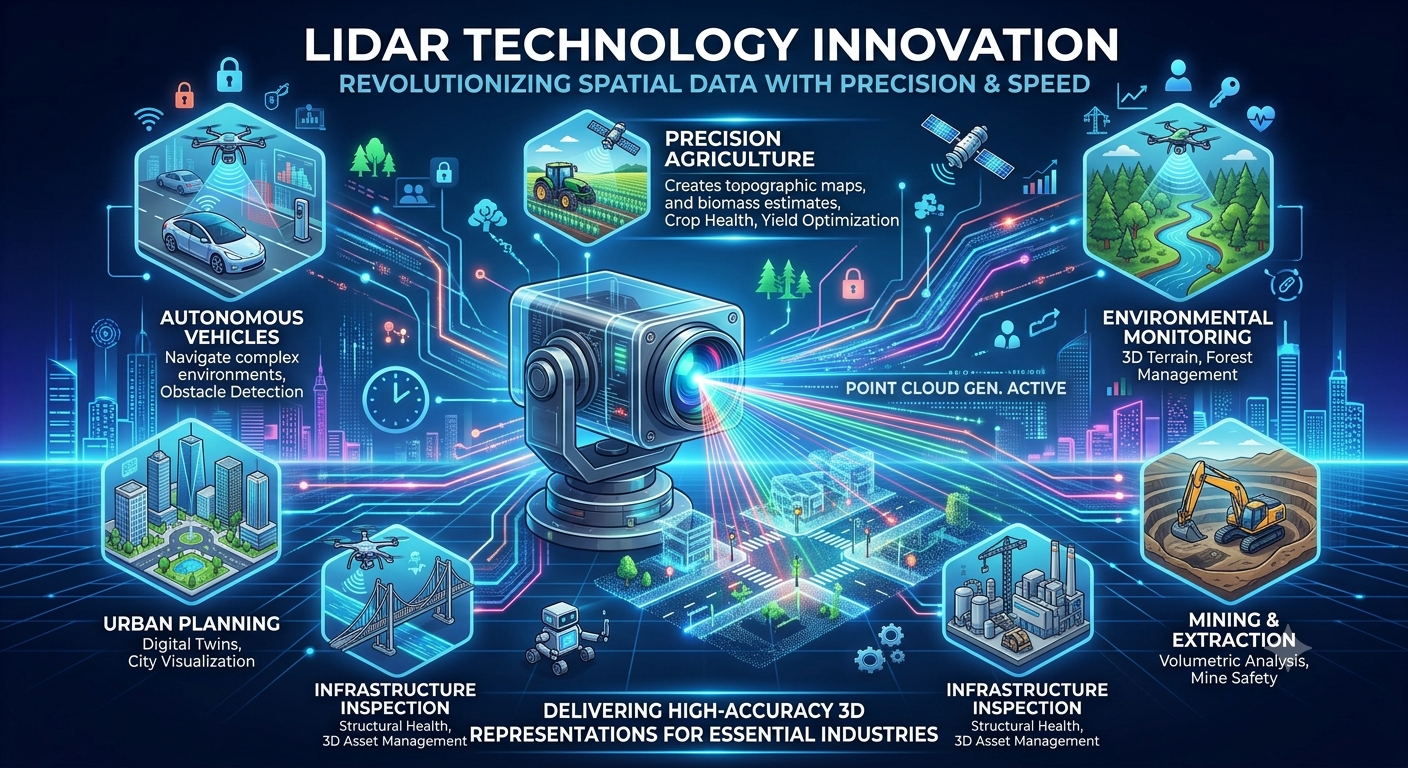
The LiDAR Market Share is expanding rapidly as industries adopt high-precision 3D sensing technologies for autonomous vehicles, advanced driver assistance systems (ADAS), smart infrastructure, surveying, mapping, environmental monitoring, robotics, and urban planning. LiDAR, or Light Detection and Ranging, uses laser pulses to measure distances and generate detailed three-dimensional representations of physical environments. Its ability to deliver accurate spatial information is making it an increasingly important sensing technology across transportation, infrastructure, industrial, and geospatial applications.
According to MarketsandMarkets, the global LiDAR market was valued at USD 3.27 billion in 2025 and is projected to reach USD 12.79 billion by 2030, growing at a CAGR of 31.3% from 2025 to 2030. Rising adoption in autonomous vehicles, environmental mapping, smart infrastructure, digital twins, and 3D mapping is supporting the rapid expansion of the market.
The development of solid-state LiDAR, improvements in sensor accuracy, integration with artificial intelligence (AI), and increasing demand for automated mapping are further changing the competitive landscape. As LiDAR systems become more compact, accurate, and cost-efficient, their applications are expanding beyond conventional surveying and mapping into automotive, robotics, industrial automation, defense, and smart-city environments.
Autonomous Vehicles Drive LiDAR Market Share
The growing development of autonomous vehicles and ADAS is one of the most important factors supporting LiDAR Market Share expansion. Autonomous vehicles require accurate perception technologies to identify objects, pedestrians, road infrastructure, and surrounding environments.
LiDAR provides three-dimensional information that can complement cameras and radar, supporting object detection, distance measurement, mapping, and navigation. As automotive manufacturers and technology companies develop higher levels of vehicle automation, demand for advanced sensing technologies continues to increase.
MarketsandMarkets identifies ADAS & driverless cars as the leading end-use application segment in the LiDAR market. The increasing adoption of solid-state LiDAR for vehicle safety and autonomous driving is contributing to this trend.
The automotive industry is also creating opportunities for LiDAR manufacturers through partnerships, supply agreements, and integration into new vehicle platforms. The growing deployment of Level 2 to Level 4 automated driving technologies could create additional opportunities for LiDAR suppliers.
Smart Infrastructure Accelerates LiDAR Adoption
Smart infrastructure is another major contributor to LiDAR Market Share growth. Governments and infrastructure developers are increasingly using 3D mapping technologies to plan, monitor, and manage roads, bridges, utilities, railways, and urban environments.
LiDAR can rapidly capture detailed information about terrain, buildings, roads, vegetation, and infrastructure. This information can be converted into 3D models and digital elevation models that support engineering, urban planning, asset management, and infrastructure development.
Investments in smart cities and digital infrastructure are therefore creating new demand for LiDAR-based surveying and mapping. MarketsandMarkets identifies smart infrastructure projects, urban planning, and digital twin technologies among the factors supporting LiDAR market expansion.
Ground-Based LiDAR Holds a Larger Market Share
By installation, ground-based LiDAR holds a larger LiDAR Market Share than airborne LiDAR. MarketsandMarkets expects ground-based LiDAR to grow at a higher CAGR during the forecast period, supported by its lower cost and relatively simpler approval requirements for mapping and surveying applications.
Ground-based systems are widely used for corridor mapping, environmental monitoring, meteorology, engineering, ADAS, and autonomous vehicle applications. Their ability to capture detailed spatial information from fixed or mobile ground platforms makes them suitable for a wide range of surveying and infrastructure projects.
The increasing demand for high-resolution mapping and 3D visualization is expected to support continued adoption of ground-based systems.
Download PDF Brochure @ https://www.marketsandmarkets.com/pdfdownloadNew.asp?id=1261
Mechanical LiDAR Maintains a Strong Market Position
By type, mechanical LiDAR accounted for a larger market share in 2024. Mechanical systems are widely used in corridor mapping, military applications, volumetric mapping, and engineering because of their wide field of view and long-range capabilities.
Mechanical LiDAR systems use moving components to direct laser beams across the surrounding environment. Their established performance and broad scanning capabilities have supported adoption in large-scale mapping and surveying applications.
At the same time, solid-state LiDAR is gaining attention because of its potential for smaller form factors, improved durability, and cost efficiency. The increasing use of solid-state systems in automotive applications is expected to influence the future distribution of LiDAR Market Share.
Short-Range LiDAR Gains Momentum
The short-range segment is projected to lead the LiDAR market because of increasing adoption in automobiles, security, and robotics.
Short-range LiDAR can support applications where accurate detection of nearby objects is essential. In vehicles, these systems can contribute to perception and safety functions. In robotics, short-range sensing can help autonomous machines navigate indoor and controlled environments.
The growing adoption of robotics, automated systems, and smart machines is expected to create additional opportunities for compact LiDAR sensors.
Aerial Surveying Supports LiDAR Market Share
Aerial surveying is projected to dominate the LiDAR market by service. LiDAR mounted on aircraft and unmanned aerial vehicles (UAVs) can capture large quantities of geographic information efficiently across extensive areas.
UAV LiDAR systems are increasingly being used for surveying, environmental monitoring, infrastructure assessment, corridor mapping, and remote-area data collection. Drones equipped with LiDAR can access hazardous or difficult-to-reach locations while generating detailed 3D representations.
The growing use of UAVs is therefore creating opportunities for LiDAR system manufacturers, surveying companies, geospatial service providers, and software developers.
3D Mapping and Digital Twins Create New Opportunities
The increasing demand for accurate 3D data is another important factor supporting LiDAR Market Share growth. LiDAR can generate detailed point clouds that can be processed into three-dimensional models of buildings, roads, terrain, and other physical assets.
These capabilities are particularly relevant to digital twin applications. Digital twins require accurate representations of physical assets and environments to support monitoring, simulation, planning, and optimization.
Infrastructure developers can use LiDAR-generated data to create digital representations of roads, bridges, buildings, and utility networks. Urban planners can also use 3D spatial information to analyze development scenarios and infrastructure requirements.
As organizations increasingly adopt digital twins and spatial computing technologies, demand for high-quality 3D data is expected to increase.
AI Integration Enhances LiDAR Capabilities
The integration of AI and machine learning with LiDAR data is creating new possibilities for automated perception and spatial analysis. AI algorithms can process LiDAR point clouds to identify objects, classify terrain, detect changes, and extract useful information from large datasets.
In autonomous vehicles, AI can analyze LiDAR-generated information to support object recognition and navigation. In surveying, AI-powered analytics can automate classification and feature extraction from point clouds.
The combination of LiDAR, AI, edge computing, and cloud-based processing is helping transform LiDAR from a sensing device into part of a broader intelligent data ecosystem.
MarketsandMarkets identifies improvements in sensors, accuracy, portability, and AI integration as factors accelerating LiDAR adoption.
Environmental Monitoring Expands LiDAR Applications
Environmental monitoring represents another important application area. LiDAR can capture information about forests, vegetation, terrain, coastlines, and other environmental features.
Its ability to collect data across large and difficult-to-access areas makes it valuable for forest management, terrain analysis, environmental assessment, and climate-related monitoring.
LiDAR can also support the development of detailed elevation models that help organizations understand terrain characteristics and monitor changes over time.
Increasing investments in environmental monitoring and sustainable infrastructure are therefore creating additional opportunities for LiDAR technology.
Asia Pacific Leads Regional Growth
Asia Pacific is projected to be the fastest-growing region in the LiDAR market, with the regional market expected to increase from USD 0.92 billion in 2025 to USD 4.01 billion by 2030, representing a CAGR of 34.1%.
Growth is supported by infrastructure development, surveying and mapping activities, forest management, mining, smart-city programs, autonomous and electric vehicles, industrial automation, robotics, and drone-based surveying.
China, Japan, and countries across Southeast Asia are investing in smart infrastructure and advanced mobility technologies. These developments are creating a strong application base for LiDAR systems.
The region’s expanding automotive and electronics industries also provide opportunities for LiDAR manufacturers developing compact and automotive-grade sensing technologies.
North America Maintains a Significant Market Position
The North American LiDAR market is projected to reach USD 4.8 billion by 2030 from USD 1.25 billion in 2025, growing at a CAGR of 30.9%.
The regional market is supported by autonomous vehicle development, ADAS adoption, mapping, infrastructure projects, robotics, and geospatial applications. Automotive OEMs and technology companies are increasingly exploring LiDAR integration through partnerships and supply agreements.
The presence of established LiDAR companies and technology developers also supports innovation across automotive, mapping, industrial, and robotics applications.
Europe Expands LiDAR Adoption
Europe’s LiDAR market is projected to reach USD 3.16 billion by 2030 from USD 0.87 billion in 2025, representing a CAGR of 29.6%.
The region’s growth is associated with autonomous driving, smart mobility initiatives, advanced mapping, environmental monitoring, agriculture, and infrastructure planning.
Government and industry initiatives around intelligent transportation and digital infrastructure are creating additional opportunities for LiDAR deployment. The growing adoption of automated mobility technologies is also encouraging automotive companies to evaluate advanced sensing solutions.
Rising UAV Adoption Creates Growth Opportunities
UAV LiDAR is becoming increasingly important for surveying and mapping because drones can carry LiDAR systems into areas that may be difficult, hazardous, or expensive to access using conventional surveying approaches.
According to MarketsandMarkets, the rising adoption of UAV LiDAR systems is a key market driver. These systems can support infrastructure surveys, environmental monitoring, corridor mapping, engineering projects, and remote-area assessments.
The combination of drones, LiDAR, AI, and geospatial software can enable faster data collection and automated analysis, creating opportunities across construction, mining, agriculture, forestry, and infrastructure.
Cost and Software Complexity Remain Challenges
Despite rapid expansion, several factors can limit LiDAR Market Share growth. Low-cost and lightweight photogrammetry systems can serve as alternatives for certain mapping and surveying applications. While LiDAR generally provides highly detailed spatial data, its equipment and processing costs can be higher.
Post-processing software costs can also create challenges for smaller organizations. MarketsandMarkets identifies the high cost of post-processing LiDAR software and complexities associated with miniaturized LiDAR sensing among the challenges affecting the market.
As technology matures, manufacturers are focusing on reducing system costs, improving portability, and developing more integrated software platforms.
Competitive Landscape and Key Companies
The global LiDAR market includes technology companies specializing in sensors, complete LiDAR systems, geospatial solutions, and software. Major companies identified by MarketsandMarkets include Hesai Group, RoboSense Technology, SICK, Ouster, Luminar Technologies, Leica Geosystems, Trimble, Teledyne Optech, FARO Technologies, RIEGL Laser Measurement Systems, NV5 Geospatial, Beijing SureStar Technology, and YellowScan.
Companies are pursuing strategies such as product launches, partnerships, acquisitions, and technology development to expand their product portfolios and strengthen their positions in the evolving LiDAR ecosystem.
Competition is increasingly centered on sensing accuracy, detection range, reliability, size, cost, software capabilities, and suitability for automotive and industrial applications.
Future Outlook for LiDAR Market Share
The future of LiDAR Market Share will be shaped by the convergence of autonomous mobility, smart infrastructure, AI, robotics, digital twins, UAVs, and advanced geospatial technologies.
The global LiDAR market is projected to grow from USD 3.27 billion in 2025 to USD 12.79 billion by 2030, representing a 31.3% CAGR.
Autonomous vehicles and ADAS will remain important growth areas, while infrastructure development, smart cities, environmental monitoring, surveying, mapping, and robotics will broaden the technology’s commercial applications.
The transition toward solid-state and more compact LiDAR systems could further expand deployment in automotive and industrial environments. Meanwhile, AI-powered point-cloud processing and cloud-based geospatial platforms are expected to improve the speed and value of LiDAR data analysis.
As LiDAR becomes more affordable, compact, intelligent, and integrated with digital platforms, its role is expected to expand from specialized surveying equipment to a broader sensing technology supporting autonomous systems and connected infrastructure.
Overall, rising adoption across autonomous vehicles, ADAS, smart infrastructure, 3D mapping, UAV surveying, environmental monitoring, robotics, and digital twins is creating multiple pathways for continued LiDAR Market Share expansion through 2030.
Frequently Asked Questions
1. What is the size of the LiDAR Market?
The global LiDAR Market is projected to grow from USD 3.27 billion in 2025 to USD 12.79 billion by 2030, at a CAGR of 31.3%.
2. Which application is driving the LiDAR Market Share?
ADAS and driverless cars are major application areas driving LiDAR Market Share, supported by increasing demand for advanced sensing and autonomous driving technologies.
3. Which region is expected to grow fastest in the LiDAR Market?
Asia Pacific is expected to register the highest growth rate, with increasing investments in autonomous vehicles, smart infrastructure, surveying, mapping, robotics, and smart-city projects.
4. Which LiDAR segment is expected to grow at a significant rate?
Ground-based LiDAR is expected to register strong growth, supported by increasing adoption in mapping, surveying, infrastructure monitoring, autonomous vehicles, and environmental applications.
5. Who are the key players in the LiDAR Market?
Key players include Hesai Group, RoboSense Technology, SICK, Ouster, Luminar Technologies, Leica Geosystems, Trimble, Teledyne Optech, FARO Technologies, and RIEGL Laser Measurement Systems
About MarketsandMarkets™
MarketsandMarkets™ has been recognized as one of America’s Best Management Consulting Firms by Forbes, as per their recent report.
MarketsandMarkets™ is a blue ocean alternative in growth consulting and program management, leveraging a man-machine offering to drive supernormal growth for progressive organizations in the B2B space. With the widest lens on emerging technologies, we are proficient in co-creating supernormal growth for clients across the globe.
Today, 80% of Fortune 2000 companies rely on MarketsandMarkets, and 90 of the top 100 companies in each sector trust us to accelerate their revenue growth. With a global clientele of over 13,000 organizations, we help businesses thrive in a disruptive ecosystem.
The B2B economy is witnessing the emergence of $25 trillion in new revenue streams that are replacing existing ones within this decade. We work with clients on growth programs, helping them monetize this $25 trillion opportunity through our service lines – TAM Expansion, Go-to-Market (GTM) Strategy to Execution, Market Share Gain, Account Enablement, and Thought Leadership Marketing.
Built on the ‘GIVE Growth’ principle, we collaborate with several Forbes Global 2000 B2B companies to keep them future-ready. Our insights and strategies are powered by industry experts, cutting-edge AI, and our Market Intelligence Cloud, KnowledgeStore™, which integrates research and provides ecosystem-wide visibility into revenue shifts.
To find out more, visit www.MarketsandMarkets™.com or follow us on Twitter , LinkedIn and Facebook .
Contact:
Mr. Rohan Salgarkar
MarketsandMarkets™ INC.
1615 South Congress Ave.
Suite 103, Delray Beach, FL 33445
USA: +1-888-600-6441
