The Humanoid Robot Market Size 2035 is expected to expand significantly as artificial intelligence (AI), physical intelligence, advanced sensors, robotics, and automation technologies move humanoid robots from research environments toward commercial applications. According to MarketsandMarkets, the global humanoid robot market is estimated at USD 5.41 billion in 2026 and is projected to reach USD 50.27 billion by 2035, registering a CAGR of 28.1% from 2026 to 2035. The market was valued at USD 1.95 billion in 2025.
The Humanoid Robot Market Size 2035 outlook reflects the growing demand for flexible automation across manufacturing, warehousing and distribution centers, healthcare, education, hospitality and entertainment, retail, and personal assistance. Humanoid robots can operate in environments designed for humans, allowing organizations to explore automation for repetitive, labor-intensive, physically demanding, and human-facing tasks.
AI Is Reshaping the Humanoid Robot Market
Artificial intelligence is becoming a fundamental technology in the development of next-generation humanoid robots. AI-based perception, machine learning, computer vision, motion planning, manipulation software, and robot foundation models are improving the ability of robots to understand their surroundings and perform increasingly complex tasks.
The Humanoid Robot Market Size 2035 will increasingly depend on the integration of physical AI with sophisticated robotic hardware. Physical AI enables robots to connect digital intelligence with physical actions, allowing them to perceive environments, make decisions, navigate spaces, manipulate objects, and interact with people.
According to MarketsandMarkets, rapid progress in physical AI, robot foundation models, and simulation tools is a key driver of market growth. Simulation-based training can help robots learn tasks in virtual environments before deployment, while AI-powered perception and control systems improve task execution in real-world environments.
Physical Intelligence Creates New Automation Opportunities
Physical intelligence is transforming the role of humanoid robots from programmable machines into more adaptive automation platforms. Traditional industrial robots are generally designed for highly structured and predefined environments. Humanoid robots, by contrast, are being developed to navigate environments originally designed around human movement and interaction.
This capability can create opportunities in factories, warehouses, hospitals, stores, educational institutions, and service environments. Humanoid robots can potentially perform tasks such as material handling, assembly assistance, inspection, facility operations, patient support, interactive learning, and customer engagement.
As physical AI models become more capable, humanoid robots may be able to learn and adapt to a broader range of tasks. This evolution is expected to contribute to the expansion of the Humanoid Robot Market Size 2035.
Download PDF Brochure @ https://www.marketsandmarkets.com/pdfdownloadNew.asp?id=99567653
Manufacturing Emerges as a Major Application Area
Manufacturing is expected to remain a significant application area for humanoid robots. Manufacturers are increasingly exploring flexible automation to address labor-intensive activities, improve productivity, and support workers.
Humanoid robots can be designed to perform tasks within existing human-centric production environments without requiring every facility to be completely redesigned. Potential applications include assembly assistance, material movement, inspection, machine tending, and repetitive production activities.
MarketsandMarkets identifies manufacturing as an important growth area and expects the manufacturing segment to register a growth rate of approximately 27%–30% during the forecast period.
The integration of AI-powered vision, advanced actuators, force and torque sensing, motion controllers, and manipulation systems can further expand the range of manufacturing tasks that humanoid robots can perform.
Logistics and Warehousing Drive Demand for Flexible Robots
The rapid growth of e-commerce and distribution networks is increasing the need for automation throughout logistics operations. Warehouses frequently contain repetitive material-handling activities that require continuous labor.
Humanoid robots could support applications such as picking, placing, transportation, sorting, inventory handling, and facility operations. Their human-like form may allow them to navigate workspaces and interact with infrastructure designed for people.
MarketsandMarkets identifies increasing demand from the logistics sector as an opportunity for the humanoid robot industry. Robotics-as-a-Service (RaaS) and fleet-management platforms can further support deployment by reducing upfront investment requirements and enabling centralized monitoring and management of robotic fleets.
Healthcare Expands the Role of Humanoid Robots
Healthcare represents another emerging application area for humanoid robotics. Aging populations, healthcare workforce shortages, and demand for automated support services are creating opportunities for robots in hospitals and care environments.
Potential applications include patient assistance, hospital logistics, rehabilitation support, elderly care, routine transportation, and other non-invasive support activities. Humanoid robots could also assist with repetitive operational tasks, allowing healthcare personnel to focus on activities requiring direct professional expertise.
The development of safer navigation, computer vision, human-robot interaction, and AI-enabled decision-making will remain important for healthcare deployments. MarketsandMarkets identifies healthcare as a growing application area within the humanoid robot industry.
Hardware Remains a Core Component of the Market
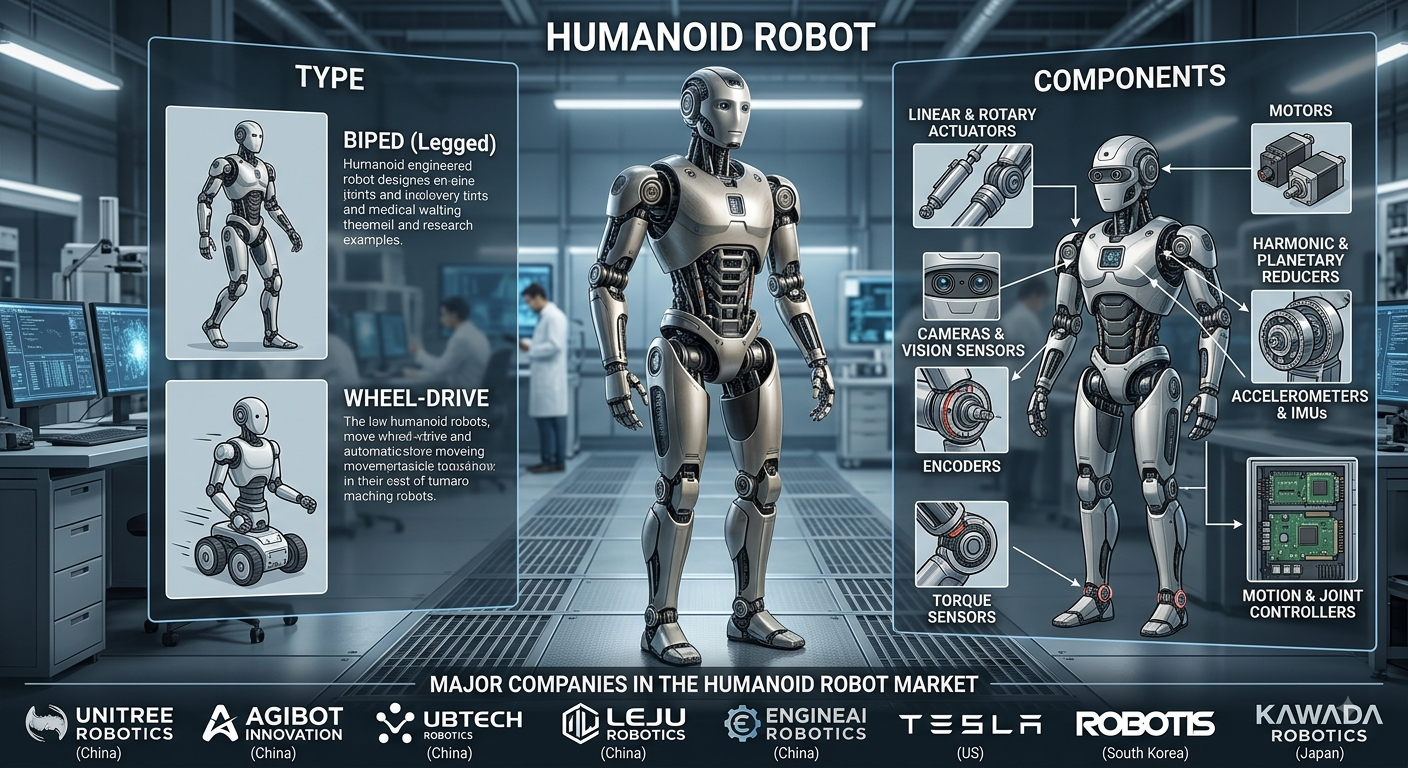
While AI and software are becoming increasingly important, hardware remains fundamental to humanoid robot development. Advanced actuators, motors, cameras, vision sensors, reducers, encoders, accelerometers, torque sensors, and motion and joint controllers enable robots to move, perceive, balance, and interact with physical objects.
MarketsandMarkets estimates that the hardware segment will account for approximately 65%–75% of the market in 2026.
The development of lighter actuators, higher-density batteries, more efficient motors, advanced sensing technologies, and compact computing platforms will be important for improving humanoid robot performance.
These improvements can enhance mobility, balance, dexterity, operating time, and task accuracy—factors that will directly influence the Humanoid Robot Market Size 2035.
Biped Humanoid Robots Gain Momentum
The market includes biped, wheel-drive, and torso & stationary humanoid robots. Among these, biped robots are designed to replicate human walking and movement patterns and can potentially operate across environments created for human workers.
MarketsandMarkets expects the biped segment to register the highest growth rate of approximately 28%–30% during the forecast period.
The development of advanced balance-control algorithms, actuators, sensors, and AI-based motion planning is improving biped mobility. These technologies are important for enabling robots to navigate stairs, uneven surfaces, production areas, warehouses, and other complex environments.
Robots-as-a-Service Opens New Business Models
The adoption of Robotics-as-a-Service (RaaS) is creating another growth opportunity for the humanoid robot industry. Instead of purchasing robotic systems outright, organizations can use subscription or service-based models that may include robot deployment, software, maintenance, fleet management, and upgrades.
RaaS can lower initial capital requirements and make advanced robotics more accessible to organizations that may not have extensive robotics infrastructure.
Fleet-management platforms can also enable centralized monitoring, software updates, performance optimization, and coordination across multiple robots. According to MarketsandMarkets, increasing adoption of RaaS and fleet-management models represents an important opportunity for the market.
Simulation and Digital Twins Accelerate Robot Development
Simulation technologies and digital twins are becoming increasingly important in humanoid robotics. Developers can use virtual environments to train robots, test movements, identify potential failures, and optimize task performance before deploying physical systems.
Simulation-based training can reduce the need for extensive physical testing and allow robots to experience large numbers of scenarios in controlled digital environments. Digital twins can also support monitoring and optimization after deployment.
The combination of simulation, digital twins, generative AI, and physical AI could accelerate the development of more capable humanoid robots and contribute to the long-term Humanoid Robot Market Size 2035 opportunity.
Asia Pacific Leads the Global Opportunity
Asia Pacific is expected to account for more than 50% of the humanoid robot market share throughout the forecast period, according to MarketsandMarkets.
The region benefits from strong manufacturing ecosystems, robotics development capabilities, investments in artificial intelligence, and growing automation demand. China, Japan, and South Korea are important markets for robotics development and adoption.
North America also represents an important market because of investments in AI, robotics startups, automation, and advanced computing. Europe is witnessing growth supported by investments in advanced manufacturing, industrial automation, AI, robotics R&D, and autonomous systems.
Key Companies Shaping the Humanoid Robot Industry
The competitive landscape includes established robotics companies and emerging AI-focused humanoid robotics developers. MarketsandMarkets identifies Unitree Robotics, AGIBOT Innovation, UBTECH Robotics, Leju Robotics, EngineAI, Fourier, Figure AI, Agility Robotics, Tesla, and Boston Dynamics, among others, as companies operating in the market.
These companies are developing technologies spanning humanoid platforms, actuators, perception systems, AI software, mobility, manipulation, control systems, and commercial deployment.
The competitive landscape is also expanding beyond hardware. Companies are increasingly developing AI-enabled software, foundation models, fleet-management platforms, simulation tools, connectivity solutions, analytics, and predictive maintenance capabilities.
Challenges Could Influence Market Adoption
Despite the strong growth outlook, humanoid robotics faces several challenges. Developing sophisticated humanoid robots requires substantial investment in hardware, AI software, sensors, actuators, batteries, testing infrastructure, and safety validation.
Performance in untested environments remains another challenge. Humanoid robots must operate reliably around people while maintaining balance, avoiding collisions, understanding surroundings, and completing tasks accurately.
Safety is particularly important because humanoid robots are expected to operate in human-centric environments. Reliable movement, emergency response, collision avoidance, task accuracy, and compliance with relevant safety requirements will be critical to broader adoption.
Future Outlook: From Robotics to Physical AI
The future of the Humanoid Robot Market Size 2035 will be shaped by the convergence of AI, robotics, computer vision, advanced sensors, high-performance computing, simulation, and physical intelligence.
The industry is moving beyond conventional robotic automation toward machines capable of perceiving, reasoning, learning, and acting in dynamic environments. As AI models become more capable and robotic hardware becomes more efficient, humanoid robots can potentially address a wider range of industrial and service applications.
MarketsandMarkets projects the market to increase from USD 5.41 billion in 2026 to USD 50.27 billion by 2035, representing a 28.1% CAGR. This growth outlook highlights the increasing commercial interest in humanoid robots and the broader shift toward AI-enabled physical automation.
Ultimately, the Humanoid Robot Market Size 2035 will be influenced by how effectively manufacturers and technology providers overcome challenges related to cost, safety, reliability, energy efficiency, dexterity, and real-world adaptability. With continued advances in physical AI, robot foundation models, simulation, sensors, actuators, and intelligent control systems, humanoid robots are becoming an increasingly important component of the next generation of automation.
FAQ
Q1. What will the Humanoid Robot Market Size be in 2035?
A: The Humanoid Robot Market is projected to reach USD 50.27 billion by 2035, growing at a CAGR of 28.1% from 2026 to 2035.
Q2. What factors are driving the Humanoid Robot Market Size 2035?
A: The market is driven by AI, physical intelligence, advanced sensors, improved actuators, automation, and increasing demand for flexible robotic solutions.
Q3. Which applications are driving the Humanoid Robot Market?
A: Major applications include manufacturing, logistics and warehousing, healthcare, education, hospitality and entertainment, retail, and personal assistance.
Q4. Which region is expected to hold a major share of the Humanoid Robot Market?
A: Asia Pacific is expected to account for more than 50% of the humanoid robot market share during the forecast period, supported by strong manufacturing and robotics ecosystems.
Q5. Who are the key players in the Humanoid Robot Market?
A: Key players include Unitree Robotics, AGIBOT Innovation, UBTECH Robotics, Leju Robotics, EngineAI, Fourier, Figure AI, Agility Robotics, Tesla, and Boston Dynamics, among others.
