The precision farming market is entering a period of accelerated transformation as agriculture moves from conventional field management toward data-driven, connected, and increasingly automated operations. Farmers and agricultural enterprises are adopting technologies such as IoT sensors, artificial intelligence (AI), GPS/GNSS, drones, remote sensing, variable-rate technology (VRT), cloud platforms, and automated machinery to improve productivity while optimizing water, fertilizers, pesticides, fuel, and labor.
According to MarketsandMarkets, the global precision farming market is projected to grow from USD 11.97 billion in 2026 to USD 23.07 billion by 2033, registering a CAGR of 9.8% during the forecast period. The expansion is being supported by rising food demand, sustainability requirements, digital transformation, technological advances, and government initiatives promoting modern agricultural practices.
Download PDF Brochure @ https://www.marketsandmarkets.com/pdfdownloadNew.asp?id=1243
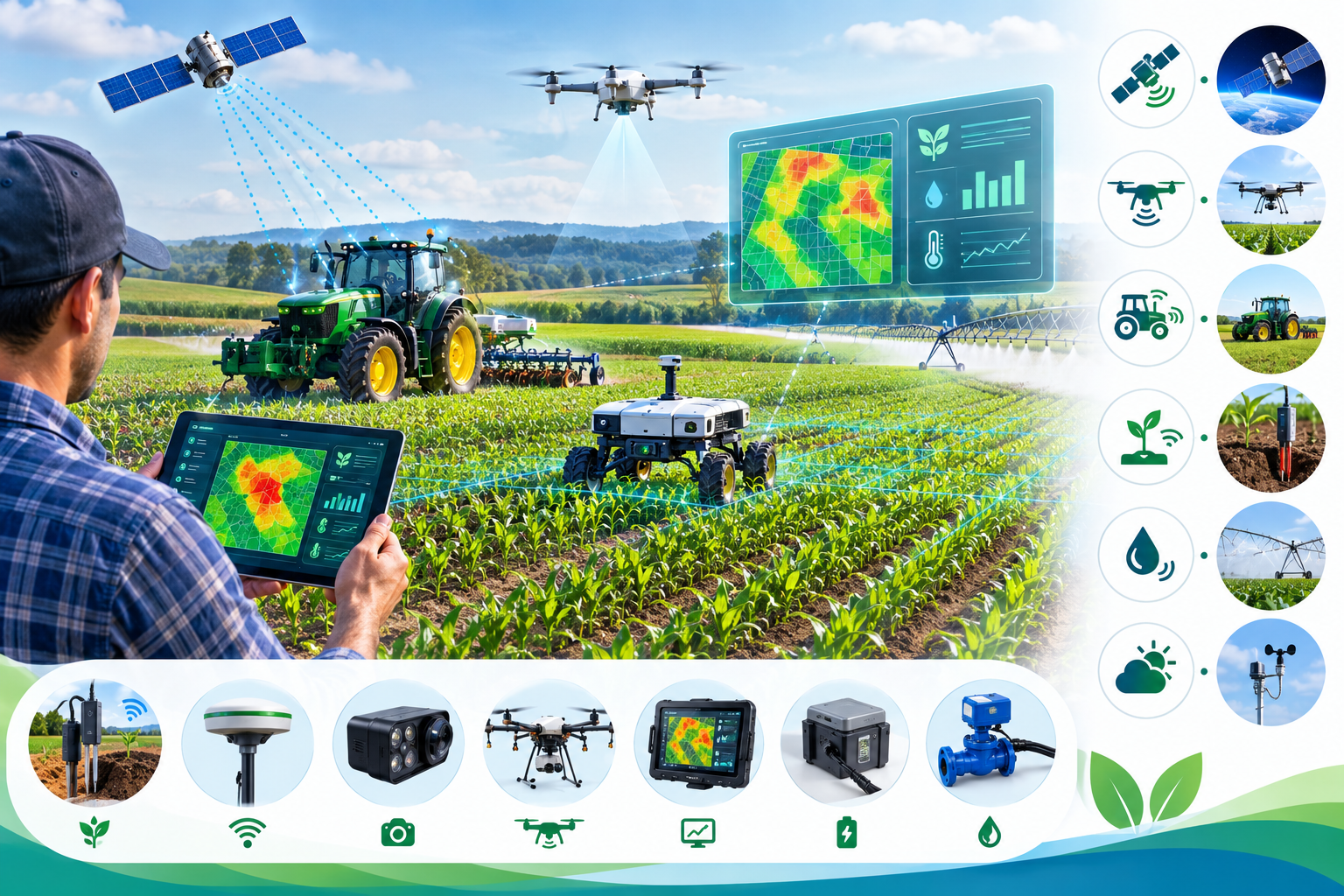
AI and IoT Accelerate Data-Driven Precision Agriculture
One of the most significant precision farming market trends in 2026 is the integration of AI, machine learning, IoT, and data analytics into agricultural workflows. Connected sensors, drones, satellite imagery, and farm machinery generate large volumes of field-level data that can be analyzed to support timely decisions.
AI-enabled platforms can help identify crop health conditions, forecast yields, optimize irrigation, and improve pest and nutrient management. The growing availability of cloud-based farm management platforms is also enabling farmers to access field information remotely and integrate data from multiple sources.
This transition is expanding the market opportunity beyond traditional agricultural hardware toward software, analytics, connectivity, and recurring digital services.
Variable-Rate Technology Becomes a Key Growth Opportunity
Variable-rate application (VRA) is emerging as an important technology within precision agriculture. VRA allows farmers to adjust the application of seeds, fertilizers, pesticides, and water according to variations in soil, crop, and field conditions.
By applying inputs where they are needed rather than uniformly across an entire field, VRA can support improved input efficiency, lower waste, and more sustainable farming practices. MarketsandMarkets identifies VRA as a high-growth technology area, supported by the increasing deployment of GPS-enabled equipment, IoT sensors, and advanced analytics.
Companies such as Deere & Company, Hexagon AB, and Valmont Industries are advancing solutions related to smart machinery, digital agriculture, and precision application, illustrating the broader shift toward integrated agricultural ecosystems.
Guidance Technology Remains Foundational to Farm Automation
GPS- and GNSS-enabled guidance technology remains a core component of precision farming. It accounted for approximately 40.0% of the market in 2025, according to MarketsandMarkets, as farmers increasingly use automated guidance and steering systems for planting, spraying, tilling, and harvesting.
Precise navigation can reduce overlaps and unnecessary input consumption while improving field coverage. The technology is also creating a foundation for increasingly autonomous agricultural machinery, including automated tractors and other robotic systems.
Software and Weather Intelligence Create New Opportunities
Software is expected to record the highest CAGR among precision farming offerings during 2026–2033. Increasing data generation from sensors, drones, machinery, and satellite imagery is creating demand for platforms capable of converting raw information into actionable farm-management insights.
Weather tracking and forecasting is another emerging application. Increasing climate variability and extreme weather conditions are encouraging farmers to adopt systems that monitor rainfall, temperature, humidity, and other environmental parameters. AI-driven forecasting can support decisions related to irrigation, planting, harvesting, and crop protection.
Sustainability and Food Demand Drive Adoption
The growing emphasis on sustainable agriculture is a major driver of the precision farming market. Soil sensors, remote sensing, data analytics, and variable-rate systems can help optimize the use of water, fertilizers, and pesticides while supporting productivity.
At the same time, population growth and increasing food requirements are placing pressure on agricultural producers to generate higher output from available land. Precision agriculture addresses this challenge by enabling more targeted resource allocation and data-based farm management. Government support and digital-agriculture initiatives are further encouraging adoption in multiple markets.
High Costs and Connectivity Remain Market Challenges
Despite the benefits, high initial investment remains a significant restraint. GPS-guided machinery, sensors, drones, software platforms, and other precision technologies can require substantial expenditure for acquisition, installation, integration, and maintenance. This can limit adoption among small and marginal farmers, particularly in developing agricultural markets.
Technical skills and workforce availability also influence adoption. Furthermore, inconsistent standards can create interoperability challenges between equipment and software from different suppliers. Data privacy and security are becoming increasingly important as agricultural operations become more connected.
Asia Pacific Emerges as a High-Growth Market
Asia Pacific is expected to register the highest CAGR in the precision farming market during the forecast period. Agricultural modernization, government support, rising food demand, and increasing investment in AI, IoT, digital platforms, and precision machinery are supporting growth across countries including China, India, Japan, and Australia.
The region’s combination of large agricultural production bases and increasing digitalization creates opportunities for technology providers to develop scalable and cost-effective precision agriculture solutions.
Future Outlook for the Precision Farming Market
The precision farming market in 2026 is moving toward connected, intelligent, and increasingly autonomous agricultural operations. Future growth will be shaped by AI-powered analytics, VRA, autonomous machinery, remote sensing, cloud-based platforms, IoT connectivity, and advanced weather intelligence.
As precision agriculture evolves, value creation will increasingly depend on the ability to combine hardware, software, data, and automation into integrated solutions that deliver measurable improvements in productivity, resource efficiency, labor utilization, and sustainability. With the market projected to reach USD 23.07 billion by 2033, precision farming is positioned to become an increasingly important technology foundation for the digital transformation of global agriculture.
Find More Information on Precision Farming Market Innovation @ https://www.marketsandmarkets.com/Market-Reports/precision-farming-market-1243.html
