The Large Format Printer Market Key Trends are increasingly centered on digitalization, advanced ink technologies, customization, wireless connectivity, automation, and sustainable printing. Large format printers are becoming essential tools for businesses that require high-quality, high-resolution, and customized graphics across advertising, signage, textiles, packaging, décor, retail, and technical printing applications.
According to MarketsandMarkets, the global Large Format Printer Market was valued at USD 7.94 billion in 2025 and is projected to reach USD 10.36 billion by 2030, registering a CAGR of 5.5% from 2025 to 2030. Market expansion is supported by rising demand for customized printing, personalized textiles, promotional materials, signage, packaging, and visual communication.
The evolution of digital inkjet technologies, UV-cured and latex inks, wireless connectivity, automated workflows, and environmentally sustainable printing solutions is reshaping the industry. These developments represent some of the most important Large Format Printer Market Key Trends that will influence manufacturers, print service providers, retailers, advertisers, and industrial users over the coming years.
Large Format Printer Market Overview
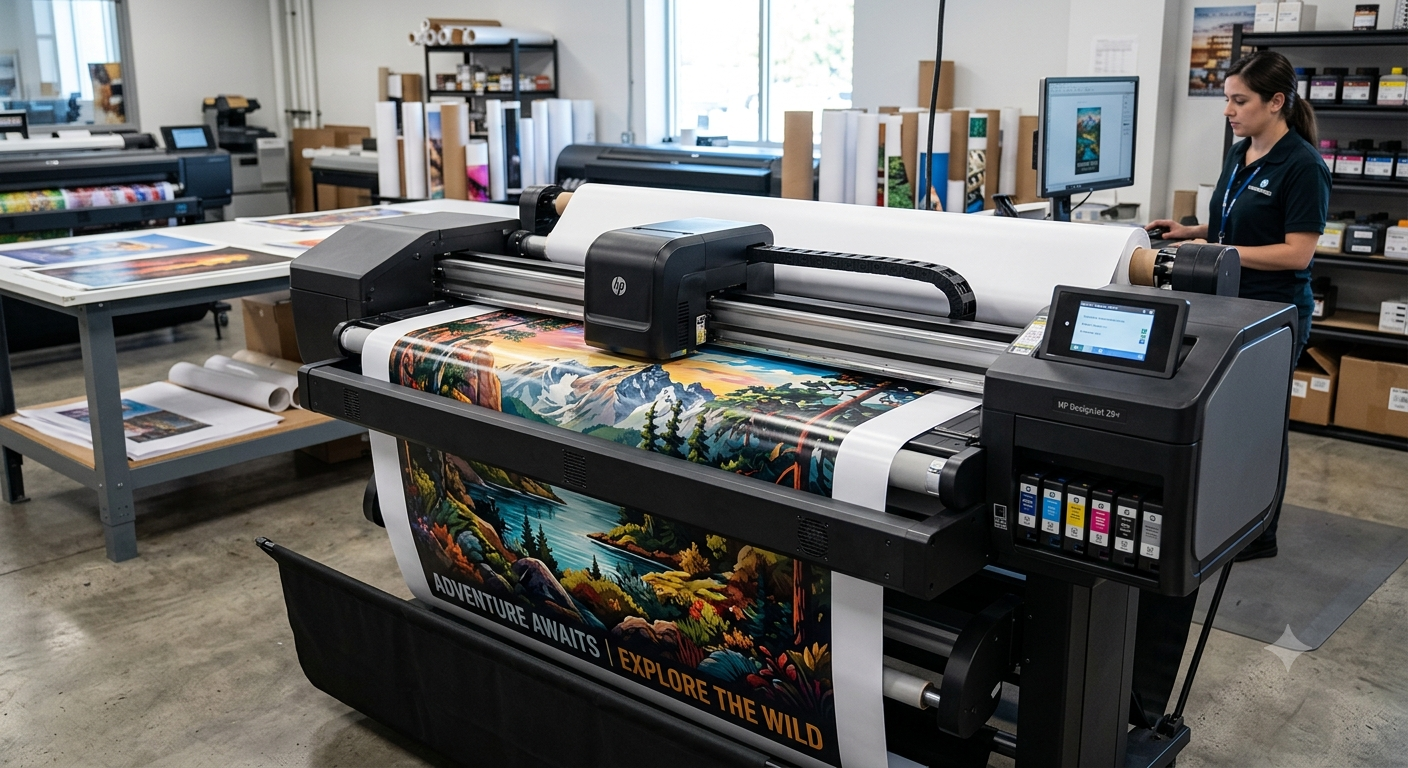
Large format printers are designed to produce high-quality graphics and images on substrates significantly larger than those supported by conventional printers. They are widely used for banners, posters, signage, vehicle wraps, wallpapers, textiles, retail displays, architectural drawings, technical documents, and other applications requiring large-scale output.
The market is segmented by offering, connectivity, printing material, technology, print width, ink type, application, and geography. The offering segment includes printers, RIP software, and after-sales services. Connectivity is categorized into wired and wireless, while printing technologies include ink-based and toner-based solutions.
Ink types include aqueous, solvent, UV-cured, latex, and dye sublimation. Applications include apparel & textile, signage & advertising, décor, and CAD & technical printing.
As businesses increasingly demand short-run production, personalized graphics, faster turnaround, and flexible media compatibility, the role of large format printing is expanding beyond traditional advertising. This diversification is a major factor behind the latest Large Format Printer Market Key Trends.
Digitalization Is Transforming Large Format Printing
One of the most significant Large Format Printer Market Key Trends is the rapid digitalization of printing workflows. Digital printing allows businesses to produce customized graphics with greater flexibility while reducing the need for lengthy setup processes associated with traditional printing techniques.
Digital inkjet systems can support variable designs, short production runs, quick turnaround times, and on-demand printing. These capabilities are particularly valuable for retailers, advertising agencies, textile manufacturers, packaging companies, and print service providers.
The increasing integration of digital workflows with design software, RIP software, cloud connectivity, and automated production systems is further improving productivity. Businesses can manage jobs more efficiently, reduce production delays, and respond rapidly to changing customer requirements.
This shift toward digitally managed production is expected to remain a central component of Large Format Printer Market Key Trends as companies prioritize flexibility and operational efficiency.
Download PDF Brochure @ https://www.marketsandmarkets.com/pdfdownloadNew.asp?id=523
Advanced Ink Technologies Drive Market Growth
Advancements in ink technology are playing an important role in the development of the large format printing industry. UV-cured, latex, solvent, aqueous, and dye-sublimation inks enable printers to serve different substrates and applications.
Among these technologies, UV-cured inks are projected to register the highest CAGR during the forecast period. Their fast-drying properties, durability, and compatibility with diverse substrates make them increasingly attractive for advertising, signage, packaging, and décor applications.
UV-cured printing can deliver vibrant, high-resolution, and scratch-resistant output while supporting efficient production. These capabilities are helping printers expand into applications where durability and visual quality are critical.
The increasing adoption of UV-cured inks is therefore one of the most important Large Format Printer Market Key Trends, particularly as customers seek high-quality output with improved productivity.
Growing Adoption of Sustainable Printing Solutions
Sustainability is becoming an increasingly important consideration in printing. Businesses and consumers are paying greater attention to environmentally responsible inks, energy-efficient equipment, sustainable substrates, and reduced material waste.
The market is witnessing growing adoption of UV, latex, and other sustainable ink solutions. Manufacturers are also investing in energy-efficient printing systems and environmentally friendly packaging.
Sustainable printing technologies can help organizations reduce environmental impact while maintaining print quality and productivity. This is especially relevant for retailers, brands, packaging companies, and advertising agencies that are increasingly incorporating sustainability into their procurement strategies.
Consequently, sustainable inks and energy-efficient systems will remain an important part of Large Format Printer Market Key Trends.
Wireless Connectivity Is Gaining Momentum
Connectivity is another important area of innovation. Although wired connectivity currently dominates the market because of its reliability and compatibility with existing IT infrastructure, wireless connectivity is projected to register the highest CAGR of 5.7% during the forecast period.
Wireless connectivity can provide greater flexibility in print environments and support easier integration with digital workflows. It can be particularly valuable in commercial environments where multiple devices, users, and printing jobs need to be managed efficiently.
As printing environments become increasingly connected, wireless technologies are expected to support more flexible and scalable production workflows. This makes connectivity an increasingly relevant component of Large Format Printer Market Key Trends.
Ink-Based Technology Maintains Market Leadership
Ink-based printing technology is expected to maintain its dominance in the large format printer market. According to MarketsandMarkets, ink-based technology accounted for a 91.5% market share in 2025.
The technology is widely used because of its versatility, high-resolution output, compatibility with different substrates, and suitability for applications ranging from advertising to textiles and décor.
Continuous improvements in printheads, ink formulations, color accuracy, printing speed, and energy efficiency are further strengthening the position of ink-based systems.
The continued development of ink-based platforms will therefore remain a fundamental aspect of Large Format Printer Market Key Trends.
Customization and Personalization Create New Opportunities
Demand for customized products and visual graphics is rapidly expanding across retail, textiles, décor, packaging, and advertising. Consumers increasingly expect personalized products, while brands seek differentiated visual experiences.
Large format printers can support customized wallpapers, banners, apparel, vehicle graphics, retail displays, promotional materials, and packaging. Digital printing enables businesses to produce smaller batches without the limitations associated with conventional mass production.
This flexibility is particularly important for e-commerce and retail companies that need to respond quickly to changing consumer preferences.
The increasing demand for personalized and on-demand printing is consequently one of the strongest Large Format Printer Market Key Trends shaping future applications.
Décor Applications Are Creating New Growth Opportunities
Décor is emerging as a particularly attractive application area. The décor segment is forecast to register the highest CAGR of 12.3% from 2025 to 2030, driven by increasing demand for customized wallpapers, wall graphics, vehicle wraps, canvas art, and interior design solutions.
Large format printers can produce vibrant, detailed, and durable graphics on a broad range of materials. This makes them suitable for residential interiors, commercial buildings, hotels, retail stores, restaurants, and other spaces.
The expansion of digital printing into interior décor demonstrates how the industry is moving beyond conventional signage and advertising. This diversification is expected to create significant opportunities for manufacturers and print service providers.
Expansion Across Textiles and Apparel
Digital textile printing is another major area influencing Large Format Printer Market Key Trends. Textile companies are increasingly using large format printers to produce customized designs, patterns, apparel graphics, and other textile products.
Digital textile printing offers advantages such as shorter production cycles, design flexibility, and support for customized orders. These characteristics are particularly important as fashion brands and retailers respond to rapidly changing consumer preferences.
Growing demand for personalized textiles and promotional materials is therefore expected to support continued adoption of advanced large format printing technologies.
Outdoor Advertising Continues to Support Demand
Despite the growing popularity of digital advertising, physical signage, banners, posters, vehicle graphics, and promotional displays continue to represent important applications for large format printers.
The increase in outdoor advertising and demand for high-impact visual communication is supporting market growth. Large format printers can produce high-resolution graphics across a wide variety of substrates, helping advertisers create visually prominent campaigns.
At the same time, the industry faces competition from digital signage, digital billboards, interactive displays, and other electronic advertising technologies. MarketsandMarkets identifies the preference for digital advertising over conventional advertising techniques as a key challenge for the market.
Automation and Smart Printing Workflows
Automation is becoming increasingly important as print service providers seek to improve production speed and reduce operating costs. Modern large format printing systems can integrate automated media handling, workflow management, color management, and finishing processes.
Automation reduces manual intervention and can improve consistency across high-volume production environments. Combined with cloud-connected workflows and AI-enabled print management, automation can help businesses optimize production schedules and reduce material waste.
The convergence of automation, software, connectivity, and advanced printing hardware is therefore becoming another important element of Large Format Printer Market Key Trends.
Growth of In-Plant Printing
The rising use of large format printers in in-plant operations represents another opportunity. Businesses are increasingly bringing printing activities in-house to improve control over production schedules, reduce outsourcing costs, and accelerate turnaround times.
In-house printing can be particularly beneficial for retailers, manufacturers, advertising organizations, and enterprises that frequently require signage, promotional materials, technical drawings, or visual graphics.
MarketsandMarkets identifies rising use of large format printers in in-plant operations as an important market opportunity.
High Initial Investment Remains a Restraint
Despite technological advancements, the high initial investment required for large format printing equipment remains a significant barrier. Professional-grade systems can require substantial capital expenditure, while specialized substrates, inks, electricity, maintenance, and servicing contribute to ongoing operating costs.
High-resolution and true-color printing can also increase technical and maintenance requirements. Specialized inks designed for durability, UV resistance, and color accuracy can add to operating expenses.
Manufacturers are therefore focusing on developing more affordable systems with advanced features to expand adoption among smaller businesses and emerging markets.
Asia Pacific Emerges as a Fast-Growing Market
Asia Pacific is expected to register the highest CAGR during the forecast period. Growth is being supported by the expansion of advertising, retail, textiles, packaging, e-commerce, and digital signage across the region.
Manufacturers and users in China, Japan, and India are increasingly adopting advanced inkjet, UV, and other printing technologies to meet demand for high-resolution, customized, and environmentally sustainable printing.
Urbanization, e-commerce growth, and increasing investment in visual communication are further supporting market expansion across Asia Pacific.
The region’s growing manufacturing base and expanding consumer markets make it an important geographic focus for future Large Format Printer Market Key Trends.
North America Maintains a Strong Market Position
North America held a 39.3% revenue share of the global large format printer market in 2024, according to MarketsandMarkets. The region benefits from established advertising, retail, commercial printing, and industrial applications.
High adoption of advanced printing technologies and strong demand for customized visual communication continue to support the market.
At the same time, North American businesses are increasingly emphasizing workflow automation, sustainable printing, cloud connectivity, and operational efficiency. These developments are expected to influence the evolution of the regional market.
Recent Technological Developments
Manufacturers are introducing new products and technologies to address changing customer requirements. In September 2026, Canon launched eight new imagePROGRAF TM Series models, including six large-format printers and two large-format multifunction printers. The new models use five-color pigment ink, while two models add built-in large-format scanners for copying and digitizing drawings, posters, and signage.
In November 2025, Epson made its SureColor S7170 64-inch solvent printer available through authorized professional imaging resellers. The printer uses Epson’s latest-generation printhead and targets applications including signs, banners, stickers, and vehicle wraps.
In October 2025, HP launched the DesignJet T870 for architecture, engineering, and construction applications. The 24-inch printer supports multi-size printing and combines pigment-based inks with HP Click Print solutions.
These developments highlight the industry’s emphasis on productivity, multifunctionality, automation, sustainability, and application-specific solutions.
Competitive Landscape
The competitive landscape includes major companies such as HP Development Company, Canon, Seiko Epson, Brother Industries, and Mimaki Engineering. These companies are investing in product innovation, advanced ink technologies, connectivity, automation, and application-specific printing solutions.
HP is identified as a leading player with a strong market share and broad product portfolio. Fujifilm is gaining recognition through advanced printing technologies and specialized solutions.
Competition is increasingly focused on improving print speed, resolution, color accuracy, substrate compatibility, energy efficiency, and total cost of ownership.
Future Outlook for Large Format Printer Market Key Trends
The future of the large format printing industry will be shaped by the convergence of digitalization, automation, AI-enabled workflows, sustainable inks, wireless connectivity, advanced printheads, and customized production.
The market is expected to increasingly move toward connected and intelligent printing environments. Cloud-based workflows can enable centralized job management, while AI-based tools can help optimize production processes, reduce errors, and improve resource utilization.
At the application level, décor, textiles, vehicle wraps, packaging, retail displays, and in-plant printing are expected to provide new opportunities beyond traditional signage and advertising.
As businesses seek faster turnaround, greater customization, improved sustainability, and more flexible production, the Large Format Printer Market Key Trends will increasingly revolve around digital, connected, and efficient printing ecosystems.
Conclusion
The Large Format Printer Market Key Trends demonstrate a clear shift toward advanced digital printing technologies, sustainable solutions, automation, connectivity, and customization. The global market is projected to grow from USD 7.94 billion in 2025 to USD 10.36 billion by 2030, at a CAGR of 5.5%.
Digitalization is enabling faster and more flexible production, while UV-cured and other advanced inks are expanding substrate compatibility and improving print durability. Wireless connectivity, automated workflows, and AI-enabled print management are further transforming the way large format printing is performed.
At the same time, growing applications in décor, textiles, packaging, vehicle wraps, retail, and in-plant printing are opening new revenue opportunities. While high initial investment and competition from digital advertising remain challenges, ongoing technological innovation is strengthening the industry’s long-term growth prospects.
Ultimately, the next phase of the Large Format Printer Market Key Trends will be defined by high-resolution output, smart automation, sustainable printing, personalized production, connected workflows, and advanced ink technologies, positioning large format printing as an increasingly important technology across commercial and industrial applications.
FAQ:
1. What are the key trends in the Large Format Printer Market?
The key trends in the Large Format Printer Market include digitalization, advanced ink technologies, wireless connectivity, automation, sustainable printing, customization, and growing adoption of UV-cured and latex printing technologies.
2. What is driving the growth of the Large Format Printer Market?
Growth is driven by rising demand for high-quality customized printing, digital advertising, textile printing, décor applications, signage, packaging, retail displays, and advancements in inkjet printing technologies.
3. Which printing technology dominates the Large Format Printer Market?
Ink-based printing technology dominates the Large Format Printer Market because of its versatility, high-resolution output, broad substrate compatibility, and suitability for applications such as signage, advertising, textiles, and décor.
4. Which region is expected to grow fastest in the Large Format Printer Market?
Asia Pacific is expected to register the highest growth rate during the forecast period, supported by expanding advertising, retail, textile, packaging, e-commerce, and digital printing industries.
5. What is the future outlook for the Large Format Printer Market?
The Large Format Printer Market is expected to expand as digitalization, automation, AI-enabled workflows, wireless connectivity, sustainable inks, and customized printing gain adoption across commercial and industrial applications.
