The Quantum Computing Market Growth Trends are accelerating as businesses, governments, research institutions, and technology companies invest in next-generation computing capabilities. Quantum computing is moving beyond an experimental research technology toward early commercial applications, with opportunities emerging across healthcare, finance, technology, logistics, energy, chemicals, and defense.
According to MarketsandMarkets, the global quantum computing market was valued at USD 3.52 billion in 2025 and is projected to reach USD 20.20 billion by 2030, expanding at a CAGR of 41.8% from 2025 to 2030. The market is being driven by advances in quantum hardware, cloud-based accessibility, growing investments, increasing enterprise experimentation, and the need to solve complex computational problems that are difficult for classical computing systems.
Among the most important Quantum Computing Market Growth Trends are the increasing adoption of Quantum Computing as a Service (QCaaS), the expansion of cloud-based quantum computing, advances in superconducting qubits and other quantum technologies, and growing applications in optimization, simulation, machine learning, financial modeling, and drug discovery.
Quantum Computing Market Growth Trends Driven by Advanced Computational Requirements
The growing need for computational power is one of the fundamental factors supporting the Quantum Computing Market Growth Trends. Classical computers remain highly effective for many workloads, but some complex optimization, simulation, and modeling problems become increasingly difficult as their scale and complexity increase.
Quantum computers use quantum mechanical principles to process information differently from classical systems. This creates opportunities to address specialized problems involving optimization, molecular simulation, financial modeling, machine learning, logistics, and materials science.
MarketsandMarkets identifies expanding applications across healthcare, finance, materials science, logistics, manufacturing, and energy as an important factor supporting market development.
As organizations evaluate where quantum computing can provide measurable business value, the market is gradually shifting from technology experimentation toward application-specific deployments. This transition is expected to remain a defining characteristic of Quantum Computing Market Growth Trends through 2030.
Market Size and Growth Outlook
The quantum computing market represents one of the fastest-growing segments within advanced computing technologies. MarketsandMarkets estimates that the market will increase from USD 3.52 billion in 2025 to USD 20.20 billion by 2030, representing a 41.8% CAGR.
This rapid growth reflects several converging developments. Technology companies and governments are increasing investment in quantum research and development, while enterprises are exploring quantum applications through cloud-based platforms. At the same time, hardware improvements are helping expand the capabilities of quantum systems.
The combination of hardware innovation, software development, cloud accessibility, and application development is creating an increasingly comprehensive quantum computing ecosystem.
For technology providers, this creates opportunities across quantum processors, application software, consulting, cloud services, development tools, error correction, and hybrid quantum-classical computing.
Quantum Computing as a Service Accelerates Adoption
One of the most significant Quantum Computing Market Growth Trends is the expansion of Quantum Computing as a Service. MarketsandMarkets identifies the services segment as the largest offering segment in the market.
QCaaS enables organizations to access quantum computing resources through cloud platforms without purchasing and maintaining specialized quantum hardware. This lowers the financial and technical barriers associated with experimentation and allows companies to evaluate quantum algorithms using remotely accessible systems.
Cloud access is particularly important because quantum hardware continues to evolve rapidly and typically requires specialized infrastructure. Rather than investing in dedicated systems, enterprises can access multiple quantum devices and simulators through cloud environments.
This model also supports universities, research organizations, software developers, and smaller enterprises that may not have the resources to build their own quantum infrastructure.
As QCaaS platforms become more integrated with conventional cloud and high-performance computing environments, hybrid quantum-classical workloads are expected to become increasingly important.
Cloud-Based Quantum Computing Creates New Opportunities
Cloud deployment is projected to hold the largest share of the quantum computing market during the forecast period. MarketsandMarkets highlights the flexibility of cloud platforms, which allow users to access quantum systems and simulators remotely.
Cloud-based quantum computing is therefore a major component of Quantum Computing Market Growth Trends because it enables organizations to experiment without owning rapidly evolving and highly specialized hardware.
Cloud platforms can also provide access to different quantum architectures, development environments, software libraries, and classical computing resources. This creates an environment where enterprises can compare algorithms and technologies while developing application-specific use cases.
The increasing integration of quantum computing with cloud infrastructure is also encouraging the development of hybrid workflows that combine CPUs, GPUs, high-performance computing, AI, and quantum processors.
Download PDF Brochure @ https://www.marketsandmarkets.com/pdfdownloadNew.asp?id=144888301
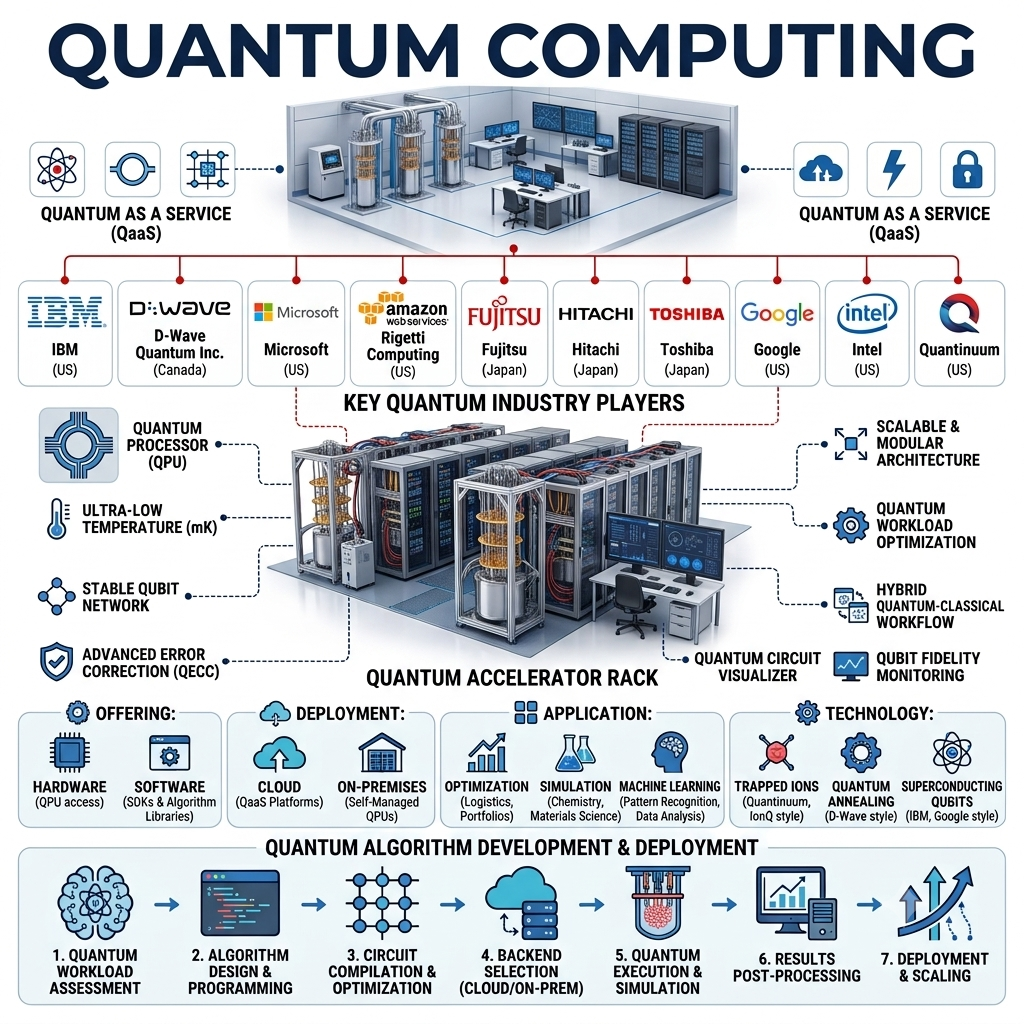
Superconducting Qubits Supporting Hardware Innovation
Hardware innovation remains central to Quantum Computing Market Growth Trends. Among the technologies covered by MarketsandMarkets are superconducting qubits, trapped ions, quantum annealing, photonic networks, topological approaches, and other technologies.
Superconducting qubits currently dominate the market due to their technological maturity, scalability potential, fast gate operations, and compatibility with established cryogenic technologies. Major technology companies are investing significantly in this architecture, helping develop an expanding ecosystem of hardware, software, control systems, and cloud services.
At the same time, competing approaches such as trapped ions, quantum annealing, and photonic technologies continue to attract investment. The coexistence of multiple architectures creates opportunities for specialized applications and technological breakthroughs.
Future competition is likely to focus not only on the number of qubits but also on fidelity, error rates, connectivity, scalability, error correction, energy requirements, and useful computational performance.
Optimization Emerges as a Leading Application
Optimization is expected to account for the largest application segment during the forecast period, making it a major element of Quantum Computing Market Growth Trends. Quantum optimization can be applied to problems where organizations need to identify the best solution among a large number of possible combinations.
Potential applications include portfolio optimization, supply chain planning, transportation routing, production scheduling, resource allocation, logistics, and operations research.
For businesses, the attraction of quantum optimization comes from the possibility of improving decision-making for complex problems involving numerous variables and constraints.
Financial institutions can explore quantum approaches to portfolio construction and risk management, while logistics companies can investigate optimization of transportation networks and delivery routes.
As quantum hardware becomes more capable, optimization is expected to remain one of the most commercially relevant areas for early quantum applications.
Healthcare and Pharmaceuticals Create Significant Opportunities
Healthcare and pharmaceuticals represent one of the most promising areas for Quantum Computing Market Growth Trends. MarketsandMarkets expects the healthcare and pharmaceuticals end-use segment to record the highest CAGR during the forecast period.
Drug discovery is particularly attractive because it involves complex molecular interactions and enormous numbers of potential compounds. Quantum computing can potentially support molecular simulation, drug-target interaction analysis, molecular property prediction, and optimization of candidate compounds.
Traditional drug development can require significant amounts of time and investment. Quantum computing offers the possibility of improving computational approaches used during early-stage research by providing new methods for modeling complex molecular systems.
The opportunity extends beyond pharmaceuticals. Healthcare organizations could potentially use quantum-enhanced optimization for treatment planning, resource allocation, medical scheduling, and complex data analysis.
However, practical quantum advantage for many healthcare workloads remains an area of active research. Near-term opportunities are likely to involve hybrid workflows that combine quantum methods with classical high-performance computing and AI.
Financial Services Remain a Major Market
Banking and finance are expected to represent the largest end-use industry segment in the quantum computing market. This makes financial services one of the most important areas within Quantum Computing Market Growth Trends.
Financial institutions manage highly complex datasets and optimization problems involving risk, pricing, trading, portfolio management, and market behavior.
Quantum computing is being explored for applications including:
- Portfolio optimization
- Risk modeling
- Asset pricing
- Trading strategy optimization
- Fraud detection
- Financial forecasting
- Cybersecurity
- Market instability analysis
Quantum computing can also complement AI and machine learning approaches in financial applications. By combining quantum algorithms with classical AI infrastructure, financial institutions can investigate new approaches to complex analytical workloads.
The growing need for advanced cybersecurity is another important factor. As quantum capabilities advance, financial institutions are also examining quantum-resistant cryptography and secure communication technologies.
Technology Sector Driving Quantum Ecosystem Development
The technology sector plays a central role in Quantum Computing Market Growth Trends because technology companies are developing processors, cloud platforms, software tools, development environments, and quantum services.
Companies including IBM, Amazon Web Services, Microsoft, Rigetti Computing, D-Wave Quantum, Intel, Google, Toshiba, Quantinuum, QC Ware, and IonQ are identified by MarketsandMarkets among the key players in the market.
Competition is expanding beyond hardware performance. Companies are increasingly building broader ecosystems that include cloud access, developer tools, quantum software, partnerships, consulting, and hybrid computing capabilities.
This ecosystem approach is important because the commercialization of quantum computing requires more than quantum processors. Enterprises also need software, algorithms, development tools, technical expertise, cloud infrastructure, and integration with existing computing environments.
AI and Quantum Computing Convergence
The convergence of artificial intelligence and quantum computing is becoming another important Quantum Computing Market Growth Trends. MarketsandMarkets identifies integration with AI as a market driver because quantum computing can potentially support faster data analysis and complex problem-solving.
The future quantum ecosystem is therefore likely to combine quantum processors with classical CPUs, GPUs, AI accelerators, and high-performance computing systems rather than replace conventional computing completely.
Hybrid quantum-classical computing can allow organizations to assign appropriate workloads to different processing technologies. Classical systems can manage conventional tasks while quantum processors are used for specialized calculations.
Recent industry developments demonstrate this direction. In August 2026, Oracle and Quantinuum announced a strategic alliance to integrate Quantinuum’s Helios quantum computer with Oracle Cloud Infrastructure, with plans to support hybrid workloads involving quantum computing, AI, and classical computing across areas such as materials discovery, drug development, logistics, energy, and financial modeling.
Materials Science and Chemicals Offer Emerging Opportunities
Materials science and chemicals are emerging areas of opportunity within Quantum Computing Market Growth Trends because quantum systems are naturally suited to investigating molecular and chemical interactions.
Companies are already exploring quantum computing for chemical reaction optimization and materials development. MarketsandMarkets highlights IBM and Daimler’s collaboration on quantum computing for chemical reactions and reactor design, as well as BASF’s work using quantum techniques alongside classical computing for materials and cheminformatics applications.
Potential applications include battery materials, catalysts, industrial chemicals, advanced materials, and sustainable manufacturing.
The ability to better model molecular structures could eventually help researchers identify promising materials more efficiently. This creates opportunities for chemical companies, automotive manufacturers, semiconductor companies, energy providers, and pharmaceutical organizations.
Quantum Cybersecurity Becomes Increasingly Important
Cybersecurity is another area influencing Quantum Computing Market Growth Trends. As quantum computers become more capable, organizations are increasingly concerned about the ability of future quantum systems to compromise some existing cryptographic approaches.
At the same time, quantum technologies can contribute to new approaches for secure communication and encryption. MarketsandMarkets identifies growing demand for quantum cybersecurity as a driver of market adoption.
Financial institutions, governments, defense organizations, technology companies, and critical infrastructure providers are likely to be particularly important users of quantum-safe security technologies.
The transition toward post-quantum security is expected to occur alongside the development of quantum computing rather than after fully fault-tolerant quantum systems become commercially available.
Asia Pacific to Experience the Fastest Growth
Asia Pacific is expected to be the fastest-growing region in the global quantum computing market. Countries including China, Japan, South Korea, India, and Australia are investing in quantum research, national programs, infrastructure, and industry development.
Government initiatives and public-private partnerships are helping establish quantum research ecosystems across the region. Increasing digital transformation across banking, manufacturing, healthcare, logistics, and energy is also creating potential application opportunities.
India is emerging as an important market within the region. MarketsandMarkets projects India’s quantum computing market to grow from USD 120.8 million in 2025 to USD 922.1 million by 2030, representing a 50.2% CAGR. Healthcare and pharmaceuticals are projected to grow at 53.7% CAGR in India during the same period.
These developments position Asia Pacific as a major growth center for quantum hardware, software, services, research, and enterprise applications.
Investments and Partnerships Accelerate Commercialization
Increasing investment is a major factor behind Quantum Computing Market Growth Trends. Governments and technology companies are funding research programs, hardware development, workforce initiatives, and commercialization efforts.
Partnerships are particularly important because quantum computing requires expertise across multiple disciplines. Hardware developers, cloud providers, software companies, universities, research institutions, and end users can collaborate to accelerate application development.
Recent partnerships illustrate the shift toward industrial-scale quantum infrastructure. Quantinuum and Quanta Computer announced a collaboration in August 2026 focused on infrastructure, systems engineering, manufacturing capabilities, and scalable quantum hardware.
Such partnerships can help address one of the industry’s central requirements: developing a reliable supply chain and scalable infrastructure capable of supporting commercial quantum systems.
High Error Rates and Qubit Instability Remain Challenges
Despite rapid market growth, technical limitations remain a major factor affecting Quantum Computing Market Growth Trends. High error rates and qubit instability can limit the reliability of quantum computations.
Qubits are highly sensitive to environmental interference, which can result in decoherence and computational errors. Building stable systems requires sophisticated error correction, control systems, cryogenic infrastructure, and fault-tolerant architectures.
These technical challenges increase costs and complexity. The industry must therefore make progress in improving qubit fidelity, reducing errors, increasing coherence times, and developing practical error-correction techniques.
Another challenge is the shortage of professionals with expertise spanning quantum physics, computer science, engineering, mathematics, and application development.
Future Outlook for Quantum Computing Market Growth Trends
The future of Quantum Computing Market Growth Trends will depend on the industry’s ability to transition from experimental systems toward scalable and commercially useful quantum computing.
The market is expected to evolve around several interconnected developments. Quantum hardware will continue advancing, while cloud platforms will make quantum resources more accessible. Quantum software will become increasingly focused on industry-specific applications, and hybrid computing architectures will combine quantum processors with AI, GPUs, CPUs, and high-performance computing.
Healthcare and pharmaceuticals could benefit from quantum-enabled molecular simulation and drug discovery. Financial institutions are likely to remain major users of optimization and risk-management applications. Technology companies will continue building quantum hardware, cloud infrastructure, software, and developer ecosystems.
Meanwhile, logistics, energy, chemicals, defense, and manufacturing will create additional application opportunities.
Recent developments suggest that hybrid quantum-classical infrastructure will be particularly important. The integration of quantum processors into cloud and AI data center environments can enable enterprises to experiment with quantum workloads without maintaining specialized infrastructure themselves.
Conclusion
The Quantum Computing Market Growth Trends indicate that quantum computing is moving toward a broader commercial ecosystem supported by hardware innovation, cloud accessibility, software development, AI integration, government investment, and industry partnerships.
The global quantum computing market is projected to grow from USD 3.52 billion in 2025 to USD 20.20 billion by 2030 at a CAGR of 41.8%. Services are expected to hold the largest offering share, cloud-based deployment is projected to lead deployment, optimization is expected to be the largest application, and banking and finance is projected to represent the largest end-use industry. Asia Pacific is expected to be the fastest-growing region.
Healthcare and pharmaceuticals represent a particularly attractive growth opportunity because of the potential for quantum computing to accelerate drug discovery and molecular modeling. Finance remains a major commercial application area through portfolio optimization, risk modeling, trading, and cybersecurity. Technology companies are simultaneously building the hardware, cloud platforms, software, and partnerships required to create a scalable quantum ecosystem.
Ultimately, the strongest Quantum Computing Market Growth Trends will emerge from the convergence of quantum computing with AI, cloud computing, high-performance computing, cybersecurity, and industry-specific software. As technical challenges around qubit stability, error correction, scalability, and cost are addressed, quantum computing is positioned to become an increasingly important component of next-generation computing infrastructure.
Frequently Asked Questions (FAQs)
1. What are the key Quantum Computing Market Growth Trends?
The key Quantum Computing Market Growth Trends include the growing adoption of Quantum Computing as a Service (QCaaS), cloud-based quantum computing, advancements in quantum hardware and qubits, AI and quantum computing integration, optimization applications, and increasing investments in quantum technologies.
2. What is the projected growth of the Quantum Computing Market?
According to MarketsandMarkets, the global quantum computing market is projected to grow from USD 3.52 billion in 2025 to USD 20.20 billion by 2030, registering a CAGR of 41.8% during the forecast period.
3. Which industries are creating opportunities in the quantum computing market?
Healthcare and pharmaceuticals, banking and finance, technology, chemicals, energy, logistics, manufacturing, and defense are creating significant opportunities. Healthcare and pharmaceuticals are expected to experience particularly strong growth due to applications in drug discovery, molecular simulation, and optimization.
4. Which region is expected to grow fastest in the quantum computing market?
Asia Pacific is expected to be the fastest-growing region, supported by increasing government investments, quantum research initiatives, technology development, and growing adoption across industries such as finance, healthcare, manufacturing, and technology.
5. Why is Quantum Computing as a Service important for market growth?
Quantum Computing as a Service allows organizations to access quantum processors and software through cloud platforms without investing heavily in specialized quantum hardware. This lowers adoption barriers and enables enterprises, researchers, and developers to experiment with quantum applications more easily
About MarketsandMarkets™
MarketsandMarkets™ is a blue ocean alternative in growth consulting and program management, leveraging a man-machine offering to drive supernormal growth for progressive organizations in the B2B space. We have the widest lens on emerging technologies, making us proficient in co-creating supernormal growth for clients.
The B2B economy is witnessing the emergence of $25 trillion of new revenue streams that are substituting existing revenue streams in this decade alone. We work with clients on growth programs, helping them monetize this $25 trillion opportunity through our service lines – TAM Expansion, Go-to-Market (GTM) Strategy to Execution, Market Share Gain, Account Enablement, and Thought Leadership Marketing.
Built on the ’GIVE Growth’ principle, we work with several Forbes Global 2000 B2B companies – helping them stay relevant in a disruptive ecosystem. Our insights and strategies are molded by our industry experts, cutting-edge AI-powered Market Intelligence Cloud, and years of research. The KnowledgeStore™ (our Market Intelligence Cloud) integrates our research, facilitates an analysis of interconnections through a set of applications, helping clients look at the entire ecosystem and understand the revenue shifts happening in their industry.
To find out more, visit www.MarketsandMarkets™.com or follow us on Twitter, LinkedIn and Facebook.
Contact:
Mr. Rohan Salgarkar
MarketsandMarkets™ INC.
1615 South Congress Ave.
Suite 103
Delray Beach, FL 33445
USA : 1-888-600-6441
