According to MarketsandMarkets™, the global Bus Duct Market size is projected to grow from USD 14.29 billion in 2026 to USD 19.35 billion by 2031 at a compound annual growth rate (CAGR) of 6.2% during the forecast period.
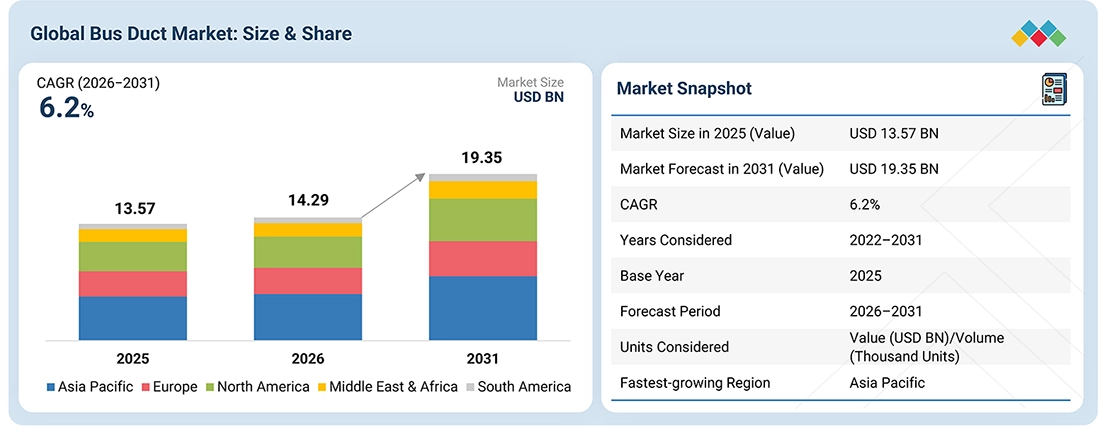
The bus duct market is experiencing steady growth, supported by increasing requirements for high-capacity electrical distribution, space-efficient power transmission, and flexible installation architectures. The growing electrical loads of data centers, industrial production facilities, and large commercial buildings are increasing the importance of bus duct systems for distributing power between transformers, switchgear, and downstream equipment. In addition, the expansion of semiconductor manufacturing, automated production lines, and critical infrastructure is supporting demand for busways capable of accommodating substantial electrical loads within constrained installation spaces.
The market is also being shaped by increasing demand for modular and reconfigurable power distribution systems. The adoption of high-density computing infrastructure is creating additional technical requirements for bus ducts, particularly in terms of current-carrying capacity, thermal performance, short-circuit withstand capability, and flexible tap-off arrangements. Advancements in compact sandwich construction, insulation materials, enclosure engineering, and plug-in distribution designs are, therefore, supporting the development of more adaptable bus duct solutions for data centers, industrial facilities, and commercial power distribution applications.
Download PDF Brochure @ https://www.marketsandmarkets.com/pdfdownloadNew.asp?id=14743619
Copper is expected to maintain the leading position in the bus duct market, by material, throughout the forecast period.
Copper is expected to retain its dominant market position due to its established specification in electrically demanding installations where conductor performance, connection integrity, and long-term operational consistency are critical. Its suitability for compact distribution assemblies and applications involving frequent load fluctuations supports continued preference among engineering contractors and facility designers. In addition, established fabrication practices, standardized connection designs, and familiarity among electrical installation teams reinforce copper’s position in projects where dependable performance and predictable commissioning are prioritized.
The 2,001–5,000 A segment is expected to account for the largest share of the bus duct market, by current rating, over the forecast period.
Bus ducts rated 2,001–5,000 A are suitable for applications requiring high power distribution capacity, including high-rise buildings, large data centers and industrial facilities. These systems support substantial electrical loads while providing reliable power distribution between transformers, switchgear, distribution boards, and major equipment. Increasing investments in data center infrastructure, industrial electrification, and large-scale commercial developments are expected to drive demand for this current rating range. Its suitability for high-capacity power distribution, combined with the need for scalable and space-efficient electrical infrastructure, is expected to sustain its leading position in the bus duct market.
North America is expected to register the second-fastest growth in the global bus duct market during the forecast period.
North America’s growth is supported by substantial investments in AI computing infrastructure, expansion of colocation facilities, and increasing requirements for high-density electrical distribution across data center campuses. The US is expected to remain the principal regional contributor as operators develop facilities requiring scalable power delivery, coordinated electrical layouts, and rapid commissioning. In addition, the modernization of manufacturing facilities, semiconductor fabrication investments, and upgrades to aging commercial electrical infrastructure are creating opportunities for bus duct suppliers. The growing preference for prefabricated electrical systems is further supporting adoption, as contractors seek to reduce on-site installation time, simplify cable routing, and accommodate phased capacity expansion without extensive distribution system redesign.
Make an Inquiry @ https://www.marketsandmarkets.com/Enquiry_Before_BuyingNew.asp?id=14743619
Key Players
Key players in the bus duct market include ABB (Switzerland), Schneider Electric (France), Siemens (Germany), Eaton (Ireland), Legrand (France), Powell Industries (US), Technibus, Inc. (US), NOVOLECS (Canada), Powergear Limited (India), HYOSUNG HEAVY INDUSTRIES (South Korea), LS Corp. (South Korea), and Vertiv Group Corp. (US). These companies are strengthening their market position through product portfolio expansions, technological developments, capacity expansions, strategic partnerships, and geographic expansions.