The global SCADA in Data Center Market Growth is gaining momentum as organizations increasingly invest in intelligent infrastructure management, automation, and real-time monitoring technologies. The rapid expansion of cloud computing, artificial intelligence (AI), hyperscale data centers, and high-performance computing is increasing the complexity of data center operations. As a result, operators are adopting Supervisory Control and Data Acquisition (SCADA) systems to improve operational visibility, optimize energy consumption, enhance equipment reliability, and minimize downtime.
SCADA systems play an important role in monitoring and controlling critical data center infrastructure, including power distribution, cooling systems, environmental conditions, backup power equipment, and connected industrial devices. By integrating hardware, software, sensors, and communication networks, these systems enable centralized supervision and automated responses to operational changes.
According to MarketsandMarkets, The global SCADA in data center market is projected to grow from USD 0.88 billion in 2026 to USD 2.01 billion by 2032, registering a CAGR of 14.7% during the forecast period. Increasing investments in AI-ready data centers, rising energy management requirements, and growing demand for predictive maintenance are among the major factors supporting this expansion.
SCADA in Data Center Market Growth and Industry Outlook
The increasing importance of digital infrastructure is creating new opportunities for SCADA technology providers. Modern data centers require continuous monitoring of electrical systems, cooling infrastructure, environmental conditions, and other mission-critical assets. Even minor equipment failures or operational disruptions can affect service availability and result in significant financial losses.
SCADA platforms provide centralized monitoring capabilities that allow operators to collect real-time operational information, identify abnormalities, and manage infrastructure through automated control systems. These capabilities are becoming increasingly important as data centers expand their computing capacity and support more demanding workloads.
The SCADA in Data Center Market Growth outlook is also influenced by the increasing adoption of integrated infrastructure management platforms. Data center operators are combining SCADA with Data Center Infrastructure Management (DCIM) and Building Management Systems (BMS) to create unified monitoring environments.
These integrated platforms improve coordination between electrical, mechanical, and environmental systems while helping operators make informed operational decisions. As data center infrastructure becomes more distributed and complex, demand for intelligent supervisory control solutions is expected to increase.
Key Factors Driving SCADA in Data Center Market Growth
1. Increasing Deployment of AI and Hyperscale Data Centers
The rapid expansion of artificial intelligence and generative AI applications is creating substantial demand for high-performance computing infrastructure. AI workloads require powerful processors, advanced networking equipment, and high-density server configurations, resulting in increased power consumption and cooling requirements.
Hyperscale data centers are investing in advanced automation technologies to manage these complex environments. SCADA systems enable operators to monitor electrical distribution, cooling equipment, backup power infrastructure, and other essential systems from centralized platforms.
The growing requirement for continuous infrastructure visibility and automated operational control is strengthening the SCADA in Data Center Market Growth outlook. As hyperscale operators expand their facilities, the need for scalable monitoring and supervisory control solutions will continue to rise.
2. Rising Demand for Energy Efficiency and Power Monitoring
Electricity consumption represents a major operational expense for data center operators. Increasing computing workloads and expanding infrastructure capacity are encouraging organizations to implement advanced energy monitoring and optimization technologies.
SCADA systems help monitor power distribution networks, transformers, generators, uninterruptible power supply (UPS) systems, and other electrical assets. Real-time data collection enables operators to identify inefficient energy consumption patterns and respond to equipment abnormalities.
The integration of SCADA with energy management platforms also supports improved power utilization and operational efficiency. Growing emphasis on sustainability, carbon reduction, and efficient electricity consumption is expected to create additional opportunities in the SCADA in Data Center Market.
3. Growing Adoption of Predictive Maintenance
Equipment reliability is essential for maintaining uninterrupted data center operations. Traditional maintenance approaches often depend on scheduled inspections or corrective maintenance after equipment failures.
SCADA platforms are increasingly being integrated with advanced analytics and artificial intelligence to support predictive maintenance. These systems analyze operational information from sensors, controllers, and connected equipment to identify abnormal performance patterns.
By detecting potential equipment problems earlier, operators can reduce unexpected downtime, improve asset utilization, and optimize maintenance schedules. The growing adoption of predictive maintenance is becoming an important contributor to SCADA in Data Center Market Growth.
4. Expansion of Cloud Computing and Edge Infrastructure
The increasing adoption of cloud computing is encouraging service providers to expand their data center networks across multiple geographic locations. Edge data centers are also gaining importance because of rising demand for low-latency computing, connected devices, and real-time data processing.
Managing distributed facilities requires centralized monitoring systems capable of providing operational visibility across multiple locations. Cloud-based and hybrid SCADA deployments allow operators to supervise geographically dispersed infrastructure without requiring extensive on-site intervention.
This trend is creating opportunities for scalable supervisory systems and remote infrastructure management solutions.
Download PDF Brochure @ https://www.marketsandmarkets.com/pdfdownloadNew.asp?id=79684683
Emerging Trends in the SCADA in Data Center Market
Integration of AI and Machine Learning
Artificial intelligence and machine learning are transforming traditional SCADA platforms into intelligent operational management systems. AI-powered analytics can evaluate large volumes of infrastructure data to identify abnormal power consumption, cooling inefficiencies, and equipment performance variations.
Machine learning algorithms can also support predictive maintenance and automated decision-making. These capabilities are particularly valuable in hyperscale facilities where thousands of connected devices generate continuous operational information.
Convergence of SCADA, DCIM, and BMS
The integration of SCADA, DCIM, and BMS platforms is emerging as a major industry trend. Traditionally, data center operators managed power, cooling, and building infrastructure through separate monitoring systems.
Integrated platforms provide a unified view of infrastructure performance and enable better coordination between different operational functions. This convergence reduces information silos, improves monitoring efficiency, and supports faster responses to operational issues.
Adoption of Digital Twin Technology
Digital twin technology is creating new opportunities for advanced data center monitoring. Digital twins use real-time operational data to create virtual representations of physical infrastructure.
When integrated with SCADA systems, digital twins can help operators analyze power distribution, cooling performance, airflow patterns, and equipment utilization. These capabilities support simulation-based planning, operational optimization, and infrastructure performance improvements.
Increasing Focus on Operational Technology Cybersecurity
As SCADA systems become more connected to enterprise networks and cloud environments, cybersecurity is becoming an important purchasing consideration.
Data center operators are investing in secure communication protocols, network segmentation, access management, and threat monitoring to protect critical operational infrastructure. The growing importance of operational technology (OT) cybersecurity is influencing product development and procurement strategies across the market.
SCADA in Data Center Market Segmentation Analysis
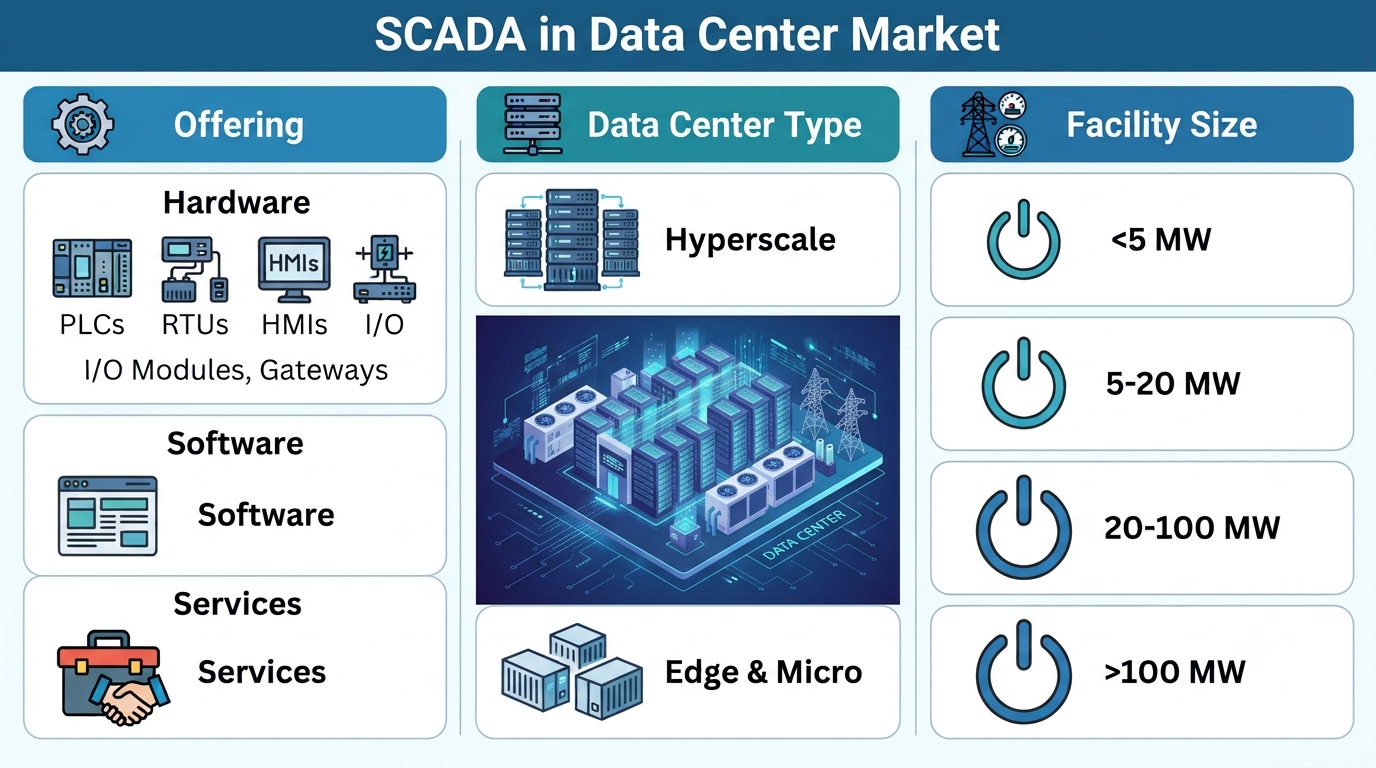
The SCADA in data center market is segmented by component, deployment mode, data center type, application, and end user. Each segment addresses specific operational requirements associated with monitoring, automation, and infrastructure management.
Application Areas Driving SCADA in Data Center Market Growth
Power Monitoring and Energy Management
Power monitoring is one of the most important applications of SCADA technology in data centers. Operators require continuous visibility into electrical distribution, UPS systems, generators, and power consumption.
SCADA platforms help identify electrical abnormalities, monitor equipment performance, and improve energy management. Increasing electricity requirements associated with AI workloads are creating additional demand for intelligent power monitoring.
Cooling and HVAC Management
Cooling systems are essential for maintaining appropriate operating temperatures in data centers. High-density computing and AI infrastructure are increasing thermal management requirements.
SCADA solutions help monitor chillers, pumps, cooling towers, air handling units, and other HVAC equipment. Integration with intelligent control systems enables operators to optimize cooling performance and improve energy efficiency.
Predictive Maintenance and Asset Monitoring
Data center operators are increasingly using SCADA systems to monitor equipment conditions and identify potential operational problems. Sensors and connected devices provide real-time information about equipment performance, allowing maintenance teams to respond proactively.
This application is becoming increasingly important as operators seek to minimize downtime and extend the operational life of critical infrastructure.
Environmental and Security Monitoring
Environmental monitoring enables operators to track temperature, humidity, air quality, and other conditions that influence data center performance. SCADA integration also supports centralized visibility into selected security and safety systems, depending on the facility architecture.
Regional Outlook of the SCADA in Data Center Market
North America
North America represents a leading regional market for SCADA in data centers, supported by the strong presence of hyperscale cloud providers, advanced digital infrastructure, and established industrial automation capabilities.
The United States is a major contributor because of increasing investments in AI-ready data centers, cloud infrastructure, and advanced power management technologies. Data center operators are adopting integrated SCADA and DCIM platforms to improve operational efficiency and maintain infrastructure reliability.
Asia Pacific
Asia Pacific is emerging as a significant growth region for the SCADA in Data Center Market. Rapid digitalization, increasing cloud adoption, expanding internet usage, and investments in hyperscale infrastructure are supporting regional demand.
China, India, Japan, Singapore, and South Korea are important markets for data center development. Growing investments in AI computing, edge infrastructure, and digital transformation initiatives are creating opportunities for SCADA technology providers.
Europe
Europe is witnessing increasing adoption of intelligent infrastructure management solutions as operators prioritize energy efficiency, sustainability, and operational reliability.
Countries such as Germany, the United Kingdom, and France are investing in advanced data center technologies. Regulatory requirements and sustainability objectives are encouraging organizations to adopt sophisticated monitoring and energy optimization systems.
Rest of the World
The Middle East, Latin America, and other developing markets are creating additional opportunities through investments in cloud computing, digital infrastructure, and enterprise modernization. Government-backed digital transformation initiatives and expanding data center capacity are supporting the adoption of advanced supervisory control technologies.
Competitive Landscape and Key Companies
The competitive landscape of the SCADA in Data Center Market is characterized by technological innovation, strategic partnerships, integrated automation solutions, and investments in intelligent infrastructure management.
Major companies operating in the market include:
- Schneider Electric
- Siemens
- ABB
- Honeywell
- Emerson Electric
- Vertiv
- Eaton
- Johnson Controls
- Rockwell Automation
- Delta Electronics
These companies are focusing on integrated monitoring platforms, intelligent power management, predictive analytics, and advanced cooling control solutions.
Schneider Electric and Siemens are strengthening their automation and infrastructure management portfolios. ABB and Emerson are focusing on industrial control and monitoring technologies, while Vertiv is expanding its offerings for AI-ready data center infrastructure.
The increasing integration of SCADA with DCIM, BMS, and energy management platforms is expected to remain an important competitive strategy.
Challenges and Opportunities in the SCADA in Data Center Market
Despite favorable growth prospects, the market faces several challenges that can influence adoption.
High implementation costs: Deploying SCADA infrastructure can require substantial investment in controllers, sensors, communication networks, software, and system integration.
Integration complexity: Existing data centers often operate equipment from multiple manufacturers. Integrating legacy infrastructure with modern supervisory platforms can create technical difficulties.
Cybersecurity risks: Increasing connectivity between operational technology and enterprise networks creates additional cybersecurity requirements.
Shortage of skilled professionals: Organizations require trained professionals with expertise in industrial automation, networking, data center operations, and cybersecurity.
However, these challenges are creating opportunities for technology providers. Cloud-based SCADA platforms, AI-enabled predictive maintenance, digital twins, and integrated infrastructure monitoring are opening new avenues for innovation.
The expansion of edge computing and modular data centers is also creating demand for scalable supervisory systems that can operate across distributed infrastructure environments.
Future Prospects of SCADA in Data Center Market Growth
The future of SCADA in Data Center Market Growth will be shaped by increasing automation, artificial intelligence, energy optimization, and the expansion of high-performance computing infrastructure.
As AI workloads become more demanding, data center operators will require advanced supervisory platforms capable of monitoring power consumption, cooling performance, environmental conditions, and equipment reliability in real time.
The integration of SCADA with DCIM, BMS, digital twins, and predictive analytics will create more intelligent infrastructure management environments. Cloud-based and hybrid solutions will also support centralized supervision across geographically distributed data centers.
Asia Pacific is expected to offer significant growth opportunities as countries continue investing in hyperscale facilities, cloud infrastructure, and AI computing capabilities. Meanwhile, North America and Europe will remain important markets for advanced automation and infrastructure modernization.
FAQs
Q1. What is the projected size of the SCADA in Data Center Market by 2032?
The SCADA in Data Center Market is projected to grow from USD 3.90 billion in 2025 to USD 9.13 billion by 2032, registering a CAGR of 12.9%.
Q2. What are the key factors driving SCADA in Data Center Market Growth?
The market is driven by increasing investments in hyperscale data centers, rising AI workloads, growing demand for real-time infrastructure monitoring, energy efficiency requirements, and the adoption of predictive maintenance technologies.
Q3. What are the major components of SCADA systems used in data centers?
The major components include hardware, software, and services. Hardware includes PLCs, RTUs, sensors, meters, and communication devices, while software supports monitoring, visualization, analytics, and supervisory control.
Q4. Which data center types are adopting SCADA systems?
Hyperscale, colocation, enterprise, and edge data centers are adopting SCADA systems to monitor power distribution, cooling infrastructure, environmental conditions, and critical equipment performance.
Q5. Who are the key players in the SCADA in Data Center Market?
Major players include Schneider Electric, Siemens, ABB, Honeywell, Emerson Electric, Vertiv, Eaton, Johnson Controls, Rockwell Automation, and Delta Electronics.
About MarketsandMarkets™
MarketsandMarkets™ has been recognized as one of America’s Best Management Consulting Firms by Forbes, as per their recent report.
MarketsandMarkets™ is a blue ocean alternative in growth consulting and program management, leveraging a man-machine offering to drive supernormal growth for progressive organizations in the B2B space. With the widest lens on emerging technologies, we are proficient in co-creating supernormal growth for clients across the globe.
Today, 80% of Fortune 2000 companies rely on MarketsandMarkets, and 90 of the top 100 companies in each sector trust us to accelerate their revenue growth. With a global clientele of over 13,000 organizations, we help businesses thrive in a disruptive ecosystem.
The B2B economy is witnessing the emergence of $25 trillion in new revenue streams that are replacing existing ones within this decade. We work with clients on growth programs, helping them monetize this $25 trillion opportunity through our service lines – TAM Expansion, Go-to-Market (GTM) Strategy to Execution, Market Share Gain, Account Enablement, and Thought Leadership Marketing.
Built on the ‘GIVE Growth’ principle, we collaborate with several Forbes Global 2000 B2B companies to keep them future-ready. Our insights and strategies are powered by industry experts, cutting-edge AI, and our Market Intelligence Cloud, KnowledgeStore™, which integrates research and provides ecosystem-wide visibility into revenue shifts.
To find out more, visit www.MarketsandMarkets™.com or follow us on Twitter , LinkedIn and Facebook .
Contact:
Mr. Rohan Salgarkar
MarketsandMarkets™ INC.
1615 South Congress Ave.
Suite 103, Delray Beach, FL 33445
USA: +1-888-600-6441
