Actuators are becoming increasingly important across industrial automation, robotics, automotive systems, aerospace applications, energy infrastructure, and advanced manufacturing. These components convert electrical, hydraulic, or pneumatic energy into controlled mechanical movement, enabling machines and equipment to perform precise operations. The growing focus on automation, operational efficiency, electrification, and intelligent control is changing how actuator technologies are designed and deployed. As industries modernize their production environments, demand is increasingly shifting toward compact, efficient, reliable, and digitally connected actuation solutions. These developments are also influencing the strategies adopted by Actuators Market Companies as they strengthen their technology portfolios and expand their presence across application areas.
The competitive environment includes manufacturers offering electric, hydraulic, pneumatic, linear, and rotary actuator technologies. Companies compete through product development, application expertise, geographic expansion, partnerships, acquisitions, and investments in digital technologies. The referenced industry analysis identifies electric actuation, robotics, industrial automation, vehicle equipment, and smart manufacturing as important areas shaping demand. It also highlights the increasing integration of sensors, controllers, and connectivity into actuator systems.
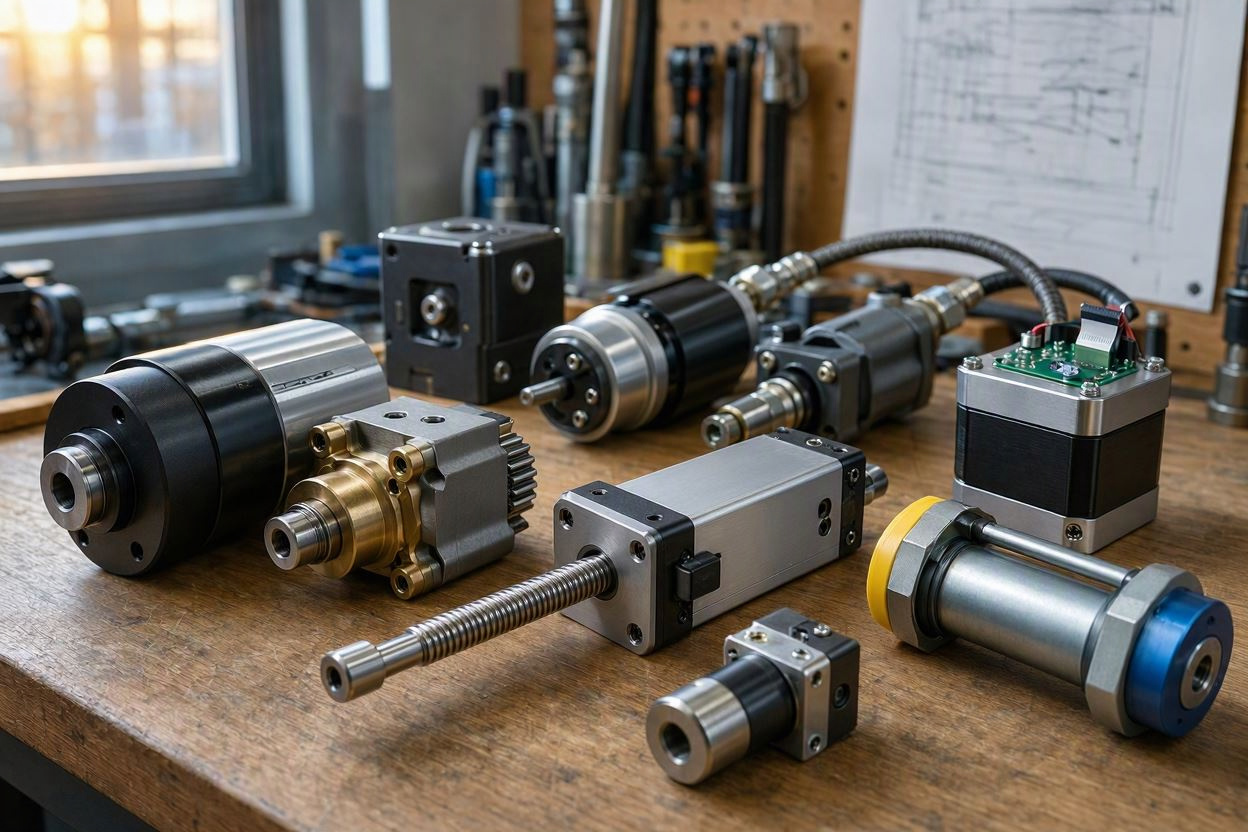
Competitive Landscape Is Driven by Technology
Competition within the actuators industry is increasingly centered on the ability to deliver precise motion while improving energy efficiency, reliability, and system intelligence. Traditional actuator technologies remain important in applications where high force, ruggedness, or established infrastructure is required. At the same time, electric actuation is gaining attention because it can provide precise control, lower maintenance requirements, and easier integration with digital control systems. This technology transition is encouraging manufacturers to develop products that can communicate with broader automation architectures.
Actuators Market Companies are also differentiating themselves through application specific engineering. Industrial customers increasingly require actuator solutions designed around particular loads, operating environments, duty cycles, temperature conditions, and control requirements. Instead of competing only on individual component specifications, suppliers are increasingly providing integrated motion solutions that combine actuation, sensing, control, and monitoring capabilities. This approach allows manufacturers to address more complex automation requirements and develop longer term relationships with industrial customers.
According to Marketsandmarkets, the global actuators market size was valued at USD 71.22 billion in 2025 and is projected to reach USD 100.41 billion by 2030, growing at a CAGR of 7.1% from 2025 to 2030.
Download PDF Brochure @ https://www.marketsandmarkets.com/pdfdownloadNew.asp?id=59465451
Product Innovation Shapes Market Competition
Product innovation remains one of the central strategies used by manufacturers in the actuators industry. Modern actuator development focuses on improving positioning accuracy, response time, durability, energy consumption, compactness, and connectivity. Electric actuators are particularly relevant to this transition because their control characteristics make them suitable for digitally managed production environments. Sensors and embedded controllers can also provide information about position, force, temperature, vibration, and operating conditions.
The growing adoption of smart manufacturing is creating additional opportunities for actuator manufacturers. Connected actuators can provide operational information to control platforms, allowing industrial users to monitor equipment performance and identify potential maintenance requirements. These capabilities can help reduce unexpected downtime and improve equipment utilization. As industrial automation becomes more data driven, Actuators Market Companies are increasingly incorporating intelligence into products rather than treating actuators solely as mechanical motion components.
Mergers and Acquisitions Support Portfolio Expansion
Mergers and acquisitions can provide manufacturers with access to complementary technologies, engineering capabilities, customer relationships, manufacturing capacity, and geographic markets. In the actuator industry, inorganic expansion can be particularly useful when companies want to strengthen capabilities in precision motion, electric actuation, automation, robotics, or specialized industrial applications. Acquisitions can also shorten the time required to develop technologies internally and provide access to established expertise.
The broader competitive environment indicates that companies use both organic and inorganic strategies to strengthen their positions. Partnerships and investments are also important because actuator technologies increasingly intersect with industrial automation, robotics, electronics, software, and intelligent control systems.
Common strategic objectives behind mergers, acquisitions, and partnerships include:
- Expanding electric actuation capabilities and digital motion control expertise.
- Adding specialized linear or rotary actuator technologies to existing portfolios.
- Entering new industrial and geographic markets.
- Strengthening robotics and industrial automation capabilities.
- Increasing access to engineering talent, intellectual property, and application expertise.
Strategic Partnerships Expand Technology Ecosystems
Partnerships are becoming an important competitive tool because actuator systems increasingly operate as part of interconnected automation environments. A manufacturer may collaborate with automation technology providers, robotics developers, machine builders, system integrators, or industrial software companies to create more complete solutions. Such relationships can help manufacturers address customer requirements that extend beyond the actuator itself.
Strategic collaboration can also accelerate product development. Joint development programs allow participants to combine mechanical engineering expertise with electronics, software, sensing, and control capabilities. This becomes increasingly important as customers seek actuator systems capable of supporting predictive maintenance, remote monitoring, advanced diagnostics, and automated control. Consequently, Actuators Market Companies are increasingly competing through ecosystem participation rather than relying exclusively on standalone product sales.
Electric Actuation Changes Competitive Priorities
Electric actuation is becoming increasingly important because industries are looking for precise and controllable motion systems with strong integration capabilities. Electric actuators can be connected with electronic control architectures and can support highly programmable movement. This makes them suitable for robotics, automated machinery, vehicle systems, manufacturing equipment, and other applications requiring accurate positioning.
The transition toward electrification is also influencing actuator development in transportation and industrial applications. Vehicle manufacturers are increasingly incorporating electronic systems for steering, braking, thermal management, seating, doors, and other functions. Industrial equipment manufacturers are similarly evaluating electric alternatives where energy efficiency, controllability, and digital integration are important. This shift is creating opportunities for Actuators Market Companies that can provide reliable electric solutions across demanding operating environments.
Robotics Creates New Opportunities
Robotics is another major area influencing actuator competition. Robots require multiple controlled movements across joints, arms, end effectors, and positioning mechanisms. These applications require actuators capable of delivering accurate movement, repeatability, appropriate torque or force, and reliable operation over extended duty cycles. As robotics expands across manufacturing, logistics, healthcare, and other sectors, actuator suppliers are adapting products to increasingly specialized motion requirements.
Industrial robotics also increases the importance of compact and intelligent actuator designs. Space limitations within robotic systems can require high performance from relatively small components. At the same time, robots increasingly operate within connected production environments where motion data can be monitored and analyzed. This creates opportunities for manufacturers to combine mechanical performance with sensing and connectivity. The MarketsandMarkets analysis identifies robotics as an important application area for actuator demand.
Automotive Applications Strengthen Demand
Automotive systems represent an important application environment for actuator technologies. Actuators are used in vehicle functions involving steering, braking, throttle control, thermal management, seating, doors, and other mechanical or electronically controlled operations. The transition toward electric and increasingly automated vehicles is changing the requirements for these components, with greater emphasis on precision, reliability, response time, and electronic control.
Vehicle electrification can also create opportunities for new actuator architectures. As mechanical systems are increasingly replaced or supplemented by electronically controlled systems, actuator manufacturers need to address changing power requirements, packaging constraints, safety expectations, and communication interfaces. The automotive transition therefore creates a competitive environment in which product reliability and engineering capabilities are increasingly important.
Industrial Automation Supports Product Differentiation
Industrial automation remains one of the most important environments for actuator deployment. Manufacturing facilities use actuators for material handling, valve control, machine positioning, assembly, packaging, process control, and numerous other operations. Increasing automation requires motion components that can operate accurately and reliably while supporting higher production efficiency.
Smart factories are also changing customer expectations. Industrial users increasingly want equipment that can provide real time information about operating conditions and maintenance requirements. Actuator manufacturers are therefore incorporating sensors and communication capabilities into products to support connected automation architectures. This trend encourages Actuators Market Companies to invest in software compatibility, digital interfaces, diagnostics, and intelligent motion control alongside mechanical engineering.
Linear and Rotary Actuators Serve Different Needs
Linear and rotary actuators address different movement requirements and therefore create distinct competitive opportunities. Linear actuators are designed to generate movement along a straight path and are widely used for positioning, lifting, pressing, opening, closing, and material handling. Their versatility makes them relevant across industrial machinery, automotive systems, medical equipment, robotics, and other applications.
Rotary actuators provide rotational movement and are commonly used in valves, robotic joints, machine mechanisms, and automated positioning systems. The choice between linear and rotary technology depends on application requirements such as available space, required force or torque, speed, accuracy, duty cycle, and environmental conditions. Manufacturers therefore compete by offering broad portfolios capable of addressing different motion requirements.
Digitalization Is Reshaping Competitive Strategies
Digitalization is changing how actuator products are developed and managed. Sensors can capture information about movement, temperature, force, vibration, and operating conditions. Controllers can process this information and adjust actuator behavior according to programmed requirements. Connectivity can then allow equipment information to be integrated into broader industrial monitoring platforms.
This development creates opportunities for predictive maintenance and condition based monitoring. Instead of relying exclusively on fixed maintenance schedules, industrial operators can use equipment information to identify abnormal behavior and plan service activities. The integration of sensors, controllers, and connectivity into actuators is identified as an important technological driver in the referenced industry analysis.
Regional Competition Remains Diverse
The global actuator industry includes manufacturers serving different regional requirements and industrial ecosystems. Asia Pacific has strong demand because of its manufacturing base, automotive production, electronics industry, robotics adoption, and increasing automation. These conditions support significant opportunities for actuator suppliers across both established and emerging applications.
North America and Europe also provide important opportunities through aerospace, automotive, industrial automation, energy, advanced manufacturing, and process industries. Regional requirements can differ considerably depending on industrial standards, automation maturity, infrastructure, and customer preferences. Actuators Market Companies therefore need localized distribution, engineering support, application expertise, and after sales capabilities to compete effectively across international markets.
Customer Requirements Influence Competition
Industrial customers increasingly evaluate actuator suppliers based on more than product price. Reliability, lifecycle performance, service support, integration capabilities, customization, delivery reliability, and technical assistance can influence purchasing decisions. Customers operating critical infrastructure may also place significant emphasis on product certification, safety, environmental performance, and long term component availability.
This creates opportunities for manufacturers with strong application engineering capabilities. A supplier that understands the customer’s machinery and operating environment can develop actuator solutions tailored to specific requirements. Such customization can become an important competitive differentiator, particularly in aerospace, energy, industrial automation, transportation, and other demanding applications.
Sustainability Encourages Efficient Actuation
Energy efficiency is becoming increasingly relevant to actuator development as industries seek to reduce operating costs and improve environmental performance. Electric actuation can provide precise control that helps reduce unnecessary energy consumption in suitable applications. Manufacturers are also examining product designs that improve efficiency, service life, and maintainability.
Hydraulic and pneumatic systems remain valuable where high force, speed, durability, or specific operating characteristics are required. However, leakage, compressed air losses, fluid management, and maintenance requirements can influence technology selection. The industry analysis identifies leakage issues in pneumatic and hydraulic systems as an important challenge while also highlighting the shift toward electric actuation.
Key Challenges Affecting Manufacturers
The actuator industry faces several challenges despite strong demand from automation and electrification. Replacing existing systems can require significant investment, engineering work, downtime, and workforce training. This creates switching barriers, particularly in capital intensive industries where production interruptions can be costly.
Smart actuators also introduce cybersecurity and functional safety considerations. Once actuators become connected components within industrial networks, manufacturers must address communication security, software reliability, data integrity, and safe system behavior. These requirements increase development complexity and require collaboration between mechanical, electrical, software, and control engineering teams.
Competitive Strategies Continue to Evolve
Actuators Market Companies are increasingly combining product innovation with application expertise, partnerships, geographic expansion, and selective acquisitions. The objective is to create broader technology portfolios that address changing customer requirements across automation, robotics, transportation, energy, and manufacturing. Companies with capabilities across multiple actuator technologies can serve a wider range of applications and respond more flexibly to technology transitions.
Another important strategy is investment in research and development. Advanced actuator systems require improvements in materials, motors, electronics, sensors, controllers, software, and mechanical structures. Continuous innovation enables manufacturers to address requirements for higher precision, smaller form factors, improved efficiency, greater durability, and digital connectivity. This makes research and engineering capabilities important elements of competitive positioning.
Future Direction of the Competitive Landscape
The competitive landscape is expected to continue evolving as automation, robotics, electrification, and intelligent manufacturing become increasingly interconnected. Actuator manufacturers will likely focus on technologies that combine mechanical movement with sensing, control, connectivity, and diagnostics. The distinction between an actuator and a broader motion control system is therefore becoming less pronounced.
Mergers, acquisitions, partnerships, and technology investments can remain important mechanisms for strengthening capabilities. Companies may seek complementary technologies that improve their ability to address electric motion, robotics, smart manufacturing, and specialized industrial applications. At the same time, customers will continue to evaluate suppliers based on reliability, engineering support, lifecycle performance, and integration capabilities.
Conclusion
The competitive landscape for actuators is being shaped by industrial automation, electrification, robotics, smart manufacturing, and digital transformation. Manufacturers are expanding beyond conventional mechanical actuation toward connected systems that combine motion control, sensing, diagnostics, and intelligent operation. Electric actuation is receiving increasing attention because of its precision, efficiency, and compatibility with digital automation architectures.
Mergers and acquisitions, partnerships, product development, and regional expansion are important strategic approaches within this evolving environment. Actuators Market Companies that address application specific requirements while improving reliability, efficiency, connectivity, and lifecycle performance can strengthen their relationships with industrial customers. The ongoing transformation of manufacturing, transportation, robotics, and energy systems will continue to influence how actuator technologies are developed, integrated, and supplied across global industries.
FAQs
What are the major factors shaping the actuators industry?
Increasing industrial automation, robotics adoption, vehicle electrification, smart manufacturing, and demand for precise motion control are major factors shaping the industry. Integration of sensors, controllers, and connectivity is also influencing actuator development.
Why is electric actuation becoming important?
Electric actuation provides precise control, efficient operation, low maintenance requirements, and compatibility with digital control systems. These characteristics make it suitable for automation, robotics, automotive systems, and other applications requiring accurate programmable movement.
How are mergers and acquisitions affecting actuator companies?
Mergers and acquisitions can help manufacturers obtain complementary technologies, engineering capabilities, intellectual property, customer relationships, and geographic reach. They can also accelerate entry into growing application areas such as electric actuation, robotics, and intelligent motion control.
What role does robotics play in actuator demand?
Robotics requires accurate and reliable movement across multiple axes and mechanical functions. The increasing adoption of robots in manufacturing and other industries is therefore creating demand for compact, precise, durable, and increasingly intelligent actuator systems.
What are the major types of actuators?
The major actuator categories include electric, hydraulic, and pneumatic technologies. Actuators can also be classified as linear or rotary depending on the type of movement they generate. The appropriate technology depends on factors such as force, speed, precision, environment, control requirements, and application design.
How is digitalization changing actuator technology?
Digitalization is enabling actuators to incorporate sensors, controllers, communication capabilities, and diagnostic functions. These features can support real time monitoring, predictive maintenance, improved control, and integration with industrial automation platforms.
What challenges affect actuator manufacturers?
Important challenges include high switching costs in capital intensive industries, leakage in hydraulic and pneumatic systems, integration complexity, cybersecurity requirements, functional safety considerations, and the need to continuously improve product performance.
Which applications use actuators extensively?
Actuators are widely used in industrial automation, robotics, vehicle equipment, aerospace, energy, manufacturing, process industries, and other applications requiring controlled mechanical movement.
