The global AI-powered drones market is entering a new phase of expansion as artificial intelligence, autonomous navigation, computer vision, edge computing, and advanced sensing technologies transform conventional unmanned aerial systems into intelligent operational platforms. Drones are increasingly moving beyond remotely controlled aerial photography and surveillance to perform data collection, inspection, monitoring, mapping, and decision-making with significantly less human intervention.
The global AI-powered drones market was valued at approximately USD 16.5 billion in 2025 and is projected to reach USD 56.0 billion by 2032, expanding at a compound annual growth rate (CAGR) of around 19.0% between 2026 and 2032 The market’s growth reflects increasing investment in autonomous systems, the development of edge-AI hardware, regulatory progress toward beyond-visual-line-of-sight (BVLOS) operations, and expanding commercial and defense applications.
AI Is Redefining Drone Capabilities
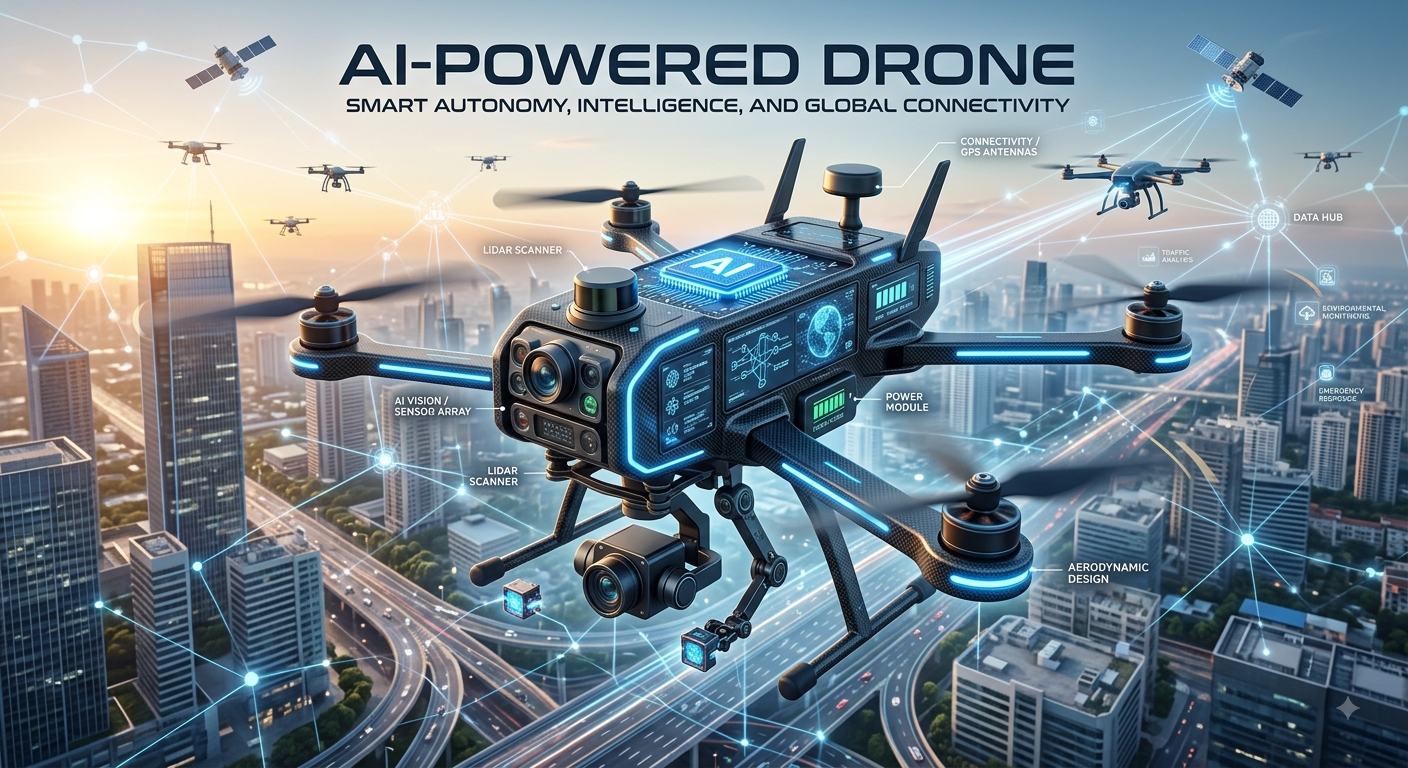
Traditional drones primarily rely on human operators to control flight and interpret captured information. AI-powered drones introduce a fundamentally different operating model. By combining onboard processors with computer vision, machine learning, sensor fusion, and autonomous navigation, drones can interpret their surroundings and respond to changing conditions with limited human intervention.
These capabilities allow drones to identify objects, recognize anomalies, navigate complex environments, analyze images, and generate actionable information in real time. This shift is particularly valuable in applications where large areas must be monitored frequently or where sending people into hazardous environments presents safety and cost challenges.
MarketsandMarkets identifies AI-powered drones as part of a broader convergence between autonomous systems, digital transformation, intelligent data capture, edge AI, and robotics.
Download PDF Brochure @ https://www.marketsandmarkets.com/pdfdownloadNew.asp?id=153952457
Automation Becomes a Major Market Driver
The growing demand for automation is one of the strongest forces supporting the AI-powered drones market. Industries including agriculture, construction, energy, logistics, and infrastructure are under increasing pressure to collect more data while controlling labor and operating costs.
AI-powered drones can automate repetitive inspection and monitoring activities. Instead of requiring personnel to manually survey large areas, autonomous systems can follow predetermined routes, capture data, identify irregularities, and transmit results to centralized platforms.
This capability is particularly valuable for organizations managing geographically dispersed assets. Powerlines, pipelines, wind farms, solar installations, construction sites, and agricultural fields can require frequent inspections that are time-consuming when performed manually. AI-powered drones can make these processes more consistent and scalable.
Autonomous Navigation Leads Technological Development
AI-based autonomous navigation is emerging as a foundational technology within the market. Reliable navigation is essential for drones operating with limited or no direct human control.
Advanced navigation systems can combine GPS, cameras, lidar, inertial measurement units, and other sensors to help drones understand their surroundings and plan routes. This is particularly important for operations in environments where GPS signals may be weak or unavailable.
MarketsandMarkets identifies AI-based autonomous navigation as the dominant technology segment, while AI-based imaging and computer vision represent one of the fastest-growing areas.
As onboard computing becomes more powerful, increasingly sophisticated AI models can be processed directly on drones rather than requiring continuous communication with cloud servers. This can reduce latency and enable faster responses during time-sensitive missions.
Computer Vision Expands Use Cases
AI-powered computer vision is changing drones from aerial cameras into intelligent inspection tools. Instead of simply recording images, drones can analyze visual information and identify specific conditions.
In agriculture, AI-enabled imaging can help detect crop stress, pest pressure, irrigation issues, and other indicators of plant health. In infrastructure inspection, computer vision can identify potential defects in power infrastructure, pipelines, buildings, and industrial equipment.
The defense and public-safety sectors can also use computer vision for object recognition, surveillance, threat identification, and situational awareness. As AI models become more efficient, more image-processing tasks can be performed onboard, expanding the range of applications that require real-time analysis.
Defense and Public Safety Remain Important Applications
Defense and public safety continue to represent significant demand pools for AI-powered drones. Modern defense organizations are investing in autonomous and semi-autonomous unmanned systems for reconnaissance, surveillance, target detection, and counter-drone operations.
The growing emphasis on autonomous capabilities reflects the need to gather intelligence while reducing risks to personnel. AI can allow unmanned systems to process information more rapidly and operate in environments where continuous manual control may be difficult.
Public safety agencies are also exploring autonomous drones for search and rescue, emergency response, disaster assessment, and tactical operations. In these scenarios, autonomous flight and intelligent image analysis can help responders obtain information quickly while keeping personnel away from hazardous locations.
Logistics and Drone Delivery Move Toward Commercial Scale
Logistics and delivery are becoming increasingly important growth areas. Drone delivery has progressed from isolated pilot programs toward broader commercial deployments, particularly as regulators and operators work toward expanding BVLOS operations.
AI can improve delivery operations by supporting route planning, obstacle avoidance, navigation, fleet coordination, and automated mission management. These capabilities could allow operators to supervise larger fleets without requiring one pilot for every individual aircraft.
MarketsandMarkets identifies logistics and delivery as one of the most dynamic application areas, with commercial deployment increasingly dependent on regulatory progress and the ability to conduct safe BVLOS operations.
Energy and Infrastructure Inspection Create Strong Opportunities
Energy infrastructure represents another promising application for intelligent drones. Utilities and energy companies operate extensive networks of powerlines, pipelines, wind turbines, solar installations, and other assets that require regular inspection.
AI-powered drones can autonomously follow inspection routes while collecting high-resolution visual and sensor data. AI algorithms can then help identify anomalies and prioritize assets that require maintenance.
This approach can reduce the need for labor-intensive inspections and potentially improve the frequency and consistency of monitoring. It can also reduce exposure to hazardous environments and lower the costs associated with traditional inspection methods.
Agriculture Embraces AI-Based Aerial Intelligence
Agriculture remains a significant commercial opportunity for AI-powered drones. Farmers are increasingly looking for technologies that can improve crop monitoring, optimize resource use, and address labor shortages.
AI-enabled multispectral and visual imaging allows drones to gather detailed information about crop conditions. Machine-learning algorithms can analyze this data to identify areas requiring attention, enabling more targeted intervention.
AI-powered drones can therefore support precision agriculture by helping growers make better-informed decisions about irrigation, crop protection, and field management. The combination of automation and data analytics is expected to encourage further adoption as agricultural producers seek greater efficiency.
Software Becomes a Key Competitive Differentiator
Although hardware remains an important part of the market, software is becoming increasingly influential. As drone platforms become more standardized, differentiation is shifting toward autonomy software, computer vision, navigation algorithms, analytics, and fleet-management capabilities.
MarketsandMarkets describes software as the fastest-growing component category, reflecting the increasing importance of software-defined autonomy. Buyers are increasingly evaluating systems based on their ability to operate independently, analyze data, manage missions, and integrate with broader enterprise workflows.
This shift could reshape competition across the industry, with companies combining airframes, sensors, AI processors, and software platforms gaining an advantage in increasingly sophisticated applications.
Multi-Rotor Drones Maintain Market Leadership
Multi-rotor drones continue to lead the market by volume because of their maneuverability, hovering capabilities, and suitability for inspection, mapping, surveillance, and monitoring applications.
Their ability to take off and land vertically makes them practical for many commercial environments. They are also well suited to operations requiring close-range inspection and precise positioning.
At the same time, hybrid VTOL platforms are gaining attention because they combine vertical takeoff and landing with longer-range flight capabilities. This makes them attractive for applications such as infrastructure inspection, delivery, and other missions where extended endurance is important.
Drone-in-a-Box Systems Support Autonomous Operations
Station-based or “drone-in-a-box” systems are becoming increasingly relevant for industrial inspection and security applications. These systems allow a drone to launch from a fixed station, conduct an automated mission, return to the station, and recharge.
For utilities, industrial facilities, and security operators, this approach can enable repeatable monitoring without requiring personnel to be physically present at every inspection location.
Cloud-based deployment and centralized fleet management are also gaining momentum. As BVLOS regulations develop, organizations could increasingly supervise multiple autonomous drones from centralized command centers, improving the economics of large-scale deployments.
Asia-Pacific Emerges as the Fastest-Growing Region
Asia-Pacific is positioned as the fastest-growing regional market. MarketsandMarkets estimates that the region was worth approximately USD 5.28 billion in 2025 and could reach around USD 21.3 billion by 2032, representing a CAGR of about 22.0%.
China’s large drone manufacturing ecosystem provides a significant foundation for regional growth, while India is strengthening domestic drone production and adoption. Japan and South Korea are advancing industrial and defense applications, while Australia is seeing opportunities in agriculture and mining because of its large geographic footprint.
The region’s combination of manufacturing capabilities, government initiatives, expanding commercial applications, and demand for automation is expected to support continued investment in AI-enabled aerial systems.
North America Remains a Major Market
North America continues to represent a leading regional market, supported by defense spending, commercial drone development, and regulatory efforts aimed at enabling expanded BVLOS operations.
MarketsandMarkets estimates the North American AI-powered drones market at approximately USD 5.78 billion in 2025, with the market projected to reach about USD 17.9 billion by 2032.
The United States is driving much of this activity through applications spanning defense, logistics, infrastructure inspection, and commercial drone services. Regulatory developments are expected to remain an important factor determining how quickly autonomous drone operations can scale.
Regulation and Cybersecurity Remain Challenges
Despite strong growth prospects, the market faces several obstacles. Regulatory uncertainty remains particularly important for commercial BVLOS operations. Drone operators need clear requirements governing airspace access, detect-and-avoid capabilities, remote operations, and interaction with conventional aircraft.
Cybersecurity is another growing concern. As drones become connected and increasingly autonomous, vulnerabilities involving GPS spoofing, command-and-control systems, data transmission, and onboard decision-making could have greater consequences.
Supply-chain considerations are also influencing the market, particularly for government and critical-infrastructure operators that require trusted hardware and compliance with national-security requirements. High costs and integration complexity can further slow adoption among smaller organizations.
The Future of Intelligent Aerial Operations
The AI-powered drones market is moving toward a model in which drones function as autonomous data and operational platforms rather than simple remotely controlled aircraft. AI-based navigation, computer vision, edge computing, sensor fusion, and fleet-management software are increasingly determining the value of a drone system.
The market’s projected growth from USD 16.5 billion in 2025 to USD 56.0 billion by 2032 highlights the scale of this transformation.
Future growth will depend not only on improvements in drone hardware but also on regulatory modernization, reliable connectivity, cybersecurity, AI performance, and integration with enterprise systems. As these elements mature, autonomous drones could become an increasingly common component of industrial operations, logistics networks, agricultural workflows, emergency response systems, and defense platforms.
The global AI-powered drones market is gaining momentum as intelligent automation changes the way organizations collect information, monitor assets, deliver goods, and respond to operational challenges. The convergence of AI, autonomous navigation, computer vision, edge computing, and advanced sensing is expanding what drones can accomplish with minimal human intervention.
With strong demand across defense, agriculture, energy, construction, logistics, public safety, and infrastructure inspection, the industry is moving toward increasingly autonomous aerial operations. The companies and organizations that successfully combine intelligent software, reliable hardware, secure connectivity, and scalable fleet management will be well positioned to benefit from the next generation of AI-driven drone technology.
About MarketsandMarkets™
MarketsandMarkets™ has been recognized as one of America’s Best Management Consulting Firms by Forbes, as per their recent report.
MarketsandMarkets™ is a blue ocean alternative in growth consulting and program management, leveraging a man-machine offering to drive supernormal growth for progressive organizations in the B2B space. With the widest lens on emerging technologies, we are proficient in co-creating supernormal growth for clients across the globe.
Today, 80% of Fortune 2000 companies rely on MarketsandMarkets, and 90 of the top 100 companies in each sector trust us to accelerate their revenue growth. With a global clientele of over 13,000 organizations, we help businesses thrive in a disruptive ecosystem.
The B2B economy is witnessing the emergence of $25 trillion in new revenue streams that are replacing existing ones within this decade. We work with clients on growth programs, helping them monetize this $25 trillion opportunity through our service lines – TAM Expansion, Go-to-Market (GTM) Strategy to Execution, Market Share Gain, Account Enablement, and Thought Leadership Marketing.
Built on the ‘GIVE Growth’ principle, we collaborate with several Forbes Global 2000 B2B companies to keep them future-ready. Our insights and strategies are powered by industry experts, cutting-edge AI, and our Market Intelligence Cloud, KnowledgeStore™, which integrates research and provides ecosystem-wide visibility into revenue shifts.
To find out more, visit www.MarketsandMarkets™.com or follow us on Twitter , LinkedIn and Facebook .
Contact:
Mr. Rohan Salgarkar
MarketsandMarkets™ INC.
1615 South Congress Ave.
Suite 103, Delray Beach, FL 33445
USA: +1-888-600-6441
