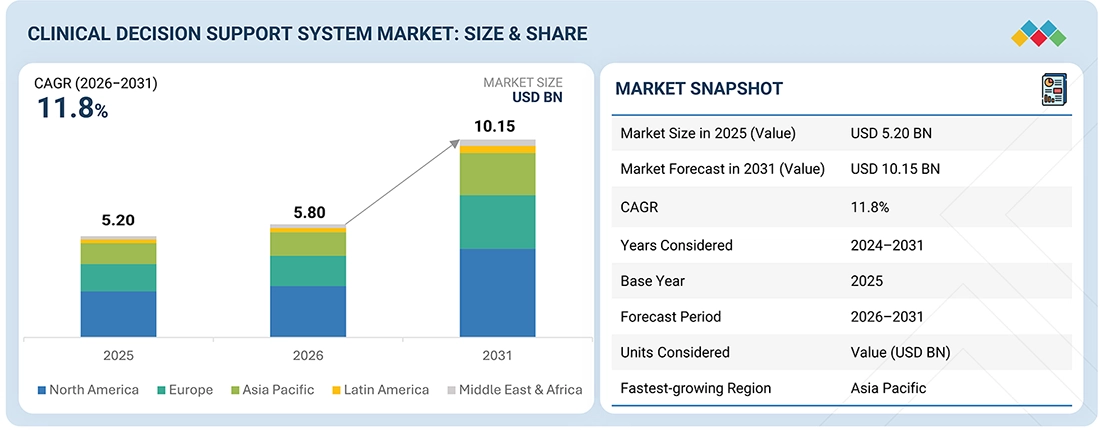
The global Clinical Decision Support System (CDSS) Market is projected to grow from USD 5.80 billion in 2026 to USD 10.15 billion by 2031, registering a CAGR of 11.8% during the forecast period. Market growth is being fueled by the increasing integration of artificial intelligence (AI) into healthcare workflows, rising adoption of electronic health records (EHRs), growing focus on value-based care, and the need to reduce medication errors and clinical inefficiencies.
Download PDF Brochure:- https://www.marketsandmarkets.com/pdfdownloadNew.asp?id=18085342
Healthcare providers are increasingly implementing AI-enabled CDSS platforms to support evidence-based treatment decisions, improve patient safety, streamline physician workflows, and optimize healthcare operations. Advanced technologies such as machine learning, natural language processing (NLP), predictive analytics, and Generative AI are transforming clinical decision-making by enabling real-time recommendations, risk prediction, and personalized care pathways.
Expanding interoperability initiatives and healthcare modernization programs are also supporting market growth. According to the US Department of Health & Human Services (HHS), nearly 500 million health records had been exchanged through the Trusted Exchange Framework and Common Agreement (TEFCA) network by February 2026, highlighting the rapid evolution of connected healthcare ecosystems.
Software Segment Leads Market Growth
Based on component, the software segment accounted for the largest share of the global CDSS market in 2025 and is expected to witness the fastest growth during the forecast period.
Healthcare organizations are increasingly adopting software-driven decision-support environments that integrate patient information, treatment recommendations, predictive analytics, medication management, and workflow coordination into unified healthcare platforms. The growing use of AI-powered clinical reasoning tools and real-time analytics is accelerating the adoption of next-generation CDSS software solutions.
According to the Office of the National Coordinator for Health Information Technology (ONC), approximately 71% of US hospitals used AI-enabled predictive models integrated with EHRs in 2024, compared with 66% in 2023, reflecting the increasing adoption of intelligent clinical technologies. Additionally, the US FDA reported that more than 1,000 AI/ML-enabled medical devices had received authorization by 2025, underscoring the expanding role of intelligent healthcare software.
The increasing deployment of software-centric CDSS solutions for chronic disease management, precision medicine, clinical documentation, and coordinated patient care is expected to strengthen market growth over the forecast period.
Hospitals and Health Systems Remain the Largest End Users
Hospitals and health systems accounted for the largest share of the CDSS market in 2025. Their dominance is attributed to the growing implementation of integrated healthcare IT infrastructure, enterprise EHR platforms, and AI-assisted clinical workflows.
Hospitals are increasingly deploying CDSS solutions for medication management, diagnostic support, treatment planning, predictive risk assessment, and clinical documentation. Rising patient volumes, increasing prevalence of chronic diseases, and a stronger focus on improving care quality and operational efficiency continue to drive adoption.
Investments in healthcare IT modernization, cloud-enabled ecosystems, interoperability frameworks, and advanced analytics platforms are further reinforcing hospitals and health systems as the primary users of enterprise-grade CDSS solutions globally.
Asia Pacific to Register the Highest Growth
The Asia Pacific region is expected to witness the fastest growth during the forecast period, driven by rapid healthcare digitalization, expanding hospital infrastructure, and increasing adoption of AI-supported healthcare technologies.
Countries such as India, China, Japan, and South Korea are investing heavily in interoperable health records, cloud-connected healthcare systems, and intelligent clinical applications to improve treatment accuracy and healthcare efficiency.
Government-led digital health initiatives are also accelerating market growth. In May 2026, India’s Ayushman Bharat Digital Mission (ABDM) announced that over 100 crore health records had been linked to ABHA accounts, demonstrating significant progress in building interoperable healthcare infrastructure.
The growing burden of chronic diseases, increasing patient volumes, and rising demand for data-driven clinical decision-making are expected to create strong opportunities for CDSS providers across the region.
Speak To Analyst:- https://www.marketsandmarkets.com/speaktoanalystNew.asp?id=18085342
AI and Interoperability Reshaping Clinical Decision-Making
The future of the CDSS market will be shaped by AI-driven automation, predictive analytics, Generative AI, cloud computing, and interoperable healthcare ecosystems. Healthcare organizations are increasingly seeking solutions that deliver real-time insights, improve care coordination, reduce physician burnout, and support personalized treatment strategies.
As healthcare systems continue to prioritize evidence-based medicine and digital transformation, AI-enabled CDSS platforms are expected to become a core component of modern healthcare delivery.
Key Market Players
Leading companies operating in the global CDSS market include:
- Epic Systems Corporation (US)
- Optum, Inc. (US)
- Oracle (US)
- Athenahealth (US)
- Veradigm LLC (US)
- Elsevier (Netherlands)
- Zynx Health (US)
These organizations are focusing on AI integration, cloud-enabled platforms, interoperability, and advanced analytics capabilities to strengthen their market positions and support next-generation clinical decision-making.
