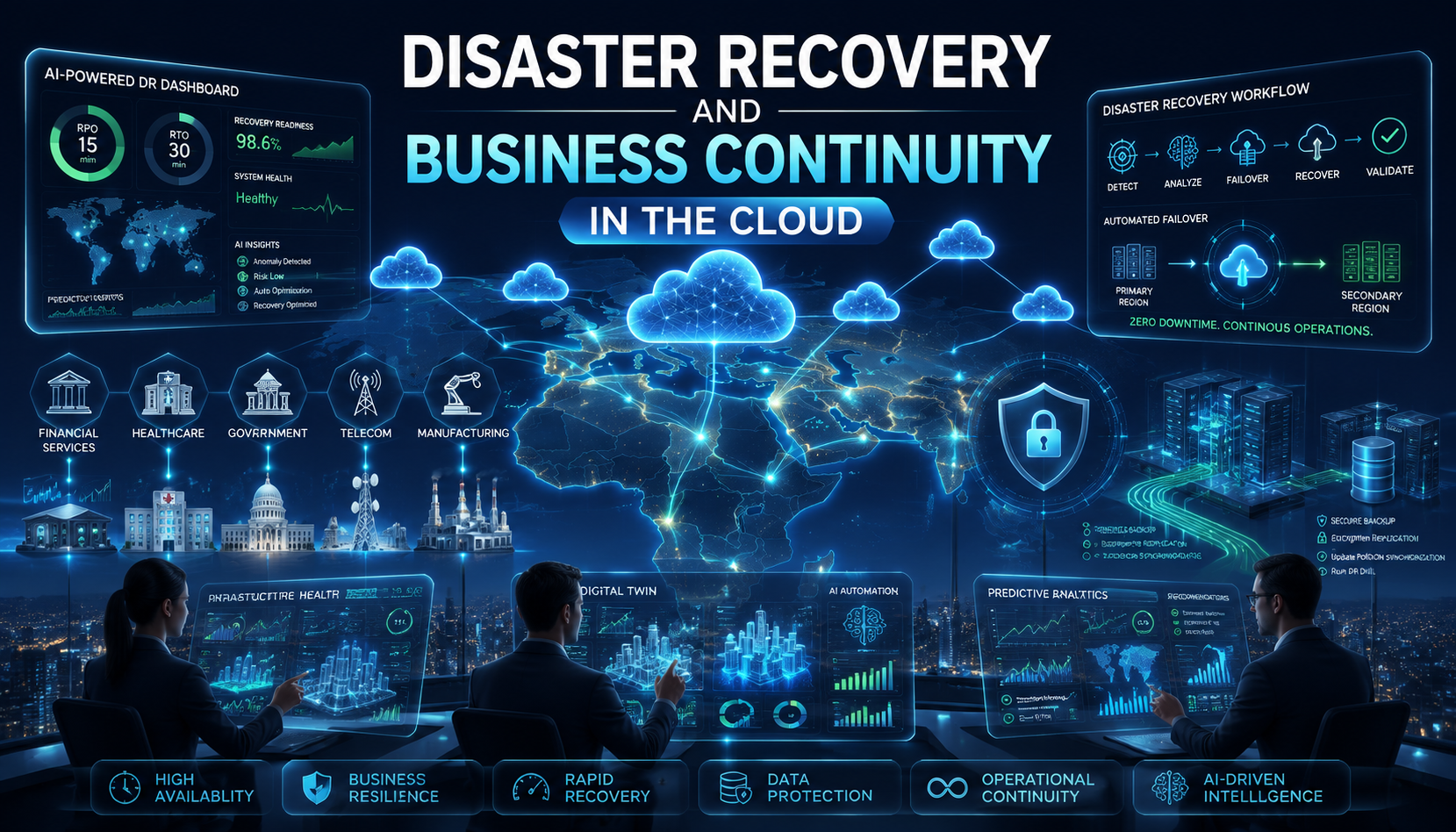
Business resilience has shifted from an IT priority to a strategic imperative for executive leadership. As cyberattacks, natural disasters, infrastructure failures, and operational disruptions become more frequent, organizations can no longer rely on conventional backup systems alone. Modern digital enterprises require continuous application availability, rapid recovery capabilities, and uninterrupted customer experiences, making cloud-based disaster recovery and business continuity essential components of enterprise strategy.
Across the Middle East and Africa, organizations are accelerating cloud adoption to strengthen resilience while advancing digital transformation initiatives. Governments, financial institutions, healthcare providers, telecommunications companies, and manufacturers are modernizing critical infrastructure through scalable cloud technologies. As these investments continue to expand, the MEA Cloud Computing Market is becoming a cornerstone of secure, resilient, and highly available digital ecosystems.
The rapid adoption of hybrid cloud, multi-cloud environments, artificial intelligence, and edge computing is redefining enterprise recovery strategies. These innovations are driving sustained MEA Cloud Computing Market growth by replacing legacy disaster recovery models with intelligent, cloud-native platforms that deliver greater agility and operational efficiency. Industry analysts also expect a strong MEA Cloud Computing Market outlook as organizations prioritize compliance, resilience, and uninterrupted business operations.
Understanding Cloud Disaster Recovery and Business Continuity
Disaster recovery focuses on restoring applications, infrastructure, and business data after an unexpected disruption, while business continuity ensures that critical operations continue with minimal interruption. Together, these strategies enable organizations to protect revenue, customer trust, and regulatory compliance during periods of uncertainty.
Cloud computing has fundamentally transformed enterprise resilience by replacing costly secondary data centers with geographically distributed cloud infrastructure. Instead of maintaining duplicate physical environments, organizations can replicate workloads across multiple cloud regions, reducing recovery times while improving scalability, flexibility, and cost efficiency.
Modern cloud disaster recovery platforms combine automated backups, workload replication, orchestration, continuous monitoring, cybersecurity, and AI-powered analytics into a unified resilience framework. These capabilities continue to strengthen the MEA Cloud Computing Market, enabling enterprises to deploy secure, highly available infrastructures that align with evolving regulatory and operational requirements.
Growing investment in resilient cloud architecture is also influencing MEA Cloud Computing Market size. Organizations increasingly seek cost-effective solutions that simplify infrastructure management while maximizing application availability, encouraging technology providers to expand enterprise-grade disaster recovery and business continuity offerings.
Discover emerging business opportunities Download the PDF supported by extensive market research.
Why the MEA Cloud Computing Market Is Accelerating Cloud Resilience
The Middle East and Africa are undergoing rapid digital transformation fueled by national innovation agendas, smart city initiatives, expanding cloud infrastructure, and enterprise modernization. As organizations digitize mission-critical operations, maintaining continuous service availability has become essential to operational resilience and long-term competitiveness.
Cloud disaster recovery enables enterprises to replicate business-critical applications across multiple cloud regions, significantly reducing downtime and improving recovery performance. This capability is accelerating adoption across the MEA Cloud Computing Market, particularly among organizations operating across multiple countries with diverse regulatory requirements.
Banks depend on resilient cloud platforms to support real-time payment systems and digital banking services, while healthcare providers require uninterrupted access to electronic medical records and clinical applications. Government agencies, telecommunications providers, retailers, and manufacturers are making similar investments to protect essential digital services against cyberattacks, hardware failures, and natural disasters.
These modernization initiatives continue to shape MEA Cloud Computing Market trends, reinforcing cloud resilience as a strategic business investment rather than simply an operational safeguard. Enterprises that prioritize cloud-based continuity planning are better positioned to improve customer confidence, maintain compliance, and accelerate digital innovation in an increasingly connected economy.
This Sample Report is designed to fuel your business growth—download it today.
Major Trends Shaping the MEA Cloud Computing Market
Cloud resilience is rapidly evolving from traditional backup practices into intelligent, automated recovery ecosystems. Organizations across the Middle East and Africa are embracing hybrid cloud, multi-cloud environments, artificial intelligence, and automation to improve disaster recovery performance while reducing operational complexity. These advancements continue to strengthen the MEA Cloud Computing Market by enabling faster recovery, improved scalability, and greater operational agility.
Artificial intelligence is becoming a defining force in modern disaster recovery strategies. Machine learning algorithms can detect anomalies, predict infrastructure failures, automate failover procedures, and optimize recovery workflows before disruptions affect critical business services. This shift is enhancing operational resilience while supporting more comprehensive MEA Cloud Computing Market analysis across industries that depend on uninterrupted digital operations.
Hybrid and multi-cloud adoption is also accelerating. Enterprises are distributing workloads across public and private cloud environments to eliminate single points of failure, strengthen compliance, and improve business continuity. This flexible deployment model supports long-term MEA Cloud Computing Market outlook, enabling organizations to modernize critical applications without sacrificing performance or security.
Cyber resilience has become another strategic priority. As ransomware attacks and advanced cyber threats continue to increase, enterprises are investing in immutable backups, zero-trust security frameworks, continuous monitoring, automated threat detection, and rapid recovery capabilities. These technologies are becoming essential components of enterprise continuity planning throughout the MEA Cloud Computing Market.
Enterprise Use Cases Driving Cloud Adoption
Financial institutions require uninterrupted access to payment systems, digital banking applications, and customer databases. Cloud-based disaster recovery enables banks to replicate mission-critical workloads across geographically distributed cloud regions, ensuring rapid recovery while maintaining strict regulatory compliance.
These capabilities continue to accelerate adoption throughout the MEA Cloud Computing Market.
Healthcare organizations rely on resilient cloud infrastructure to maintain continuous access to electronic health records, diagnostic platforms, and telemedicine services. Cloud-based continuity solutions protect sensitive patient information while reducing downtime during cyber incidents, hardware failures, or unexpected service disruptions.
Government agencies are implementing cloud disaster recovery to secure digital citizen services, taxation systems, emergency response platforms, and public administration portals. Telecommunications providers are making similar investments to maintain network availability, support 5G infrastructure, and ensure uninterrupted communication services during large-scale outages.
Manufacturing companies are protecting industrial IoT platforms, production environments, and supply chain applications through cloud continuity solutions. Retail organizations are strengthening e-commerce platforms, payment systems, and customer engagement services with resilient cloud infrastructure. These enterprise deployments continue to support MEA Cloud Computing Market growth while accelerating digital transformation across multiple industries.
Investment Opportunities Across the Cloud Ecosystem
Enterprise investment in resilient cloud infrastructure continues to expand as organizations prioritize business continuity and operational resilience. Technology vendors are developing advanced disaster recovery platforms, cloud-native backup services, AI-powered monitoring solutions, automated orchestration tools, and Disaster Recovery as a Service (DRaaS) offerings to address growing enterprise demand.
Leading MEA Cloud Computing Market companies, including cloud providers, cybersecurity firms, managed service providers, and enterprise software vendors, are investing heavily in intelligent resilience platforms. Innovation in workload mobility, cloud storage optimization, AI-driven automation, and compliance management is creating new opportunities for enterprise customers while supporting a positive MEA Cloud Computing Market forecast.
As organizations continue migrating mission-critical applications to cloud environments, demand for secure, scalable, and compliant recovery solutions is expected to accelerate. These investments position cloud resilience as one of the most dynamic segments within enterprise digital transformation, creating long-term opportunities for technology providers, investors, and organizations pursuing sustainable growth.
Market Challenges Limiting Cloud Resilience
Despite accelerating cloud adoption, organizations across the Middle East and Africa continue to face several barriers when implementing enterprise-scale disaster recovery strategies. Data sovereignty requirements, legacy IT environments, cybersecurity risks, and shortages of skilled cloud professionals remain among the most significant challenges. Overcoming these obstacles will be essential for organizations seeking to unlock the full value of the MEA Cloud Computing Market.
Cybersecurity remains the foremost concern. Ransomware attacks, insider threats, and increasingly sophisticated malware campaigns are driving enterprises to strengthen cloud disaster recovery with encryption, immutable backups, identity and access management, continuous monitoring, and automated incident response. These investments not only improve resilience but also reinforce sustainable MEA Cloud Computing Market growth.
Cost management is another critical consideration. Although cloud-based disaster recovery significantly reduces capital investment compared with maintaining dedicated secondary data centers, organizations must still optimize spending on storage, network bandwidth, replication, and cloud resources. FinOps practices and intelligent resource management are becoming increasingly important for maximizing long-term return on investment.
Workforce readiness also influences successful implementation. As hybrid and multi-cloud environments become more complex, enterprises require experienced cloud architects, cybersecurity specialists, and disaster recovery professionals capable of designing and managing resilient infrastructures. Continued investment in workforce development and strategic technology partnerships will remain essential for long-term enterprise success.
Future Outlook for the MEA Cloud Computing Market
The next generation of enterprise resilience will be driven by intelligent automation, AI-powered operations, cloud-native architectures, and edge computing. Organizations are increasingly integrating disaster recovery into broader digital transformation initiatives to improve agility, strengthen compliance, and deliver consistent customer experiences across rapidly evolving business environments.
Emerging technologies such as predictive analytics, autonomous recovery orchestration, digital twins, and AI-enabled infrastructure management are expected to redefine business continuity planning during the coming decade. These innovations support a positive MEA Cloud Computing Market outlook, enabling enterprises to recover more quickly while minimizing operational disruption and business risk.
Government-led digital transformation programs, smart city investments, expanding regional cloud infrastructure, and continued investment by global hyperscale cloud providers are expected to reinforce the MEA Cloud Computing Market forecast. As organizations migrate more mission-critical applications to cloud environments, demand for resilient and scalable infrastructure will continue to expand.
Industry collaboration will also shape future growth. Partnerships among cloud providers, cybersecurity companies, managed service providers, regulators, and enterprise technology vendors will accelerate innovation, improve interoperability, and strengthen governance frameworks. These collaborative initiatives are expected to influence future MEA Cloud Computing Market report findings while supporting wider enterprise adoption across the region.
Key Industry Insights
Several technology and investment trends continue to reinforce the strategic importance of cloud resilience throughout the Middle East and Africa:
- Hybrid and multi-cloud deployments are becoming the preferred foundation for enterprise disaster recovery.
- AI-powered automation is reducing recovery times while improving operational efficiency and infrastructure visibility.
- Cybersecurity investment continues to increase alongside enterprise cloud adoption.
- Disaster Recovery as a Service (DRaaS) is emerging as a preferred solution for organizations seeking scalable resilience.
- Digital transformation initiatives continue to expand MEA Cloud Computing Market share, creating new opportunities across banking, healthcare, government, telecommunications, manufacturing, and retail.
Business continuity is no longer viewed as a defensive IT function—it has become a strategic differentiator that enables long-term business resilience and competitive advantage. Organizations across banking, healthcare, government, manufacturing, telecommunications, and retail increasingly rely on cloud-based disaster recovery to safeguard critical applications, maintain regulatory compliance, and deliver uninterrupted digital services.
The MEA Cloud Computing Market is central to this transformation, providing secure, scalable, and intelligent cloud platforms that help enterprises respond more effectively to evolving operational risks. Continued advances in artificial intelligence, hybrid cloud infrastructure, cybersecurity, and automation will accelerate enterprise modernization while creating new opportunities for technology providers and cloud service partners.
Looking ahead, organizations that invest in proactive disaster recovery planning, cloud-native infrastructure, advanced security frameworks, and intelligent automation will be best positioned to navigate future disruptions with confidence. As digital transformation continues across the region, the MEA Cloud Computing Market will remain a critical pillar of enterprise resilience, driving innovation, operational continuity, and sustainable economic growth for years to come.