The Electronics Manufacturing Services Market Growth is gaining momentum as original equipment manufacturers (OEMs) increasingly outsource electronics production, design, engineering, testing, and supply chain activities to specialized electronics manufacturing services (EMS) providers. Rising demand for cost-efficient production, faster time-to-market, advanced electronics, and flexible manufacturing is encouraging companies to rely on EMS providers for both high-volume production and value-added services.
According to MarketsandMarkets, the global Electronics Manufacturing Services Market is projected to grow from USD 648.51 billion in 2025 to USD 853.05 billion by 2030, registering a CAGR of 5.6% from 2025 to 2030. The expansion of AI servers, electric vehicles, connected devices, consumer electronics, telecommunications infrastructure, and industrial automation is creating new opportunities for EMS providers.
AI Is Creating New Opportunities for Electronics Manufacturing Services
Artificial intelligence is becoming an important growth opportunity for the Electronics Manufacturing Services Market Growth. AI infrastructure requires highly sophisticated electronic systems, including computing platforms, servers, power systems, networking equipment, thermal management solutions, and advanced circuit assemblies. As enterprises and hyperscalers increase investments in AI infrastructure, EMS providers are expanding their capabilities to manufacture complex AI-enabled systems.
MarketsandMarkets identifies increasing demand for AI servers as a major opportunity for EMS providers. Companies are increasingly moving beyond conventional PCB assembly toward system integration, design support, testing, supply chain management, and manufacturing of sophisticated computing infrastructure.
Recent industry developments highlight this trend. Jabil partnered with Adani Enterprises in June 2026 to develop an integrated AI and data-center infrastructure manufacturing platform in India. Hon Hai Precision Industry also continued expanding manufacturing operations for AI server racks, while Pegatron advanced its US manufacturing footprint for AI server products. These developments demonstrate how AI infrastructure is becoming an important demand generator for the EMS industry.
Automation and Smart Manufacturing Transform EMS Operations
Automation is reshaping manufacturing facilities by improving production efficiency, quality, flexibility, and scalability. EMS providers are increasingly deploying robotics, automated inspection systems, machine vision, connected production equipment, and digital manufacturing platforms to manage increasingly complex electronics production requirements.
Smart manufacturing enables EMS companies to monitor production processes in real time and identify quality issues at earlier stages. Automated optical inspection, automated test equipment, robotics, predictive maintenance, and data analytics can help manufacturers reduce production errors and improve resource utilization.
The integration of automation with AI is also creating more intelligent manufacturing environments. AI-powered analytics can identify production patterns, optimize manufacturing parameters, forecast equipment maintenance requirements, and support faster decision-making. This transition allows EMS providers to handle higher production complexity while maintaining consistent quality.
Flex’s expanded partnership with Teradyne Robotics in April 2026 provides an example of this shift. Flex is deploying Universal Robots and Mobile Industrial Robots solutions across its manufacturing operations while also manufacturing robotics components.
Download PDF Brochure @ https://www.marketsandmarkets.com/pdfdownloadNew.asp?id=123721672
Outsourcing Drives Electronics Manufacturing Services Market Growth
Outsourcing remains one of the strongest foundations of Electronics Manufacturing Services Market Growth. OEMs increasingly outsource manufacturing activities to reduce capital expenditure, improve operational efficiency, access specialized manufacturing capabilities, and focus internal resources on product development and innovation.
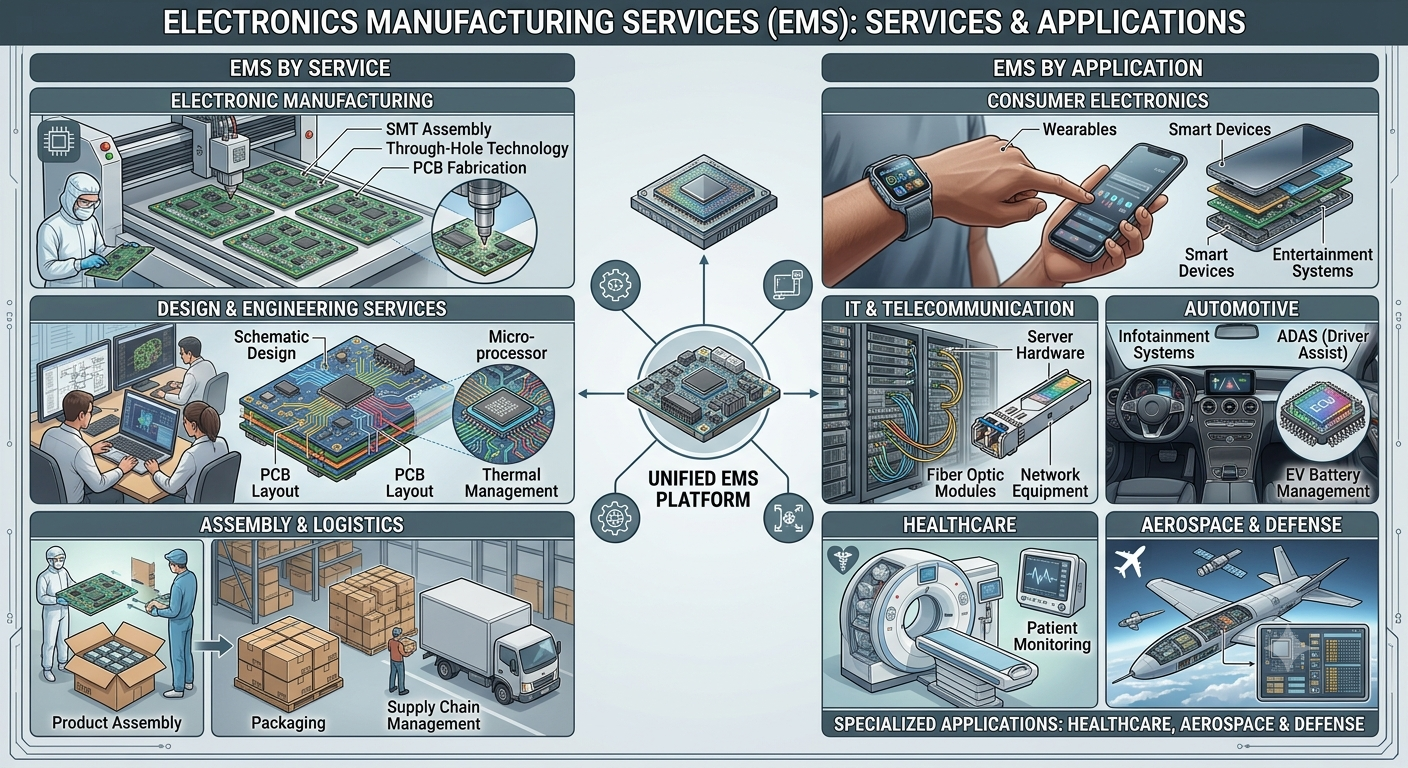
EMS providers can offer integrated capabilities covering manufacturing, design, engineering, testing, supply chain management, logistics, and after-sales services. This enables OEMs to reduce the complexity of managing multiple suppliers while improving time-to-market.
MarketsandMarkets identifies the rising focus on EMS and value-added services as a key market driver. EMS companies are moving higher in the value chain by providing end-to-end solutions rather than focusing only on traditional PCB assembly.
This transition is particularly important as electronic products become more sophisticated. Modern products require advanced component integration, software-hardware coordination, testing, certification, and supply chain management. EMS providers that can combine manufacturing with design and engineering capabilities are therefore positioned to capture additional value.
Design and Engineering Services Gain Importance
Within the service landscape, design and engineering services are projected to grow at the fastest rate during 2025–2030, according to MarketsandMarkets. This reflects the increasing need for EMS providers to support OEMs from the early stages of product development through manufacturing and commercialization.
The growing complexity of electronics is increasing demand for design optimization, prototyping, engineering validation, component selection, testing, and system integration. EMS providers with strong engineering capabilities can work closely with OEMs to improve product manufacturability, reduce development cycles, and accelerate product launches.
The movement toward engineering-led EMS is also strengthening collaboration between manufacturers and technology companies. Rather than simply receiving finished product designs, EMS providers are increasingly becoming strategic partners throughout the product lifecycle.
Consumer Electronics Remains a Major Application
Consumer electronics represents the largest application segment of the Electronics Manufacturing Services Market. Smartphones, laptops, wearables, connected devices, and other consumer electronics products require high-volume manufacturing and frequent product updates.
The short product life cycles of consumer electronics encourage OEMs to work with EMS providers that can rapidly scale production and manage complex global supply chains. EMS companies can provide flexible manufacturing capacity while helping OEMs manage costs and accelerate product launches.
According to MarketsandMarkets, consumer electronics is expected to dominate the application segment because of the high-volume and fast product lifecycle characteristics of products such as smartphones, laptops, and wearables.
Electric Vehicles Expand EMS Demand
The increasing adoption of electric vehicles is another important factor supporting Electronics Manufacturing Services Market Growth. EVs require significantly more electronic content than traditional vehicles, including battery management systems, power electronics, sensors, connectivity modules, advanced driver-assistance systems, infotainment systems, and vehicle control units.
As automotive manufacturers increase investments in electrification and software-defined vehicles, demand for specialized electronic manufacturing capabilities is expected to increase.
EMS providers can support automotive OEMs by providing electronics design, circuit assembly, testing, system integration, and supply chain services. The increasing complexity of automotive electronics also creates opportunities for providers with strong quality management and engineering capabilities.
Asia Pacific Maintains a Strong Manufacturing Position
Asia Pacific remains a critical region for the Electronics Manufacturing Services Market because of its established electronics manufacturing ecosystem, cost-effective production capabilities, skilled workforce, extensive supplier networks, and presence of major EMS companies.
MarketsandMarkets identifies Asia Pacific as the fastest-growing region during the forecast period and notes that the region holds the largest market share. Supply chain diversification strategies and new manufacturing investments are further strengthening the region’s position.
Countries across Asia Pacific are also attracting investments in semiconductor manufacturing, electronics assembly, EVs, data centers, consumer electronics, and industrial automation. These developments are creating new opportunities for EMS companies to expand manufacturing capacity and serve both regional and global customers.
At the same time, EMS providers are expanding production footprints outside traditional manufacturing hubs. Investments in North America, Mexico, India, and other regions are helping companies create more diversified and resilient supply chains.
Supply Chain Integration Creates Competitive Advantages
Supply chain management is becoming increasingly important in the Electronics Manufacturing Services Market Growth landscape. Electronics manufacturers must manage thousands of components while dealing with changing demand, component shortages, geopolitical risks, transportation challenges, and rapidly changing product specifications.
EMS providers are responding by expanding supply chain capabilities and moving toward vertical integration. According to MarketsandMarkets, increasing vertical integration by EMS providers represents a significant market opportunity.
Integrated manufacturing models can allow EMS companies to control more stages of the production process, improve procurement efficiency, reduce supplier dependency, and provide customers with more comprehensive services.
Sustainability Becomes an Important EMS Priority
Sustainability is also influencing the development of the EMS industry. OEMs increasingly expect manufacturing partners to reduce waste, improve energy efficiency, optimize material usage, and strengthen supply chain sustainability.
Outsourcing electronics manufacturing to specialized EMS providers can help companies leverage established production infrastructure and optimized supply chains. MarketsandMarkets notes that EMS outsourcing can support cost-efficient and sustainable production by minimizing material waste, optimizing resource utilization, and improving supply chain efficiency.
Smart manufacturing technologies can further contribute to sustainability by enabling real-time monitoring of energy consumption, production waste, equipment utilization, and resource efficiency.
Challenges Facing the Electronics Manufacturing Services Market
Despite strong growth opportunities, the Electronics Manufacturing Services Market faces several challenges. Intellectual property security is an important concern because EMS providers manage sensitive product designs, software, manufacturing processes, and customer information.
MarketsandMarkets identifies IP security concerns as a key restraint. EMS companies must implement strong cybersecurity, data protection, access controls, and compliance systems to protect customer intellectual property.
Technological obsolescence is another challenge. Electronics technologies evolve rapidly, requiring EMS providers to continuously invest in equipment, automation, software, employee training, and manufacturing capabilities. Failure to keep pace with technology changes can reduce competitiveness and increase operational costs.
Quality control is also becoming more complex as electronics products incorporate advanced components and tighter performance requirements. EMS companies must maintain high levels of testing, inspection, traceability, and process control across large-scale manufacturing operations.
Competitive Landscape
The competitive environment is becoming increasingly technology-focused as EMS providers expand their manufacturing capabilities and move toward higher-value services.
Major companies identified by MarketsandMarkets include Flex Ltd., Hon Hai Precision Industry Co., Ltd., Jabil Inc., Pegatron Corporation, Wistron Corporation, Sanmina Corporation, Kinpo Group, Universal Scientific Industrial (USI), Plexus Corp., and Celestica Inc.
These companies are investing in manufacturing capacity, engineering services, automation, supply chain integration, regional expansion, and emerging technologies. Their ability to serve complex applications such as AI infrastructure, data centers, automotive electronics, healthcare devices, and industrial systems will remain important for future competitiveness.
Future Outlook for Electronics Manufacturing Services Market Growth
The future of the Electronics Manufacturing Services Market Growth will increasingly depend on the convergence of AI, automation, smart manufacturing, advanced electronics, and supply chain innovation.
AI servers and data-center infrastructure are creating new manufacturing opportunities, while EVs and connected vehicles are increasing the electronic content of automotive products. Consumer electronics will continue generating high-volume demand, while healthcare, aerospace and defense, industrial automation, and telecommunications will create additional opportunities.
EMS providers are also expected to increasingly evolve from contract manufacturers into strategic technology and manufacturing partners. Design and engineering, system integration, testing, supply chain management, and after-sales services will become increasingly important components of the EMS value proposition.
With the global market expected to increase from USD 648.51 billion in 2025 to USD 853.05 billion by 2030, the Electronics Manufacturing Services Market Growth outlook remains positive. The combination of OEM outsourcing, AI server demand, automation, smart manufacturing, EV adoption, and supply chain diversification is expected to shape the next phase of market development.
Top 10 Key Takeaways
- The Electronics Manufacturing Services Market is projected to reach USD 853.05 billion by 2030 from USD 648.51 billion in 2025.
- The market is expected to register a 5.6% CAGR from 2025 to 2030.
- OEM outsourcing is a major driver as companies seek cost efficiency, scalability, and faster time-to-market.
- AI server demand is emerging as an important opportunity for EMS providers.
- Automation and smart manufacturing are improving production efficiency, quality, and flexibility.
- Design and engineering services are projected to be the fastest-growing service segment.
- Consumer electronics is expected to remain the dominant application segment.
- Electric vehicle adoption is increasing demand for advanced automotive electronics manufacturing.
- Asia Pacific is expected to remain a leading manufacturing region and the fastest-growing regional market.
- Vertical integration, AI-enabled manufacturing, supply chain optimization, and value-added services will shape the future competitive landscape.
Frequently Asked Questions
1. What is driving Electronics Manufacturing Services Market Growth?
Electronics Manufacturing Services Market Growth is primarily driven by increasing OEM outsourcing, demand for cost-efficient and scalable production, AI server manufacturing, electric vehicle adoption, automation, and the growing need for value-added design and engineering services.
2. What will be the size of the Electronics Manufacturing Services Market by 2030?
The Electronics Manufacturing Services Market is projected to reach USD 853.05 billion by 2030, compared with USD 648.51 billion in 2025.
3. Which service segment is expected to grow fastest?
The design and engineering services segment is projected to grow at the fastest rate from 2025 to 2030 as OEMs increasingly seek integrated product development and manufacturing support.
4. Why are AI servers important for EMS providers?
AI servers require sophisticated computing, networking, power, thermal, and electronic systems. Increasing investments in AI infrastructure are therefore creating new opportunities for EMS providers to manufacture and integrate complex AI hardware systems.
5. Which companies are major players in the Electronics Manufacturing Services Market?
Major players include Flex, Hon Hai Precision Industry, Jabil, Pegatron, Wistron, Sanmina, Kinpo Group, Universal Scientific Industrial, Plexus, and Celestica
