The LiDAR Market Trends are rapidly evolving as industries adopt high-precision 3D sensing for autonomous mobility, robotics, mapping, infrastructure development, environmental monitoring, and smart cities. LiDAR, or Light Detection and Ranging, uses laser pulses to measure distances and generate highly detailed three-dimensional representations of objects, terrain, and environments. The technology is increasingly becoming an important sensing layer for applications that require accurate perception, positioning, mapping, and object detection.
According to MarketsandMarkets, the global LiDAR market was valued at USD 3.27 billion in 2025 and is projected to reach USD 12.79 billion by 2030, growing at a CAGR of 31.3% from 2025 to 2030. Rising adoption of autonomous vehicles, advanced driver assistance systems (ADAS), environmental mapping, smart infrastructure, and 3D mapping technologies is supporting this expansion. Investments in digital twins and smart city infrastructure are also creating new opportunities for LiDAR providers.
The latest LiDAR Market Trends indicate that the technology is moving beyond traditional surveying and mapping. Automotive manufacturers, robotics companies, construction firms, infrastructure operators, governments, and geospatial organizations are increasingly integrating LiDAR into digital workflows. At the same time, advances in solid-state sensors, AI-based processing, flash LiDAR, and compact sensing architectures are broadening the range of applications.
Top Key Takeaways
- The global LiDAR market is projected to reach USD 12.79 billion by 2030 from USD 3.27 billion in 2025.
- The market is expected to grow at a 31.3% CAGR from 2025 to 2030.
- Autonomous vehicles and ADAS are major application areas driving LiDAR adoption.
- Robotics is creating new demand for compact, short-range LiDAR systems.
- Digital twins and 3D mapping are expanding LiDAR applications across infrastructure and urban planning.
- Ground-based LiDAR holds a larger market share and is projected to grow at a higher rate than airborne LiDAR.
- Mechanical LiDAR held the larger market share in 2024, while solid-state LiDAR is gaining importance in automotive applications.
- UAV LiDAR is expanding the use of high-precision sensing in surveying, environmental monitoring, and infrastructure projects.
- Asia Pacific is projected to be the fastest-growing regional market, with a 34.1% CAGR from 2025 to 2030.
- AI, edge computing, flash LiDAR, and advanced geospatial solutions are expected to create additional opportunities across the LiDAR ecosystem.
Autonomous Vehicles Accelerate LiDAR Market Trends
Autonomous vehicles and ADAS are among the most important growth areas shaping LiDAR Market Trends. Autonomous systems require accurate information about surrounding vehicles, pedestrians, road infrastructure, obstacles, and other objects. LiDAR can provide high-resolution 3D information that complements cameras, radar, and other sensors within an automotive sensor suite.
MarketsandMarkets identifies ADAS & driverless cars as the leading end-use application segment during the forecast period. Increasing adoption of solid-state LiDAR in vehicles is supporting this growth, particularly as automakers introduce higher levels of vehicle automation. Several manufacturers have introduced or developed vehicles with advanced automated-driving capabilities, increasing the need for sophisticated perception technologies.
The automotive opportunity is also expanding beyond passenger vehicles. Autonomous shuttles, robotaxis, delivery vehicles, industrial vehicles, and mobility-on-demand fleets can use LiDAR for navigation and obstacle detection. The technology’s ability to generate detailed spatial information makes it valuable for environments where reliable perception is critical.
Another important development is the emergence of 4D LiDAR technology. MarketsandMarkets identifies rising deployment of 4D LiDAR in autonomous vehicles as one of the market drivers. The integration of advanced sensing with AI and machine learning can enable vehicles to interpret dynamic environments more effectively and support increasingly sophisticated automated-driving functions.
Download PDF Brochure @ https://www.marketsandmarkets.com/pdfdownloadNew.asp?id=1261
Robotics Creates New Demand for LiDAR Sensors
Robotics is becoming another significant area within LiDAR Market Trends. Industrial robots, autonomous mobile robots, warehouse automation systems, delivery robots, and service robots require accurate spatial awareness to navigate dynamic environments.
Short-range LiDAR is projected to lead the market by range because of its adoption in automobiles, security applications, and robotics. Compact sensors can help robots identify obstacles, understand their surroundings, and improve navigation in warehouses, factories, logistics centers, and other controlled environments.
The convergence of LiDAR with AI is particularly important for robotics. LiDAR generates point-cloud data, while AI and machine learning algorithms can process this information to recognize objects, identify pathways, detect changes, and support autonomous decision-making.
Recent product development also demonstrates this trend. In March 2025, Ouster introduced 3D Zone Monitoring for its REV7 digital LiDAR sensor lineup. The feature enables sensors to detect objects within customized 3D zones and trigger real-time alerts or actions, including applications in warehouse automation and industrial robotics.
These developments indicate that LiDAR is increasingly becoming part of an intelligent sensing platform rather than functioning only as a mapping device.
Digital Twins and 3D Mapping Expand Growth Opportunities
Digital twins represent another important opportunity emerging from LiDAR Market Trends. A digital twin uses digital representations of physical assets, environments, or systems to support monitoring, analysis, simulation, planning, and optimization. LiDAR can provide the highly accurate spatial information required to create and update these digital representations.
Infrastructure owners can use LiDAR data to create 3D models of roads, bridges, railways, buildings, utilities, and industrial facilities. These models can subsequently be integrated with digital-twin platforms to support asset management and infrastructure planning.
MarketsandMarkets highlights investments in digital twins and 3D mapping technologies as important contributors to LiDAR demand. The increasing development of roads, bridges, utilities, and smart city projects is also driving the adoption of LiDAR-based surveying and mapping.
The value proposition extends across the entire infrastructure lifecycle. During planning, LiDAR can provide detailed terrain and site information. During construction, it can support progress monitoring and dimensional verification. After completion, repeated LiDAR scans can help identify changes, structural conditions, and maintenance requirements.
This creates opportunities for LiDAR companies that combine sensing hardware with cloud-based processing, geospatial analytics, visualization, and digital-twin software.
UAV LiDAR Supports Remote and High-Precision Mapping
The adoption of unmanned aerial vehicles is another major trend influencing the LiDAR market. UAV LiDAR systems provide portable and flexible solutions for collecting high-resolution data over large or difficult-to-access areas.
LiDAR-equipped drones can capture information in forests, construction sites, mining areas, corridors, coastlines, and other environments where conventional surveying can be time-consuming or difficult. MarketsandMarkets identifies the rising adoption of UAV LiDAR systems for accurate data collection as a key market driver.
Aerial surveying is expected to hold the largest share of the LiDAR market by service. LiDAR-equipped manned and unmanned aerial systems can be used to inspect roads, railways, highways, bridges, and other infrastructure while generating detailed spatial information.
The combination of UAVs, LiDAR, AI, and cloud computing is therefore creating an integrated geospatial workflow. Data can be collected remotely, processed rapidly, analyzed using AI, and incorporated into mapping or digital-twin platforms.
Solid-State LiDAR and Sensor Innovation Reshape the Market
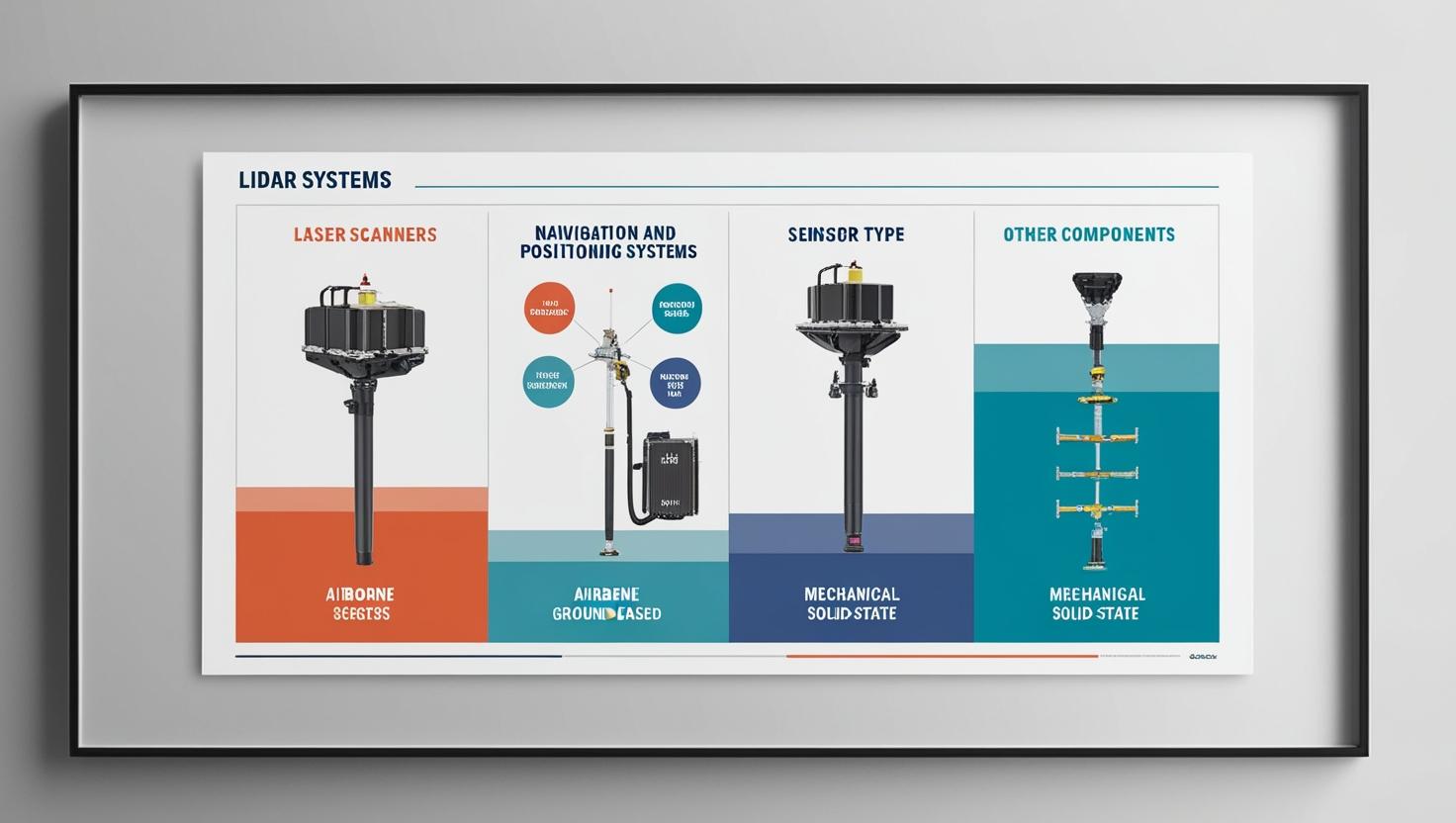
Technology innovation remains central to LiDAR Market Trends. Mechanical LiDAR currently holds a larger market share, supported by its use in corridor mapping, military applications, volumetric mapping, and engineering. Its wide field of view and long-range capabilities make it suitable for large-scale mapping.
However, solid-state LiDAR is attracting increasing attention because of its potential advantages in size, durability, scalability, and cost. Its adoption in automotive applications is particularly important because vehicles require sensors that can operate reliably while meeting demanding size and integration requirements.
Other technologies are also contributing to the evolution of the market. MarketsandMarkets identifies frequency-modulated continuous-wave LiDAR, photon-counting LiDAR, multi-wavelength LiDAR, flash LiDAR, metamaterials, and AI/ML as technologies connected to the broader LiDAR ecosystem.
The development of compact and cost-effective flash LiDAR is also identified as an opportunity. As sensor architectures become smaller and more efficient, LiDAR could become more accessible across robotics, consumer, industrial, automotive, and other applications.
Smart Cities and Infrastructure Drive LiDAR Adoption
Smart city development is creating a broad application environment for LiDAR. Governments and infrastructure operators require accurate spatial information to plan transportation networks, monitor assets, manage utilities, and develop urban environments.
LiDAR can support urban planning by generating detailed 3D representations of buildings, roads, terrain, vegetation, and infrastructure. These datasets can be used for city modeling, traffic planning, environmental analysis, disaster management, and infrastructure monitoring.
The growing number of infrastructure projects is therefore expected to sustain demand for both airborne and ground-based LiDAR. Ground-based LiDAR currently accounts for a larger market share and is projected to grow faster than airborne LiDAR during the forecast period, partly because of its relatively lower cost and less stringent approval requirements for many mapping and surveying applications.
Regional Outlook: Asia Pacific Leads Market Growth
Geographically, Asia Pacific is expected to be the fastest-growing region in the global LiDAR market. MarketsandMarkets projects the Asia Pacific market to increase from USD 0.92 billion in 2025 to USD 4.01 billion by 2030, representing a 34.1% CAGR. Growth is supported by infrastructure development, autonomous and electric vehicles, smart city initiatives, industrial automation, robotics, mining, forestry, and drone-based surveying.
North America is also a major market, with its LiDAR market projected to reach USD 4.8 billion by 2030, up from USD 1.25 billion in 2025, at a 30.9% CAGR. Autonomous vehicles, ADAS deployments, and partnerships between automotive and LiDAR companies are supporting regional expansion.
Europe is projected to reach USD 3.16 billion by 2030, growing at a 29.6% CAGR from 2025 to 2030. Autonomous driving, smart mobility, environmental monitoring, agriculture, and infrastructure planning are contributing to demand.
Challenges Could Influence LiDAR Market Trends
Despite strong growth opportunities, LiDAR adoption faces several challenges. High testing, engineering, calibration, hardware, and post-processing costs can limit adoption, particularly for smaller projects and organizations.
MarketsandMarkets identifies the availability of lower-cost and lightweight alternatives such as photogrammetry systems as a restraint. Photogrammetry can provide interpretable 2D and 3D models at lower costs, although LiDAR can offer advantages in accuracy and data acquisition in many applications.
Another challenge is the complexity associated with miniaturized LiDAR sensing. Automotive and robotics applications require compact, reliable, high-performance sensors while maintaining appropriate range, resolution, power efficiency, and cost.
Reducing system costs, improving sensor performance, simplifying integration, and developing efficient data-processing platforms will therefore remain important priorities for LiDAR companies.
Competitive Landscape and Future Outlook
The LiDAR market includes technology companies serving automotive, industrial, geospatial, surveying, infrastructure, and robotics applications. Major companies identified by MarketsandMarkets include Hesai Group, RoboSense Technology, SICK, Ouster, Luminar Technologies, Leica Geosystems, Trimble, Teledyne Optech, FARO Technologies, RIEGL, NV5 Geospatial, Beijing SureStar Technology, and YellowScan. Companies are using strategies such as product launches, partnerships, acquisitions, and technology development to strengthen their market positions.
The future of LiDAR Market Trends will increasingly depend on the convergence of sensing, AI, robotics, cloud computing, and geospatial software. LiDAR data will not only be used to create maps but also to enable real-time perception, autonomous decision-making, predictive asset management, and digital representations of physical environments.
As autonomous vehicles, robotics, smart infrastructure, UAV surveying, and digital twins mature, LiDAR is positioned to become an increasingly important component of intelligent sensing ecosystems. The projected expansion from USD 3.27 billion in 2025 to USD 12.79 billion by 2030 demonstrates the scale of this opportunity.
Frequently Asked Questions
1. What are the key LiDAR Market Trends?
Key LiDAR Market Trends include autonomous vehicles, ADAS, robotics, UAV-based surveying, solid-state LiDAR, AI-powered data processing, smart cities, 3D mapping, and digital twins.
2. How large is the LiDAR market?
The global LiDAR market was valued at USD 3.27 billion in 2025 and is projected to reach USD 12.79 billion by 2030, growing at a CAGR of 31.3%.
3. Which application is expected to lead the LiDAR market?
ADAS & driverless cars are projected to hold the largest share of the LiDAR market during the forecast period, supported by increasing adoption of LiDAR for vehicle safety and automated driving.
4. Which region is expected to grow fastest in the LiDAR market?
Asia Pacific is projected to be the fastest-growing region, with the regional market expected to grow at a 34.1% CAGR from 2025 to 2030.
5. What opportunities are emerging in the LiDAR market?
Emerging opportunities include autonomous mobility, industrial robotics, digital twins, UAV mapping, smart infrastructure, flash LiDAR, advanced geospatial solutions, and AI-enabled LiDAR data processing.
