The Microdisplay Market Growth Trends are gaining significant momentum as augmented reality (AR) glasses, virtual reality (VR) headsets, head-mounted displays (HMDs), smart wearables, automotive displays, defense systems, and medical visualization technologies become increasingly advanced. Microdisplays provide compact, lightweight, high-resolution, and energy-efficient visualization capabilities, making them an important technology for next-generation immersive and wearable devices.
According to MarketsandMarkets, the global microdisplay market was valued at USD 1.65 billion in 2025 and is projected to reach USD 5.33 billion by 2030, registering a CAGR of 26.4% from 2025 to 2030. Increasing demand for AR/VR devices, smart glasses, wearable electronics, defense applications, and advanced display technologies is supporting the rapid expansion of the market.
The increasing adoption of AR glasses and HMDs is particularly important because these devices require displays that combine high resolution, low power consumption, compact form factors, brightness, and low latency. As manufacturers work toward thinner and lighter wearable devices, microdisplay technologies are becoming increasingly important in enabling immersive digital experiences.
Top 10 Key Takeaways
- Rapid Market Expansion: The global microdisplay market is projected to grow from USD 1.65 billion in 2025 to USD 5.33 billion by 2030, at a 26.4% CAGR.
- AR Glasses Adoption: Increasing adoption of AR glasses and smart wearables is a major factor driving Microdisplay Market Growth Trends.
- Near-to-Eye Leadership: Near-to-eye devices are projected to register the highest CAGR among product categories as AR/VR headsets and smart glasses gain adoption.
- Micro-LED Momentum: Micro-LED is expected to register the highest CAGR among technology segments because of its brightness, energy efficiency, and long lifespan.
- Compact Displays: Microdisplays smaller than 0.5 inch are expected to achieve the highest growth rate as manufacturers develop smaller and lighter wearable devices.
- Consumer Electronics: Consumer electronics currently represents the largest vertical, supported by AR/VR headsets, smart glasses, gaming, and wearable devices.
- Defense Opportunities: Helmet-mounted displays, thermal imaging, night vision, and situational awareness systems are expanding microdisplay applications in defense.
- Medical Applications: Medical imaging and surgical visualization represent promising opportunities for advanced microdisplay technologies.
- Asia Pacific Growth: Asia Pacific is expected to register the highest CAGR, supported by manufacturing capabilities, AR/VR adoption, consumer electronics, and defense investments.
- Future Technology: AI, spatial computing, OLED-on-Silicon, micro-LED, low-latency displays, and advanced optical systems will shape the next phase of Microdisplay Market Growth Trends.
Download PDF Brochure @ https://www.marketsandmarkets.com/pdfdownloadNew.asp?id=430
Rising Adoption of AR Glasses Drives Microdisplay Market Growth Trends
One of the strongest factors shaping Microdisplay Market Growth Trends is the growing adoption of AR glasses. AR glasses overlay digital information, graphics, images, and other content onto the user’s physical environment. These applications require extremely compact displays capable of delivering clear visuals without significantly increasing the size or weight of the device.
Microdisplays are well suited to AR glasses because they can provide high pixel density in a very small area. Their compact form factor enables manufacturers to develop thinner and lighter optical systems while maintaining visual quality.
Consumer applications include gaming, entertainment, navigation, communication, and immersive content. Enterprise applications include logistics, manufacturing, field service, remote assistance, training, and maintenance.
As AR glasses move toward more practical and comfortable designs, demand for advanced microdisplay solutions is expected to increase significantly. MarketsandMarkets identifies the growing popularity of AR/VR headsets and smart glasses as a key market driver.
Head-Mounted Displays Expand Microdisplay Applications
Head-mounted displays are another major contributor to Microdisplay Market Growth Trends. HMDs are increasingly being used across consumer, enterprise, medical, military, aerospace, and industrial applications.
In consumer electronics, HMDs are used for gaming, virtual reality, immersive entertainment, and digital experiences. In enterprise environments, HMDs can provide workers with hands-free access to instructions, digital models, maintenance information, and real-time operational data.
Defense organizations use HMDs for situational awareness, training, simulation, targeting, night vision, and thermal imaging. These applications require high-performance displays that can operate reliably under demanding conditions.
Microdisplays offer the compactness and performance required for these applications. The ability to combine high resolution with low power consumption makes them suitable for battery-powered HMDs and wearable systems.
MarketsandMarkets expects the near-to-eye devices segment to register the highest CAGR among product categories during the forecast period, highlighting the growing importance of HMDs, AR glasses, and other near-eye applications.
OLED and Micro-LED Technologies Transform Microdisplay Market Growth Trends
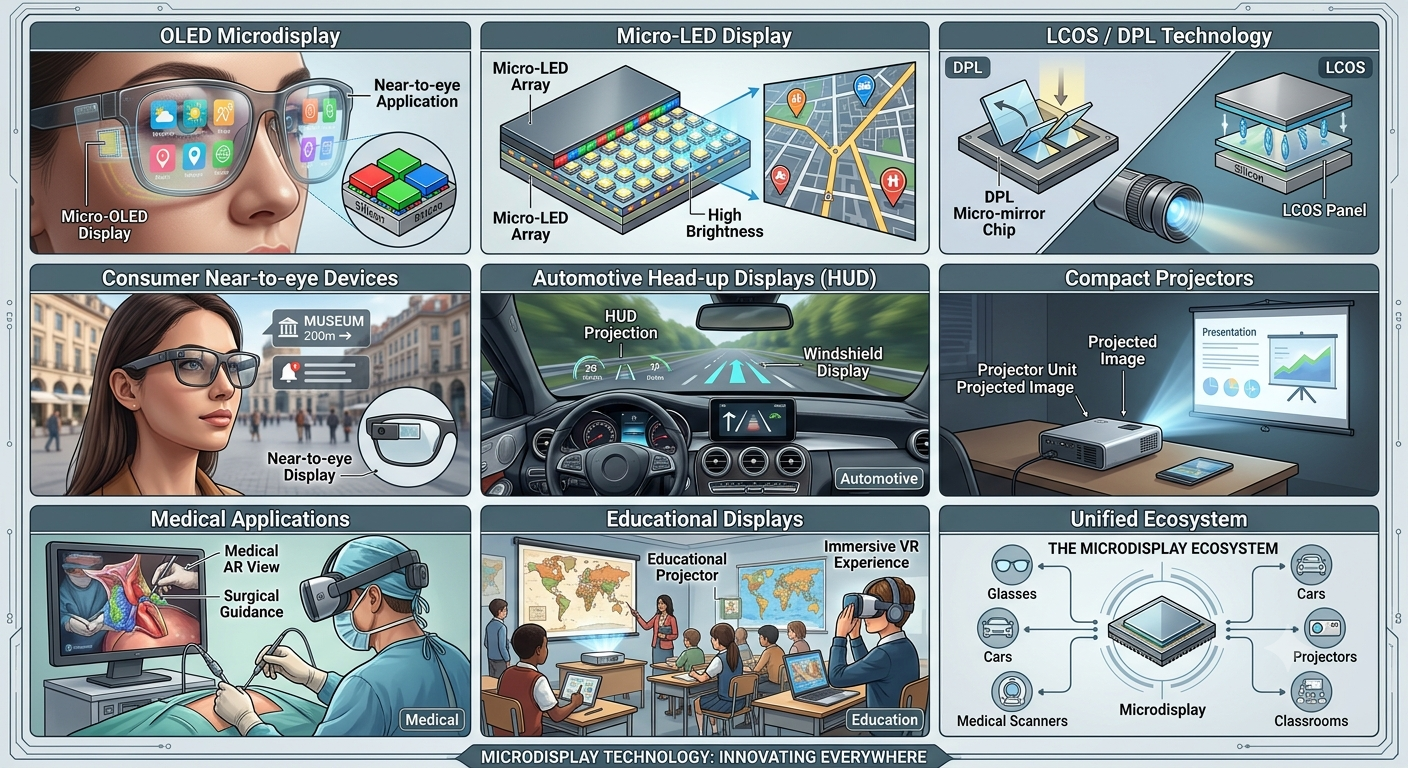
Technology advancement is at the center of Microdisplay Market Growth Trends. OLED, LCD, LCoS, and micro-LED are among the major technologies used in microdisplays, with OLED and micro-LED receiving increasing attention for next-generation applications.
OLED microdisplays offer several advantages, including high contrast, compact designs, fast response times, and low power consumption. These characteristics make OLED particularly suitable for AR/VR headsets, smart glasses, cameras, medical systems, and other portable applications.
Micro-LED is emerging as another important technology. MarketsandMarkets expects the micro-LED segment to register the highest CAGR during the forecast period. Its advantages include high brightness, energy efficiency, long operating life, and fast response characteristics.
The continued development of micro-LED manufacturing and display architectures could expand microdisplay applications in AR/VR, defense, professional imaging, and other high-performance environments.
Demand for Compact and Lightweight Wearables Supports Market Expansion
Wearable electronics are creating substantial opportunities for microdisplay manufacturers. Smart glasses, smart helmets, fitness devices, head-mounted systems, and other wearable products require components that minimize weight and power consumption while providing high-quality visuals.
Traditional displays can add considerable size and weight to wearable systems. Microdisplays address this challenge by providing high-resolution images within extremely compact form factors.
MarketsandMarkets identifies the growing popularity of wearable electronics, AR/VR headsets, and smart glasses as a key driver for the market.
The trend toward all-day wearable devices is further increasing demand for energy-efficient displays. Consumers and enterprise users increasingly expect wearable devices to be comfortable for extended periods, making display size, weight, brightness, and power efficiency critical design considerations.
Less Than 0.5-Inch Microdisplays Gain Momentum
Size is becoming an important factor in Microdisplay Market Growth Trends as manufacturers seek to develop smaller and lighter wearable products.
The market is segmented into microdisplays measuring less than 0.5 inch, 0.5–1.0 inch, and 1.0–2.0 inches. According to MarketsandMarkets, the less than 0.5-inch segment is expected to register the highest CAGR during the forecast period.
The growth of this segment is closely linked to the increasing adoption of compact AR/VR headsets, smart glasses, and other wearable devices. Smaller displays can help manufacturers reduce the overall size of optical systems while supporting lightweight designs.
Miniaturization is therefore expected to remain a major area of innovation as companies attempt to create more comfortable and commercially viable wearable devices.
Consumer Electronics Remains a Major Application Area
The consumer electronics vertical holds the largest share of the microdisplay market. The increasing use of AR/VR headsets, smart glasses, gaming devices, and other wearable electronics is supporting demand for compact display technologies.
Consumers are increasingly seeking immersive and interactive digital experiences. AR and VR technologies can provide new approaches to gaming, entertainment, social interaction, shopping, and content consumption.
As display quality improves, manufacturers can deliver more realistic and immersive experiences. Higher brightness, improved contrast, faster response times, better color reproduction, and increased resolution are becoming important differentiators.
These developments are creating opportunities for microdisplay manufacturers to develop specialized solutions for next-generation consumer electronics.
Defense and Aerospace Applications Create High-Value Opportunities
Defense and aerospace represent another important area of Microdisplay Market Growth Trends. Military organizations increasingly use microdisplays in helmet-mounted displays, thermal imaging systems, night vision equipment, targeting systems, and situational awareness platforms.
These applications require displays capable of delivering high-quality information while operating in challenging environments. Compactness and low power consumption are particularly important for equipment carried or worn by military personnel.
Microdisplays can provide critical information without requiring users to look away from their surroundings. This can improve situational awareness and support faster decision-making.
MarketsandMarkets identifies increasing defense adoption of microdisplays in helmet-mounted systems, thermal imaging, night vision, and situational awareness equipment as an important growth driver.
Medical Applications Open New Growth Opportunities
Medical applications are emerging as an important opportunity for microdisplay technologies. Microdisplays can be integrated into medical imaging systems, surgical visualization equipment, wearable medical devices, and training simulators.
Healthcare professionals can use near-eye displays to access information while maintaining attention on procedures or patients. Advanced visualization can also support minimally invasive procedures and medical training.
MarketsandMarkets identifies rising demand for medical displays as an opportunity for the microdisplay market.
One notable development highlighted by MarketsandMarkets involves flexible microdisplay technology for neurosurgery, combining GaN micro-LEDs with a flexible electrode platform to provide real-time visual feedback during surgical procedures. Such developments demonstrate how microdisplays can move beyond consumer electronics into specialized medical applications.
Automotive Displays Expand Microdisplay Market Growth Trends
The automotive sector is also creating new opportunities for microdisplay manufacturers. Head-up displays (HUDs) can project important driving information into the driver’s field of view, reducing the need to look away from the road.
Microdisplays can support compact optical systems for HUD applications while providing high-quality information. As vehicles become increasingly connected and automated, the amount of digital information presented to drivers is expected to increase.
Advanced display technologies could support navigation, vehicle status, safety alerts, driver assistance information, and other content.
However, automotive applications also involve stringent safety and quality requirements. MarketsandMarkets identifies regulatory requirements in automotive applications as one of the challenges affecting microdisplay adoption.
Asia Pacific Leads Microdisplay Market Growth Trends
Asia Pacific is expected to register the highest CAGR in the global microdisplay market. The region benefits from strong manufacturing capabilities, major display technology companies, growing consumer electronics production, increasing AR/VR adoption, and rising investments in defense technologies.
China, Japan, and South Korea are particularly important markets because of their strong electronics and display manufacturing ecosystems. The presence of major technology companies and component suppliers supports innovation and production capabilities.
Growing consumer demand for wearable devices and immersive technologies is expected to further strengthen regional opportunities.
Government initiatives supporting technology development, semiconductor manufacturing, and advanced electronics are also expected to contribute to regional market expansion.
Advanced Micro-LED Technology Creates New Opportunities
Micro-LED represents one of the most promising opportunities in the Microdisplay Market Growth Trends landscape. Micro-LED displays can provide high brightness, energy efficiency, long lifespan, and fast response.
These characteristics are especially valuable in AR applications, where displays must remain visible in different lighting conditions while maintaining low power consumption.
Micro-LED can also support defense and professional imaging applications that require high brightness and durability.
However, manufacturing complexity and high production costs remain challenges. Improving manufacturing yields, reducing production costs, and developing scalable manufacturing processes will be important for broader commercial adoption.
High Manufacturing Costs Remain a Key Restraint
Despite strong growth potential, high capital investment and manufacturing costs remain restraints for the microdisplay market. Advanced microdisplay technologies require specialized manufacturing equipment, materials, semiconductor processes, optical systems, and quality-control capabilities.
The complexity of manufacturing can affect production yields and increase the cost of finished products. This is particularly important for emerging technologies such as micro-LED.
MarketsandMarkets also identifies saturation in traditional digital camera and projector markets as a restraint. These mature applications may experience slower replacement cycles and limited growth compared with emerging AR/VR and wearable applications.
Low Latency and Display Performance Remain Critical
Reducing display latency is an important challenge influencing Microdisplay Market Growth Trends. AR and VR applications require highly responsive displays because delays between user movement and visual updates can negatively affect the experience.
Low latency is particularly important in immersive applications where users interact with digital content in real time. Display manufacturers are therefore investing in faster response technologies, improved drivers, advanced processing, and optimized optical architectures.
Brightness, contrast, resolution, color accuracy, refresh rate, and power efficiency are also important performance parameters.
The ability to deliver high visual performance within a small, low-power form factor will remain a key competitive factor in the microdisplay industry.
AI and Spatial Computing Strengthen Future Demand
The convergence of artificial intelligence and spatial computing is creating additional opportunities for microdisplays. AI-enabled wearable devices can provide contextual information, visual assistance, object recognition, translation, navigation, and other intelligent services.
As AI assistants move from smartphones and computers toward wearable devices, smart glasses could become an important interface for accessing digital information. Microdisplays provide the visual layer required to deliver this information directly within the user’s field of view.
Spatial computing is also increasing demand for immersive interfaces that combine physical and digital environments. These developments are expected to strengthen the long-term Microdisplay Market Growth Trends.
Competitive Landscape of the Microdisplay Market
The competitive landscape includes established display manufacturers and specialized microdisplay technology companies. Key players identified by MarketsandMarkets include Sony Group Corporation, Seiko Epson Corporation, SeeYA Technology, eMagin, and Kopin Corporation.
Leading companies are focusing on product development, technology innovation, partnerships, collaborations, and commercialization of advanced microdisplay technologies.
Sony, Seiko Epson, and Kopin have broad product portfolios, while specialized companies such as Mojo Vision and JBD are contributing innovation in high-reliability and advanced microdisplay designs.
The competitive environment is increasingly centered on improving resolution, brightness, power efficiency, miniaturization, manufacturing scalability, and optical performance.
Future Outlook for Microdisplay Market Growth Trends
The future of Microdisplay Market Growth Trends is closely connected to the expansion of AR glasses, VR headsets, HMDs, spatial computing, wearable electronics, automotive HUDs, defense systems, and medical visualization.
The global microdisplay market is projected to increase from USD 1.65 billion in 2025 to USD 5.33 billion by 2030, representing a 26.4% CAGR.
Near-to-eye devices are expected to remain a major growth engine, while micro-LED is positioned as the fastest-growing technology segment. Asia Pacific is expected to remain the fastest-growing regional market.
Future innovation will focus on smaller display sizes, higher resolution, brighter images, lower latency, improved energy efficiency, better optical integration, and reduced manufacturing costs.
As AR glasses and HMDs become more capable and commercially accessible, microdisplays will play an increasingly important role in enabling immersive, hands-free, and intelligent digital experiences. The convergence of AI, spatial computing, wearable technology, and advanced display architectures is therefore expected to create significant opportunities across consumer, enterprise, defense, healthcare, automotive, and industrial markets.
Frequently Asked Questions (FAQs)
1. What is driving Microdisplay Market Growth Trends?
The major factors driving Microdisplay Market Growth Trends include increasing adoption of AR glasses, VR headsets, HMDs, smart wearables, defense visualization systems, medical displays, and automotive HUDs. Advancements in OLED and micro-LED technologies are also supporting market growth.
2. What is the size of the global microdisplay market?
The global microdisplay market was valued at USD 1.65 billion in 2025 and is projected to reach USD 5.33 billion by 2030, growing at a CAGR of 26.4% during 2025–2030.
3. Which technology is expected to grow fastest in the microdisplay market?
Micro-LED technology is expected to register the highest CAGR during the forecast period. Its high brightness, energy efficiency, fast response, and long lifespan make it suitable for AR/VR, wearable, defense, and professional applications.
4. Which region is expected to witness the fastest Microdisplay Market Growth Trends?
Asia Pacific is expected to register the highest CAGR in the microdisplay market, supported by strong electronics manufacturing, increasing AR/VR adoption, wearable-device demand, and investments in defense technologies.
5. Who are the key players in the microdisplay market?
Major players in the microdisplay market include Sony Group Corporation, Seiko Epson Corporation, SeeYA Technology, eMagin, and Kopin Corporation. These companies are focusing on advanced OLED, micro-LED, and other display technologies for AR/VR, defense, consumer electronics, and industrial applications.
