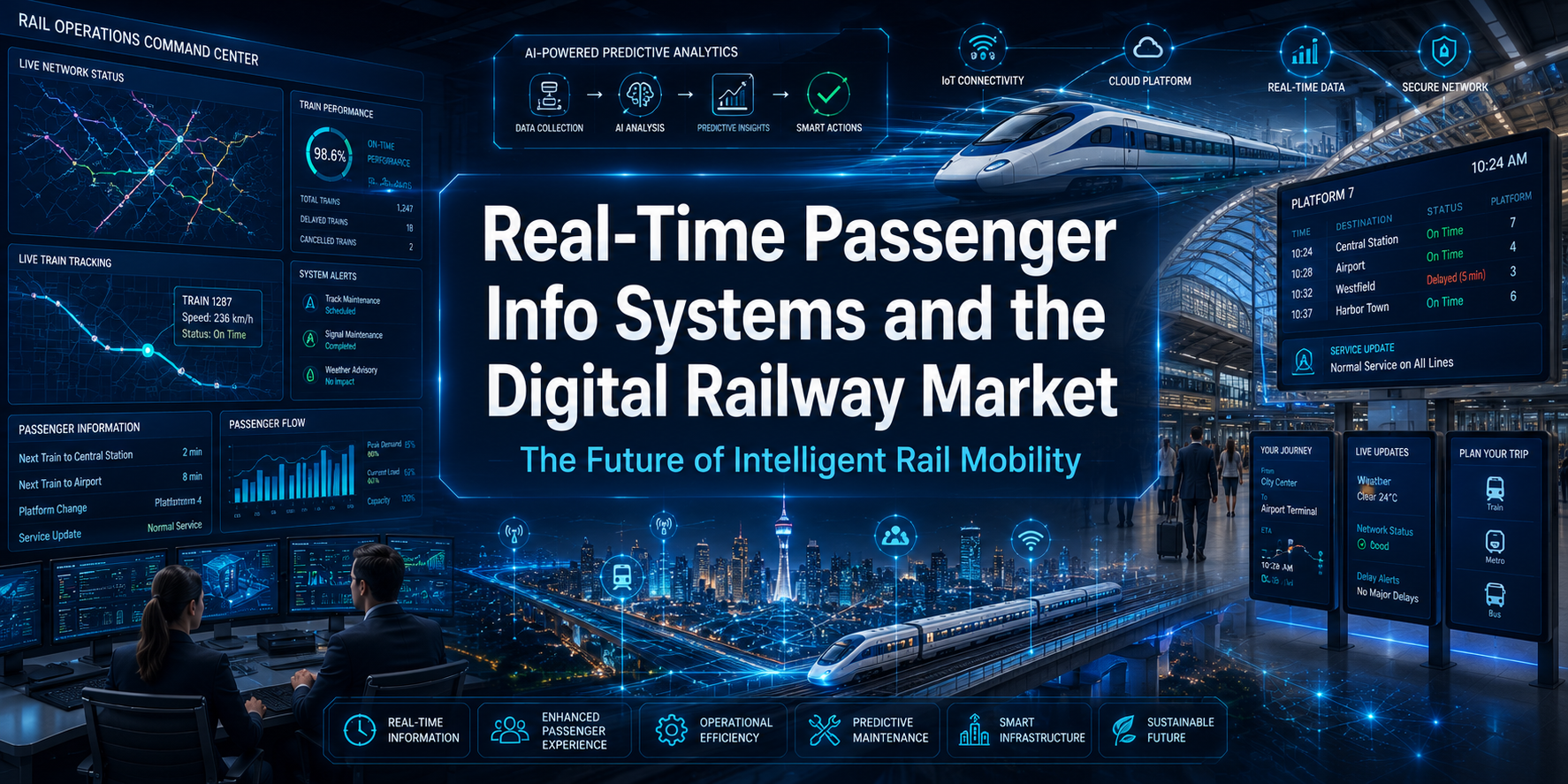
Why Real-Time Passenger Information Has Become Mission-Critical
The Digital Railway Market is rapidly evolving into a fundamental pillar of next-generation transportation infrastructure, empowering railway operators to deliver safer, more efficient, and highly connected passenger experiences. As governments, transit authorities, and rail operators accelerate digital transformation initiatives, Real-Time Passenger Information Systems (RTPIS) have become strategic assets for enhancing operational efficiency, improving customer satisfaction, and strengthening network reliability.
Modern passengers expect immediate access to accurate travel information, including train schedules, platform assignments, service disruptions, delay notifications, and journey updates. To meet these rising expectations, railway organizations are increasingly deploying intelligent passenger information platforms powered by Artificial Intelligence (AI), Internet of Things (IoT), cloud computing, and advanced analytics.
This technological evolution is significantly influencing Digital Railway Market size, Digital Railway Market share, Digital Railway Market growth, Digital Railway Market analysis, Digital Railway Market trends, Digital Railway Market outlook, Digital Railway Market report, and Digital Railway Market forecast across global transportation ecosystems.
Understanding Real-Time Passenger Information Systems
Real-Time Passenger Information Systems are advanced digital platforms designed to collect, analyze, and distribute live transportation data to passengers, railway operators, and transit management teams.
These solutions deliver:
- Real-time train arrival and departure information
- Dynamic platform allocation updates
- Service disruption and delay notifications
- Intelligent route planning assistance
- Mobile travel alerts and notifications
- Digital signage communication capabilities
- Seamless multimodal transportation integration
Modern RTPIS platforms leverage data generated from GPS-enabled assets, onboard monitoring systems, railway control centers, IoT sensors, and cloud-based infrastructures to ensure accurate, timely, and consistent communication across multiple passenger touchpoints.
Looking for growth strategies? Download the PDF with key business opportunities discovered via market research.
Digital Railway Market: Current Industry Landscape
Railway operators worldwide are actively modernizing infrastructure to address growing passenger demand, urbanization trends, sustainability goals, and increasing expectations for digital services.
Key investment priorities include:
- Smart railway infrastructure modernization
- Automated train control and signaling systems
- Intelligent passenger information platforms
- Predictive maintenance technologies
- AI-driven operational management solutions
- Advanced cybersecurity frameworks
- Intelligent traffic and network management systems
As rail networks become increasingly interconnected and data-driven, the Digital Railway Market continues to experience robust expansion across both developed and emerging economies.
Discover what’s fuelling successful companies download the Sample Report for your business growth.
Global Technology Trends Reshaping Passenger Information Systems
Several transformative technologies are driving investment in intelligent passenger communication solutions.
Artificial Intelligence Integration
Artificial Intelligence enables predictive journey management, automated passenger communications, service optimization, and real-time operational intelligence.
Internet of Things (IoT)
Connected devices and sensors continuously collect operational data from trains, stations, tracks, and signaling systems, improving visibility and decision-making.
Cloud-Based Rail Operations
Cloud technologies facilitate scalable information management, centralized monitoring, and real-time data sharing across railway ecosystems.
5G Connectivity
High-speed communication networks enhance information accuracy, improve responsiveness, and support low-latency passenger services.
Smart Mobility Ecosystems
Railway operators are increasingly integrating services with buses, metro networks, ride-sharing platforms, and urban mobility applications to deliver seamless passenger experiences.
Artificial Intelligence and Predictive Rail Operations
Artificial Intelligence is fundamentally transforming railway operations and passenger communication strategies.
AI-enabled capabilities include:
- Predictive delay management
- Passenger demand forecasting
- Route optimization
- Automated passenger announcements
- Intelligent train scheduling
- Service disruption analysis
Through predictive analytics and machine learning, railway operators can proactively address operational challenges before they impact passengers, improving reliability and service quality.
IoT, Cloud Computing, and Connected Railway Infrastructure
Connected infrastructure has become the foundation of modern digital railway ecosystems.
IoT Applications Support:
- Asset performance monitoring
- Real-time train tracking
- Platform occupancy management
- Environmental monitoring
- Infrastructure diagnostics and health assessment
Cloud Computing Enables:
- Real-time data processing
- Enterprise-wide operational visibility
- Centralized control and management
- Scalable information delivery systems
Together, these technologies create an intelligent, agile, and highly responsive railway environment.
Applications of Real-Time Passenger Information Systems Across Rail Networks
Urban Transit Systems
Metro and commuter rail operators leverage RTPIS solutions to improve passenger communication, optimize station operations, and reduce congestion.
High-Speed Rail Networks
High-speed rail providers rely on real-time information systems to manage complex operational schedules and enhance passenger experiences.
Intercity Transportation
Passenger information platforms improve route planning, service transparency, and travel coordination across long-distance networks.
Freight and Logistics Rail Operations
Rail freight operators utilize real-time information technologies to improve asset visibility, logistics planning, and supply chain coordination.
Multimodal Transportation Networks
Integrated passenger information systems enable seamless travel experiences by connecting rail services with other transportation modes.
How the Digital Railway Market Benefits Enterprises and Transportation Authorities
Improved Operational Efficiency
Real-time visibility enables faster decision-making, enhanced coordination, and optimized resource allocation.
Enhanced Passenger Satisfaction
Accurate and timely information reduces uncertainty, improves trust, and strengthens customer confidence.
Increased Revenue Opportunities
Superior passenger experiences contribute to higher ridership levels, increased loyalty, and improved revenue generation.
Better Asset Utilization
Operators can optimize train schedules, station resources, and network capacity utilization.
Reduced Operational Costs
Automation, predictive analytics, and intelligent monitoring reduce manual intervention and improve overall efficiency.
These benefits continue to drive significant investments in Digital Railway Market solutions worldwide.
Improving Passenger Experience Through Intelligent Rail Technologies
Passenger experience has become a critical competitive differentiator within the transportation sector.
Modern RTPIS platforms provide:
- Mobile journey updates
- Personalized travel notifications
- Real-time disruption alerts
- Smart station navigation assistance
- Accessibility support services
- Multilingual information delivery
By enhancing communication, transparency, and convenience, railway operators can strengthen customer trust, improve satisfaction, and increase service adoption.
Cybersecurity and Data Management in Digital Rail Ecosystems
As railway systems become increasingly connected, cybersecurity has emerged as a strategic priority.
Key security requirements include:
- End-to-end data encryption
- Secure communication networks
- Identity and access management controls
- Continuous network monitoring
- Threat detection and incident response
- Regulatory compliance management
Robust cybersecurity frameworks are essential for safeguarding passenger information, protecting critical infrastructure, and ensuring uninterrupted service delivery.
Key Challenges Facing Railway Digitalization
Despite significant opportunities, railway organizations continue to face several challenges.
Legacy Infrastructure Integration
Integrating modern digital technologies with existing infrastructure remains a complex undertaking.
Cybersecurity Risks
Expanding digital ecosystems increase exposure to evolving cyber threats.
Data Interoperability Issues
Achieving seamless data exchange across multiple platforms and systems can be challenging.
Budget Constraints
Large-scale modernization projects often require substantial capital investment.
Skills Shortages
Limited availability of specialized digital and railway technology talent can hinder transformation initiatives.
Regulatory Complexity
Organizations must navigate evolving regulations and compliance requirements across jurisdictions.
Addressing these challenges requires strategic planning, long-term investment, and strong digital transformation governance.
Future Growth Opportunities in the Digital Railway Market
Several emerging technologies are expected to drive future market expansion.
Key growth opportunities include:
- AI-powered railway operations
- Autonomous train technologies
- Digital twin implementations
- Smart station modernization
- 5G-enabled rail communications
- Advanced passenger analytics platforms
- Sustainable transportation initiatives
These innovations are expected to accelerate future Digital Railway Market growth globally.
Strategic Recommendations for Railway Leaders
To maximize value from digital railway investments, organizations should:
- Prioritize passenger-centric digital transformation strategies.
- Invest in AI-powered passenger information systems.
- Modernize legacy infrastructure environments.
- Strengthen cybersecurity and resilience frameworks.
- Expand IoT-enabled operational capabilities.
- Develop integrated mobility ecosystems.
- Establish data-driven operational models.
These initiatives can enhance efficiency, resilience, customer satisfaction, and long-term competitiveness.
Future Outlook for the Digital Railway Market
Industry experts anticipate continued expansion as governments, transit authorities, and rail operators increase investments in intelligent transportation infrastructure.
Key factors supporting future Digital Railway Market forecast include:
- Accelerating urbanization
- Expansion of smart city initiatives
- Railway modernization programs
- Increasing passenger expectations
- Adoption of AI and IoT technologies
- Growth in sustainable transportation investments
The convergence of Real-Time Passenger Information Systems, Artificial Intelligence, cloud computing, advanced analytics, and connected infrastructure will continue shaping the future trajectory of the global Digital Railway Market.
Real-Time Passenger Information Systems have evolved from operational support tools into strategic platforms that enable intelligent railway operations and superior passenger experiences. By facilitating real-time communication, predictive decision-making, and enhanced service delivery, these solutions are helping railway operators build smarter, more resilient, and more customer-centric transportation networks.
Organizations that invest in advanced passenger information technologies today will be well-positioned to capitalize on future Digital Railway Market growth, improve operational performance, enhance customer satisfaction, and establish sustainable competitive advantages within the rapidly evolving global mobility ecosystem.