The Micro-Electro-Mechanical Systems (MEMS) market is entering a new phase of growth as industries increasingly require compact, low-power, high-performance sensing and actuation technologies. MEMS devices combine mechanical structures, sensors, actuators, and electronics at the microscale, making them essential components for smartphones, wearables, connected vehicles, industrial equipment, medical devices, telecom infrastructure, and aerospace systems.
According to MarketsandMarkets, the global MEMS market is projected to grow from USD 19.06 billion in 2026 to USD 25.03 billion by 2032, registering a CAGR of 4.6% during 2026–2032. Increasing demand for motion, pressure, environmental, optical, audio, and RF sensing is supporting MEMS adoption across diverse industries. Advances in miniaturization, fabrication, integration, and packaging are also improving sensor accuracy, response time, reliability, and system-level integration.
Download PDF Brochure @ https://www.marketsandmarkets.com/pdfdownloadNew.asp?id=13689179
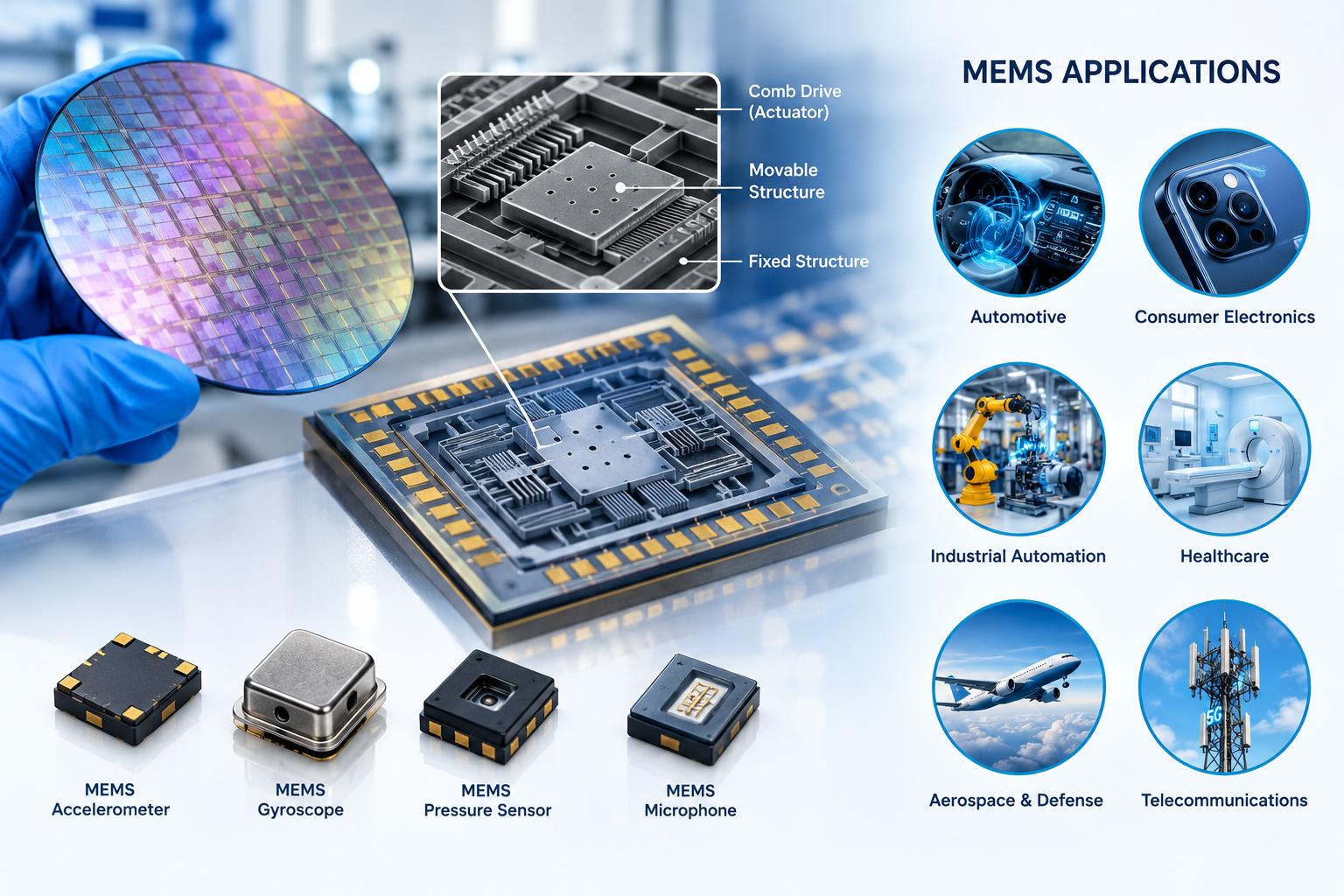
MEMS Miniaturization Supports Next-Generation Devices
One of the defining MEMS market trends in 2026 is the continued drive toward miniaturized sensing and actuation. Device manufacturers increasingly need components that deliver greater functionality without significantly increasing product size or power consumption.
MEMS technology addresses this requirement by integrating sensing and mechanical functionality into extremely compact architectures. This is particularly important for smartphones, wearables, hearables, automotive electronics, IoT devices, and industrial systems where space and energy efficiency are critical.
The growing deployment of connected devices is consequently expanding demand for accelerometers, gyroscopes, pressure sensors, microphones, environmental sensors, optical sensors, and other MEMS components.
Inertial Sensors Remain Central to MEMS Adoption
Inertial sensors, including accelerometers and gyroscopes, continue to represent a major component of the MEMS ecosystem. Their ability to measure acceleration, orientation, and movement supports applications ranging from smartphone interfaces and wearable devices to vehicle safety systems, navigation, robotics, and industrial automation.
The increasing use of ADAS and connected vehicles is creating additional opportunities for MEMS-based motion sensing. In parallel, applications such as augmented and virtual reality, gesture recognition, autonomous systems, and industrial monitoring require increasingly accurate motion information.
This broad application base positions inertial sensing as an important contributor to long-term MEMS demand.
RF MEMS and 5G Create New Growth Opportunities
The expansion of high-speed wireless communication is another important development shaping the MEMS technology market. RF MEMS devices can support switches, filters, oscillators, and other functions within increasingly sophisticated communication architectures.
MarketsandMarkets expects the RF actuator segment to register approximately 6.3% growth during 2026–2032. The telecom vertical is projected to grow at approximately 12.2% CAGR, supported by 5G deployment, increasing data traffic, IoT connectivity, edge computing, satellite communication, and demand for compact, energy-efficient RF components.
These developments demonstrate how MEMS is moving beyond conventional sensing applications toward communication infrastructure and advanced electronic systems.
MEMS Microspeakers Expand Consumer Electronics Applications
Audio applications represent another emerging opportunity. The microspeakers segment is expected to record an 18.4% CAGR from 2026 to 2032, driven by demand for compact audio components in smartphones, wearables, hearables, smart speakers, and other consumer devices.
The growth of true wireless stereo earbuds, voice assistants, active noise cancellation, beamforming, and spatial audio is increasing the need for smaller and more efficient audio technologies. MEMS-based audio components can support these requirements while enabling manufacturers to maintain compact product designs.
Sensor Fusion Opens New Industrial Opportunities
Sensor fusion is emerging as an important opportunity for MEMS manufacturers. Combining information from multiple sensors—such as accelerometers, gyroscopes, pressure sensors, and environmental sensors—can improve accuracy, contextual awareness, and system reliability.
This capability is particularly relevant to autonomous vehicles, industrial automation, healthcare equipment, robotics, and connected consumer devices. As systems become increasingly intelligent, MEMS components can serve as foundational data-generation technologies for edge computing and AI-enabled applications.
Manufacturing Investment and Skilled Talent Remain Challenges
Despite strong opportunities, MEMS manufacturers face structural challenges. MEMS fabrication requires specialized cleanrooms, semiconductor equipment, wafer-level processing, packaging, and testing infrastructure, resulting in substantial capital requirements. The industry also faces a shortage of skilled MEMS designers with expertise spanning microfabrication, mechanical and electrical engineering, materials, semiconductor processing, and system integration.
The lack of standardized fabrication processes can further increase development complexity, particularly for companies seeking to scale specialized MEMS products.
Asia Pacific Strengthens Its MEMS Market Position
Asia Pacific is expected to remain the fastest-growing regional market and account for approximately 46.8% of the global MEMS market in 2026. Strong electronics and semiconductor manufacturing ecosystems in China, Japan, South Korea, Taiwan, and India are supporting regional demand.
The region is benefiting from expanding consumer electronics production, automotive electrification, semiconductor investments, telecommunications infrastructure, and industrial automation.
India is also emerging as a notable growth market. MarketsandMarkets estimates that India’s MEMS market will increase from USD 920.1 million in 2025 to USD 1.32 billion by 2030, representing a 7.4% CAGR, supported by digital transformation, electronics manufacturing, automotive applications, and semiconductor-related investments.
Future Outlook for the MEMS Market
The MEMS market in 2026 is increasingly being shaped by miniaturization, sensor integration, low-power architectures, 5G connectivity, IoT expansion, automotive electronics, and intelligent edge systems. Future innovation is likely to focus on application-specific MEMS solutions that combine multiple sensing functions with improved accuracy, reliability, and energy efficiency.
With the market expected to reach USD 25.03 billion by 2032, MEMS technology is positioned to remain a critical enabling technology across connected devices, automotive systems, telecommunications, healthcare, industrial automation, aerospace, and next-generation electronic products.
Find More Information on Micro-Electro-Mechanical Systems Market Innovation @ https://www.marketsandmarkets.com/Market-Reports/mems-market-13689179.html
