The position sensor market is becoming increasingly important to industrial automation as manufacturers accelerate investments in robotics, smart manufacturing, machine tools, electric vehicles (EVs), and connected production systems. Position sensors provide critical feedback on the location, movement, displacement, or angle of components, enabling machines to operate with greater precision and supporting real-time motion control.
According to MarketsandMarkets, the global position sensor market is projected to grow from USD 14.53 billion in 2026 to USD 23.40 billion by 2032, registering a CAGR of 8.3% during the forecast period. Growth is being supported by increasing Industry 4.0 adoption, automotive electrification, robotics deployment, and demand for reliable, high-precision sensing across industrial applications.
Download PDF Brochure @ https://www.marketsandmarkets.com/pdfdownloadNew.asp?id=17719728
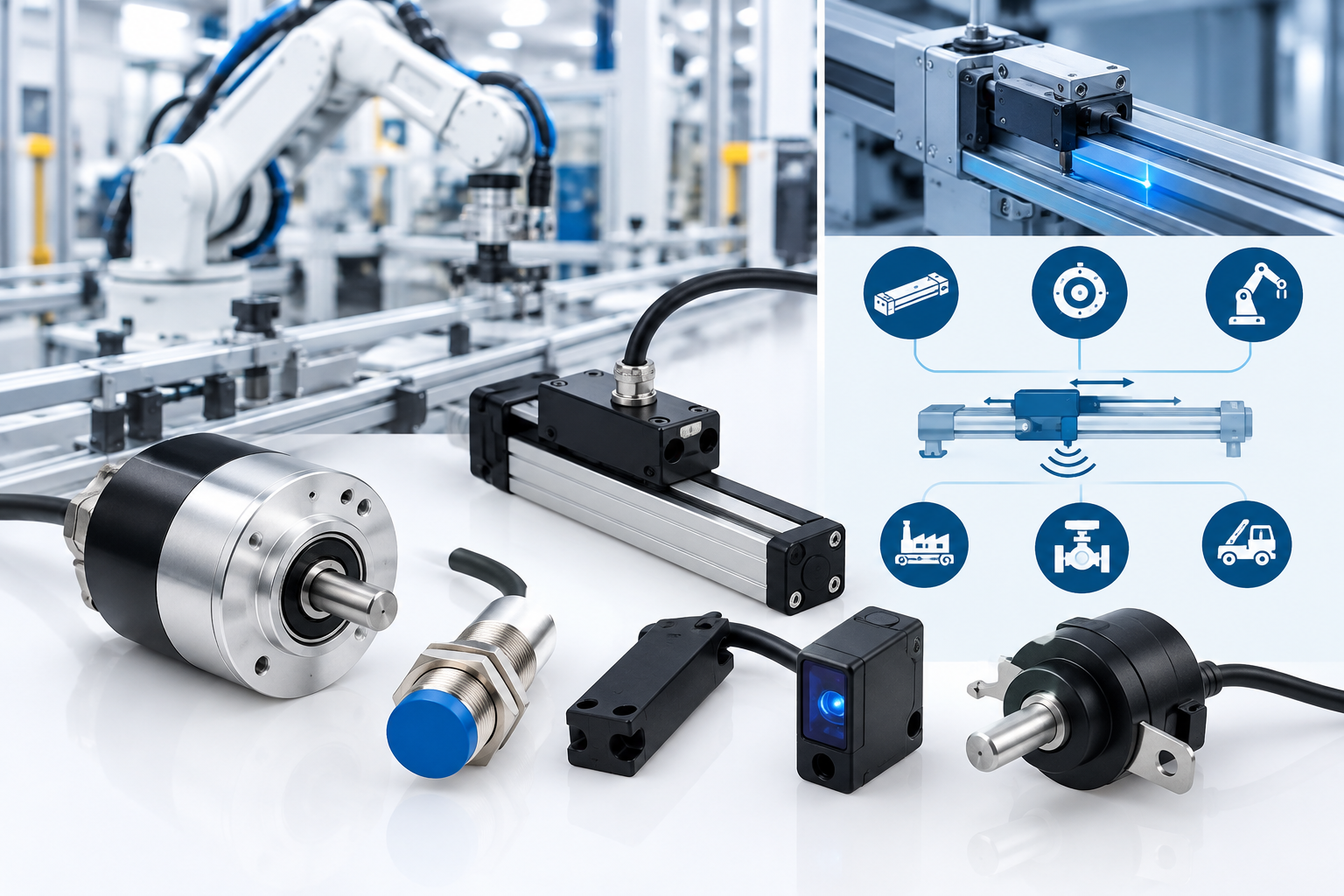
Industry 4.0 Accelerates Demand for Position Sensors
One of the most significant position sensor market trends in 2026 is the increasing integration of sensing technologies into Industry 4.0 environments. Smart factories rely on continuous feedback from machines, actuators, robots, and production equipment to improve automation, productivity, and operational visibility.
Position sensors enable this feedback by providing accurate information about component location and movement. As manufacturers deploy connected machinery and automated production lines, the requirement for real-time position measurement is expanding across machine tools, material handling systems, robotics, and motion-control applications.
The growing adoption of digital outputs is particularly relevant. Digital position sensing supports accurate data transmission, noise immunity, and integration with automated control systems, making it suitable for increasingly connected industrial environments.
3D and Non-Contact Sensing Transform Industrial Automation
Technology innovation is another major factor shaping the position sensor market. Advanced 3D position sensors are gaining traction because they can provide spatial and motion information across multiple axes. MarketsandMarkets expects the 3D sensor segment to register a 14.4% CAGR, supported by applications in robotics, automotive systems, industrial automation, and healthcare.
Non-contact sensing is also becoming increasingly important. Unlike contact-based technologies, non-contact position sensors can measure movement without mechanical interaction, helping reduce wear and maintenance requirements. These characteristics make them attractive for demanding applications where reliability, durability, and continuous operation are critical.
Inductive and magnetic technologies are also contributing to this evolution. Their ability to operate in challenging environments supports applications involving vibration, dust, moisture, and temperature variations.
Automotive Electrification Creates New Growth Opportunities
The automotive industry represents a major opportunity for position sensor manufacturers. EVs, ADAS, automated transmissions, electronic control systems, steering systems, motors, and braking systems all require accurate position feedback.
For example, TDK launched its HAL 3025 Fast Hall position sensor in May 2026, featuring high-speed analog sine/cosine outputs and stray-field compensation for high-speed motor-control applications, including EV powertrains, steering, and braking systems. The development illustrates how sensor manufacturers are adapting products to increasingly demanding automotive applications.
Automotive demand is expected to remain significant, with the automotive end-use industry projected to capture the largest position sensor market share in 2032.
Robotics and IoT Integration Expand Market Potential
The integration of position sensors with IoT platforms represents another important opportunity. Connected sensors can provide machine-level information to automation and monitoring systems, enabling more responsive control and supporting predictive and data-driven operations.
Robotics is particularly dependent on accurate position feedback. Industrial robots require precise information about joint angles, linear movement, and component positioning to perform repetitive tasks accurately. As automation expands into manufacturing, logistics, packaging, and other sectors, demand for advanced position sensing is expected to increase.
Market Challenges: Cost and Sensor Performance
Despite strong growth prospects, manufacturers face challenges related to sensor cost, performance limitations, and application-specific requirements. Position sensors can involve multiple components, including sensing elements, magnets, electronic housings, connectors, and signal-conditioning components, contributing to overall ownership and manufacturing costs.
Performance limitations involving sensing range, precision, and operating conditions can also restrict adoption in demanding applications. Autonomous systems, aerospace equipment, and other high-performance environments require sensors capable of maintaining accuracy under complex operating conditions.
Asia Pacific Emerges as a Key Growth Region
Asia Pacific is central to the expansion of the global position sensor market. The region accounted for approximately 42.5% of the market by value in 2025, while industrial automation, automotive and EV production, robotics, electronics manufacturing, and smart-factory investments continue to support regional demand. China, Japan, South Korea, and India are among the major markets contributing to this growth.
Future Outlook for the Position Sensor Market
The position sensor market in 2026 is transitioning toward higher precision, greater digital integration, non-contact measurement, and intelligent sensing. Advances in 3D sensing, Hall-effect technologies, TMR, inductive sensing, digital interfaces, and miniaturized sensing components are expected to expand the role of position sensors across industrial and automotive systems.
With the market projected to reach USD 23.40 billion by 2032, position sensors are expected to remain a foundational component of industrial automation, robotics, smart manufacturing, and next-generation mobility.
Find More Information on Position Sensor Market Innovation @ https://www.marketsandmarkets.com/Market-Reports/position-sensor-market-17719728.html
