The Visible Light Communication (VLC) / Li-Fi Market Growth is accelerating as organizations look for faster, more secure, reliable, and spectrum-efficient wireless communication technologies. VLC and Li-Fi use light waves, particularly light-emitting diodes (LEDs), to transmit data while simultaneously supporting illumination. This convergence of lighting and communication is creating new opportunities across smart stores, healthcare, transportation, enterprise connectivity, industrial environments, consumer electronics, and other connected applications.
High-Speed Connectivity Drives VLC and Li-Fi Adoption
One of the most important factors supporting Visible Light Communication (VLC) / Li-Fi Market Growth is the increasing demand for high-speed wireless connectivity. The rapid expansion of connected devices, cloud applications, IoT networks, video services, and data-intensive applications is increasing pressure on conventional wireless networks.
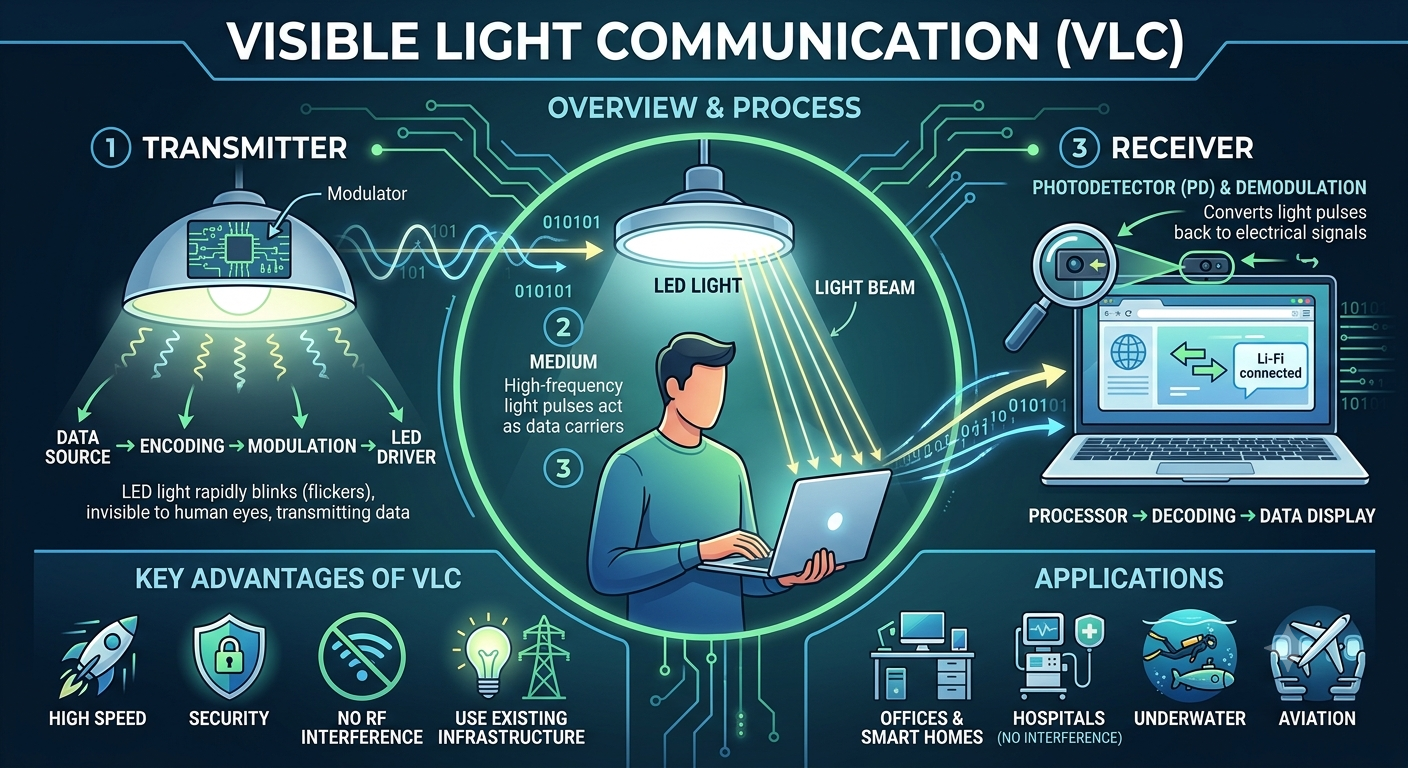
VLC/Li-Fi provides an alternative communication mechanism by transmitting information through modulated light. Unlike conventional radio-frequency technologies, Li-Fi uses the visible-light spectrum for communication. This creates opportunities to complement Wi-Fi and other wireless technologies in environments where additional capacity, security, or interference resistance is required.
The technology can support high data rates while using existing LED lighting infrastructure, making it particularly relevant for indoor connectivity applications.
Secure Data Transfer Strengthens Market Opportunities
Security is another important factor contributing to Visible Light Communication (VLC) / Li-Fi Market Growth. Light-based communication has a natural physical limitation because visible light generally does not pass through opaque walls. This can help confine communication signals within a specific physical area.
MarketsandMarkets identifies faster and safer data transfer as a primary growth driver for the VLC/Li-Fi market. The technology can offer high data rates and enhanced physical-layer security compared with conventional radio-based communication in certain indoor environments.
This characteristic makes Li-Fi relevant to applications requiring controlled wireless communication, including enterprise facilities, healthcare environments, industrial facilities, defense-related applications, and secure commercial environments.
LED Lighting and Communication Converge
The increasing deployment of LED lighting provides an important foundation for VLC technology. LEDs can be rapidly modulated to transmit data while continuing to provide illumination.
This convergence enables lighting infrastructure to become part of the communication network. Instead of deploying separate infrastructure for lighting and wireless communication, organizations can potentially use Li-Fi-enabled luminaires and optical receivers to establish localized wireless connections.
This approach is particularly relevant to smart buildings, offices, hospitals, retail stores, airports, educational institutions, and industrial facilities.
As LED lighting becomes increasingly connected and intelligent, the integration of communication capabilities can create additional value from existing lighting infrastructure.
Download PDF Brochure @ https://www.marketsandmarkets.com/pdfdownloadNew.asp?id=946
Bidirectional Communication Accelerates Li-Fi Market Growth
The bidirectional segment held a larger share of the VLC/Li-Fi transmission market in 2023 and is projected to maintain its leading position during the forecast period. Bidirectional VLC enables networked, two-way, high-speed wireless communication rather than simply transmitting information in one direction.
Bidirectional communication is important for modern connected environments because devices increasingly need to both receive and transmit data. Applications such as enterprise networking, smart stores, industrial monitoring, healthcare systems, and connected transportation can benefit from two-way communication.
The growing adoption of bidirectional systems therefore represents an important technology trend supporting Visible Light Communication (VLC) / Li-Fi Market Growth.
Software Emerges as a Fast-Growing Component
The VLC/Li-Fi market includes several key components, including LEDs, photodetectors, microcontrollers, and software. Among these components, the software segment is expected to register the highest CAGR, at 25.6% from 2024 to 2029.
Software plays an important role in managing communication protocols, network control, data processing, device management, and system optimization.
As Li-Fi networks become more sophisticated, software can support integration with existing enterprise networks, IoT platforms, smart lighting systems, and connected infrastructure.
The increasing importance of software also demonstrates how the Li-Fi ecosystem is moving beyond optical components toward complete networking solutions.
IoT Creates New Opportunities for VLC/Li-Fi
The expansion of the Internet of Things is creating additional opportunities for optical wireless communication. IoT environments can include large numbers of connected sensors, machines, devices, appliances, and infrastructure components that continuously generate and exchange data.
VLC/Li-Fi can support short-range connectivity for IoT devices, particularly in indoor environments where optical communication can complement existing wireless networks.
MarketsandMarkets identifies IoT expansion as a major trend influencing the FSO and VLC/Li-Fi industry. The growing number of connected devices is increasing demand for reliable, high-speed connectivity and creating opportunities for optical wireless technologies.
Li-Fi can also be integrated with smart lighting systems, enabling lighting infrastructure to become part of an IoT communication ecosystem.
5G and Li-Fi Can Complement Each Other
The expansion of 5G networks is also creating opportunities for complementary connectivity technologies. 5G provides high-speed wide-area connectivity, while VLC/Li-Fi can provide localized optical wireless connectivity in specific environments.
MarketsandMarkets identifies the emergence of applications related to IoT and 5G as an opportunity for the market.
Li-Fi can potentially help address connectivity requirements in high-density indoor environments where wireless capacity is increasingly important. Rather than replacing conventional networks, Li-Fi can operate as a complementary technology within heterogeneous communication architectures.
This complementary role could support market adoption as enterprises and infrastructure operators seek additional connectivity options.
Smart Stores Drive Application Growth
Smart stores are projected to account for the largest share of the VLC/Li-Fi market by application during the forecast period. Retailers are increasingly adopting connected technologies to improve customer experiences, operational efficiency, inventory management, and indoor positioning.
VLC/Li-Fi can support applications such as:
- Indoor positioning and location-based services
- Smart lighting
- Interactive displays
- Inventory management
- Customer engagement
- Secure wireless connectivity
The ability to combine lighting and communication makes VLC particularly relevant to retail environments where LED infrastructure is already widely deployed.
As retailers continue to adopt smart-store technologies, these applications can create additional opportunities for Visible Light Communication (VLC) / Li-Fi Market Growth.
Healthcare Applications Expand Li-Fi Opportunities
Healthcare is another important application area for optical wireless communication. Hospitals contain numerous connected devices and require reliable communication networks for patient monitoring, asset tracking, medical equipment, and operational management.
The MarketsandMarkets report identifies the hospital segment as the fastest-growing VLC/Li-Fi application from 2024 to 2029.
Li-Fi can provide localized connectivity within hospitals while reducing reliance on conventional radio-frequency communication in specific areas. Its potential use in sensitive environments where electromagnetic interference is a consideration creates additional application opportunities.
Hospital applications include asset tracking, data monitoring, and patient tracking, according to the market segmentation.
Industrial Connectivity Benefits from Optical Wireless Communication
Industrial facilities are increasingly adopting connected sensors, automated machinery, robotics, and Industry 4.0 technologies. These systems require reliable data communication to support real-time monitoring and operational decision-making.
Li-Fi can provide optical wireless connectivity in selected industrial environments. Its localized coverage and potential resistance to certain forms of radio-frequency interference can make it useful for specialized applications.
MarketsandMarkets identifies Industry 4.0/5.0, AI-driven automation, IoT expansion, and increasing demand for low-latency connectivity as trends influencing the industry.
The integration of Li-Fi with industrial sensors and connected equipment could therefore support more intelligent manufacturing and monitoring environments.
Automotive and Transportation Applications Create New Growth Areas
Connected transportation systems are generating demand for high-speed communication between vehicles, infrastructure, and devices. VLC can support applications involving intelligent transportation systems, location-based services, and vehicle-to-vehicle communication.
Light-based communication can use existing lighting infrastructure such as vehicle headlights, streetlights, traffic signals, and indoor transportation lighting systems for localized communication.
The market segmentation includes intelligent transportation systems, location-based services, and vehicle-to-vehicle communication within vehicles and transportation applications.
As transportation infrastructure becomes more connected, these applications could provide additional opportunities for optical wireless technologies.
Smart Infrastructure Accelerates Market Adoption
Smart cities and connected infrastructure are increasing demand for communication technologies that can support sensors, streetlights, transportation systems, public infrastructure, and location-based services.
VLC can be integrated into smart lighting infrastructure, allowing streetlights and indoor lighting systems to potentially serve dual roles as illumination and communication platforms.
MarketsandMarkets notes that rapid urban digitalization, smart city programs, and government-led adoption of next-generation connectivity are supporting market expansion, particularly in Asia Pacific.
This convergence between lighting, connectivity, and sensing could become an important source of long-term Visible Light Communication (VLC) / Li-Fi Market Growth.
Asia Pacific Leads Market Expansion
Asia Pacific is projected to register the highest growth rate in the FSO and VLC/Li-Fi market during the forecast period. Rapid digitalization, smart-city initiatives, increasing internet usage, expanding connectivity requirements, and adoption of bandwidth-intensive applications are supporting regional growth.
China and India are important contributors to the regional opportunity because of their growing internet user bases, expanding broadband infrastructure, mobile-device adoption, and increasing demand for high-speed connectivity.
Japan, South Korea, Singapore, and other Asia Pacific markets are also developing advanced digital infrastructure and smart-city ecosystems, creating opportunities for optical wireless communication technologies.
North America Maintains a Strong Market Position
North America accounted for 35.0% of the FSO and VLC/Li-Fi market revenue in 2024, according to MarketsandMarkets.
The region benefits from strong technology adoption, advanced enterprise infrastructure, research and development activities, and demand for high-performance communication technologies.
Enterprise connectivity, healthcare, defense and security, transportation, and consumer electronics represent potential application areas for VLC/Li-Fi technologies.
Emerging Technologies Expand Li-Fi Applications
The VLC/Li-Fi ecosystem is evolving as companies develop new platforms, components, networking systems, and application-specific solutions. Advancements in optical components, photodetectors, microcontrollers, software, and network management are improving the potential capabilities of Li-Fi systems.
MarketsandMarkets highlights the activities of companies such as Signify, pureLiFi, and Kyocera SLD Laser, including new Li-Fi platforms, technology partnerships, and expansion into industrial and enterprise environments.
The emergence of startups and specialized technology providers is also expanding the competitive landscape.
Key Companies Shaping the VLC/Li-Fi Market
The competitive ecosystem includes established lighting and communication technology companies as well as specialized Li-Fi providers.
Key companies identified by MarketsandMarkets include Signify Holding, Lucibel, fSONA Networks, Wireless Excellence, Oledcomm, pureLiFi, and Acuity Brands.
Other emerging companies and specialized players are developing solutions for enterprise connectivity, industrial communication, smart infrastructure, healthcare, and other niche applications.
Companies are focusing on product development, partnerships, network integration, and application-specific Li-Fi platforms to expand the commercial adoption of optical wireless communication.
Challenges Affecting Visible Light Communication (VLC) / Li-Fi Market Growth
Despite strong growth potential, the market faces several challenges. One challenge is limited technological awareness. Because VLC/Li-Fi remains an emerging technology, some potential users may lack familiarity with its capabilities, deployment models, and potential advantages.
Reliability can also be affected by signal fading during propagation. Unlike radio-based systems, optical communication depends on the availability and quality of the optical path between the transmitter and receiver.
System deployment can also require specialized components, receivers, networking equipment, and integration expertise. These factors can influence adoption decisions, particularly where conventional wireless technologies are already well established.
MarketsandMarkets identifies lack of technological awareness and reliability issues caused by fading signals as important market challenges.
Future Outlook for Visible Light Communication (VLC) / Li-Fi Market Growth
The future outlook for Visible Light Communication (VLC) / Li-Fi Market Growth is closely linked to the increasing demand for high-speed, secure, low-latency, and reliable wireless connectivity.
The market is projected to expand from USD 2.78 billion in 2024 to USD 7.39 billion by 2029, representing a 21.6% CAGR.
The growing number of connected devices, IoT applications, smart stores, healthcare systems, intelligent transportation networks, smart infrastructure, and enterprise connectivity requirements will create new opportunities for optical wireless communication.
Bidirectional communication is expected to remain an important technology segment, while software is projected to record the highest CAGR among VLC/Li-Fi components. Asia Pacific is expected to register the highest regional growth.
As LED lighting becomes increasingly intelligent and connected, the convergence of illumination and communication could enable new network architectures. Li-Fi is therefore positioned to complement conventional wireless technologies and provide targeted connectivity in environments where speed, security, spectrum availability, and localized communication are important.
Top 10 Key Takeaways
- The global FSO and VLC/Li-Fi market is projected to grow from USD 2.78 billion in 2024 to USD 7.39 billion by 2029.
- The market is expected to register a 21.6% CAGR from 2024 to 2029.
- Faster and safer data transfer is a major factor driving VLC/Li-Fi adoption.
- Bidirectional transmission is expected to maintain its leading position in the VLC/Li-Fi market.
- The VLC/Li-Fi software segment is projected to register the highest CAGR of 25.6%.
- Smart stores are projected to represent the largest VLC/Li-Fi application segment.
- Hospitals are expected to record the fastest application growth from 2024 to 2029.
- Asia Pacific is projected to register the highest growth rate during the forecast period.
- IoT, 5G, smart infrastructure, Industry 4.0, and connected devices are creating new Li-Fi opportunities.
- Secure, high-speed, localized wireless connectivity will remain a major theme shaping Visible Light Communication (VLC) / Li-Fi Market Growth.
Frequently Asked Questions
What is the size of the Visible Light Communication (VLC) / Li-Fi Market?
The global FSO and VLC/Li-Fi market was valued at USD 2.78 billion in 2024 and is projected to reach USD 7.39 billion by 2029.
What is the CAGR of the VLC/Li-Fi Market?
The market is projected to grow at a CAGR of 21.6% from 2024 to 2029.
What is driving Visible Light Communication (VLC) / Li-Fi Market Growth?
The major growth drivers include rising demand for high-speed wireless connectivity, faster and safer data transfer, increasing IoT adoption, 5G applications, smart infrastructure, and growing adoption of Li-Fi across industries.
Which VLC/Li-Fi component is expected to grow fastest?
The software segment is expected to register the highest CAGR, at 25.6% from 2024 to 2029, according to MarketsandMarkets.
Which region is expected to experience the fastest growth?
Asia Pacific is projected to register the highest growth rate in the FSO and VLC/Li-Fi market during the forecast period, supported by digitalization, smart-city development, connectivity expansion, and growing demand for high-speed networks.
About MarketsandMarkets™
MarketsandMarkets™ has been recognized as one of America’s Best Management Consulting Firms by Forbes, as per their recent report.
MarketsandMarkets™ is a blue ocean alternative in growth consulting and program management, leveraging a man-machine offering to drive supernormal growth for progressive organizations in the B2B space. With the widest lens on emerging technologies, we are proficient in co-creating supernormal growth for clients across the globe.
Today, 80% of Fortune 2000 companies rely on MarketsandMarkets, and 90 of the top 100 companies in each sector trust us to accelerate their revenue growth. With a global clientele of over 13,000 organizations, we help businesses thrive in a disruptive ecosystem.
The B2B economy is witnessing the emergence of $25 trillion in new revenue streams that are replacing existing ones within this decade. We work with clients on growth programs, helping them monetize this $25 trillion opportunity through our service lines – TAM Expansion, Go-to-Market (GTM) Strategy to Execution, Market Share Gain, Account Enablement, and Thought Leadership Marketing.
Built on the ‘GIVE Growth’ principle, we collaborate with several Forbes Global 2000 B2B companies to keep them future-ready. Our insights and strategies are powered by industry experts, cutting-edge AI, and our Market Intelligence Cloud, KnowledgeStore™, which integrates research and provides ecosystem-wide visibility into revenue shifts.
To find out more, visit www.MarketsandMarkets™.com or follow us on Twitter , LinkedIn and Facebook .
Contact:
Mr. Rohan Salgarkar
MarketsandMarkets™ INC.
1615 South Congress Ave.
Suite 103, Delray Beach, FL 33445
USA: +1-888-600-6441
