The Wide Format Printers Market Growth is being shaped by increasing demand for high-quality, customizable, and sustainable printing solutions across advertising, retail, textiles, packaging, décor, and industrial applications. As businesses increasingly prioritize visually engaging graphics, short production runs, personalization, and faster turnaround times, wide format printers are becoming important tools for commercial and industrial printing workflows.
Digital printing innovations are further transforming the market by improving print quality, production flexibility, substrate compatibility, and operational efficiency. Technologies such as inkjet printing, UV-curable inks, latex inks, eco-solvent printing, wireless connectivity, and automated workflows are enabling print service providers and enterprises to address increasingly diverse customer requirements.
According to MarketsandMarkets, the global large format printer market was valued at USD 7.94 billion in 2025 and is projected to reach USD 10.36 billion by 2030, registering a CAGR of 5.5% from 2025 to 2030. The market is driven by demand for customized printing across advertising, textiles, packaging, and industrial sectors, along with increasing adoption of sustainable printing technologies.
Digital Printing Innovations Accelerate Wide Format Printers Market Growth
Digital transformation is changing the way companies produce advertising graphics, signage, textile designs, packaging, interior décor, and technical documents. Unlike conventional printing processes that can require extensive setup, digital wide format printing provides greater flexibility for customized and short-run production.
Modern wide format printers can deliver high-resolution graphics across different substrates while supporting faster turnaround times. This flexibility is particularly valuable for businesses that need customized promotional materials, seasonal campaigns, personalized décor, vehicle graphics, and limited-volume production.
The increasing adoption of digital workflows is therefore supporting Wide Format Printers Market Growth by enabling businesses to respond quickly to changing customer requirements. Manufacturers are also investing in high-speed, high-resolution, multifunctional, and energy-efficient printing systems to improve productivity and reduce operating costs.
Rising Demand for Customized Printing Drives Market Expansion
Customization has become a significant factor influencing Wide Format Printers Market Growth. Retailers, brands, advertising agencies, textile companies, and packaging manufacturers increasingly require personalized graphics that can be produced quickly and economically.
Wide format printers enable businesses to produce customized banners, displays, wall graphics, apparel designs, packaging materials, posters, vehicle wraps, and promotional products. Digital workflows also make it easier to modify designs without significant changes to the production process.
The growth of e-commerce and retail is creating additional demand for customized visual communication. Brands increasingly use printed displays and promotional graphics to strengthen product visibility and create differentiated customer experiences.
MarketsandMarkets identifies increasing use of large format printers by textile, e-commerce, and retail companies as a key market driver. These printers provide businesses with customized, high-quality graphics while supporting faster turnaround and flexible designs.
Download PDF Brochure @ https://www.marketsandmarkets.com/pdfdownloadNew.asp?id=523
Advertising and Signage Remain Important Application Areas
Advertising and signage continue to represent important applications for wide format printing. Businesses use large-scale graphics for banners, posters, billboards, retail displays, exhibition graphics, point-of-sale materials, and promotional campaigns.
The substantial increase in outdoor advertising is supporting demand for large format printing equipment. UV-curable and other durable ink technologies can produce graphics designed to withstand outdoor conditions while maintaining strong image quality.
However, the growing use of digital signage creates a challenge for traditional printed advertising. Digital billboards, electronic displays, interactive LCDs, and dynamic point-of-sale systems can be updated rapidly and managed centrally.
As a result, wide format printer manufacturers are increasingly focusing on applications where physical graphics offer advantages such as tactile experiences, flexible substrate selection, personalization, and high-impact visual communication.
Digital Textile Printing Creates New Opportunities
Textile and apparel printing is emerging as an important opportunity for Wide Format Printers Market Growth. Digital textile printing enables manufacturers and brands to produce detailed designs, customized patterns, and smaller production batches without relying heavily on traditional printing processes.
The technology supports customization and rapid design changes, making it suitable for fashion, home textiles, promotional apparel, and specialty textile products.
Growing demand for personalized textiles is encouraging print providers to invest in advanced digital printing systems. The ability to produce high-resolution graphics across different fabrics and materials is also expanding the addressable market for wide format printing.
Asia Pacific is particularly important for this application because of its large textile manufacturing base and expanding retail and e-commerce industries.
Décor Applications Offer Significant Growth Potential
One of the most promising areas for Wide Format Printers Market Growth is décor. MarketsandMarkets projects the décor application segment to register the highest CAGR of 12.3% from 2025 to 2030.
Wide format printers are increasingly used to create customized wallpapers, wall graphics, canvas artwork, floor graphics, interior design concepts, and other decorative materials. The technology enables vibrant, high-resolution printing across a variety of media.
Vehicle wraps are another expanding application. Businesses can use digitally printed vehicle graphics for branding and mobile advertising, while consumers can personalize vehicles with customized designs.
The growing interest in personalized interiors and customized commercial spaces is creating new opportunities for printers, inks, substrates, and print service providers.
UV-Cured and Sustainable Inks Transform Printing
Ink technology is playing a central role in Wide Format Printers Market Growth. Ink-based printing is expected to maintain its dominant position, accounting for an estimated 91.5% market share in 2025, according to MarketsandMarkets.
UV-cured inks are expected to register the highest CAGR among ink types during the forecast period. These inks offer fast curing, durability, and compatibility with different substrates, making them suitable for signage, advertising, packaging, and décor.
Latex and eco-solvent technologies are also contributing to the transition toward more environmentally conscious printing. Businesses are increasingly looking for printing systems that can reduce environmental impact while maintaining high image quality and production efficiency.
The development of energy-efficient printers, sustainable inks, and recyclable substrates is expected to remain an important theme across the industry.
Automation and Wireless Connectivity Improve Workflow Efficiency
Automation is becoming increasingly important as print service providers seek to improve productivity and reduce manual intervention. Automated media handling, print monitoring, workflow management, and finishing technologies can help reduce production bottlenecks.
Wireless connectivity is another emerging trend. MarketsandMarkets expects wireless connectivity to record the highest CAGR of 5.7% during the forecast period.
Connected printers can improve communication between design systems, production environments, and workflow-management platforms. Integration with cloud-based systems can also support remote monitoring, centralized job management, and more flexible production environments.
The combination of connectivity and automation is therefore expected to contribute to Wide Format Printers Market Growth by helping businesses improve turnaround times and operational efficiency.
60–72-Inch Printers Support High-Volume Applications
Print width is another important factor shaping the market. Printers with a 60–72-inch print width are projected to record the highest CAGR during the forecast period.
These systems are suited to large-scale advertising, signage, textile, and industrial printing applications. Their ability to accommodate wider media can increase production efficiency when businesses need to produce large graphics or multiple items simultaneously.
The expansion of high-volume commercial printing and customized large-scale graphics is creating opportunities for manufacturers to develop faster and more flexible wide format printing systems.
Asia Pacific Emerges as a Fast-Growing Market
Asia Pacific is expected to register the highest CAGR in the global large format printer market during the forecast period. Growth is supported by expansion in advertising, retail, textiles, and packaging industries, along with increasing adoption of advanced printing technologies.
China, Japan, and India are important markets within the region. Manufacturers and print service providers are adopting inkjet, UV, and other digital printing technologies to address demand for high-resolution, customizable, and sustainable printing.
E-commerce expansion, urbanization, digital signage, and growing consumer demand for personalized products are further supporting regional opportunities.
The rapid development of textile and packaging industries also creates a strong application base for wide format printing technologies, supporting long-term Wide Format Printers Market Growth across the region.
North America Maintains a Strong Market Position
North America accounted for a 39.3% revenue share of the global large format printer market in 2024, according to MarketsandMarkets. The region has a mature ecosystem of printer manufacturers, print service providers, advertising companies, retailers, and industrial users.
Demand for high-quality graphics, signage, packaging, décor, and technical printing continues to support the adoption of advanced wide format printing equipment.
The region is also witnessing investments in automation, sustainable inks, and workflow technologies. These developments are helping commercial printers improve productivity while responding to customer demand for faster and more customized production.
High Initial Investment Remains a Restraint
Despite positive market prospects, the high initial investment required for large format printers remains a key restraint. Advanced equipment can require significant capital expenditure, while specialized substrates, inks, electricity, maintenance, and service requirements add to operating costs.
Professional printing also requires specialized inks capable of delivering durability, UV resistance, color accuracy, and high-resolution output. These consumables can increase the overall cost of ownership.
These factors can create adoption barriers for smaller businesses and print providers, particularly in emerging markets. Manufacturers are consequently focusing on developing more affordable systems with advanced features to expand their customer base.
In-Plant Printing Opens New Market Opportunities
The increasing use of large format printers in in-plant operations is creating another opportunity for market participants. Companies can bring certain printing activities in-house rather than outsourcing them to third-party providers.
In-house printing can provide greater control over production schedules, customization, quality, and turnaround times. Retailers, corporations, educational institutions, manufacturers, and other organizations can use wide format printers for internal signage, promotional materials, technical documents, displays, and décor.
This shift toward decentralized and on-demand production could contribute to Wide Format Printers Market Growth as organizations seek greater control over their printing workflows.
Recent Product Innovation Strengthens Competitive Dynamics
Printer manufacturers are continuing to introduce products designed to improve speed, image quality, environmental performance, and workflow efficiency.
In January 2025, Canon introduced the ImagePROGRAF TZ-5320 and TX Series large format printers, incorporating improved color performance, printing speeds of up to 4 pages per minute, lower energy consumption, and environmentally oriented packaging features. In April 2025, Epson launched the SureColor S7170, a 64-inch signage printer designed for small sign shops and featuring PrecisionCore technology and multiple ink options.
These developments demonstrate how manufacturers are competing through print quality, productivity, sustainability, connectivity, and application flexibility.
Key Companies Shaping the Wide Format Printing Landscape
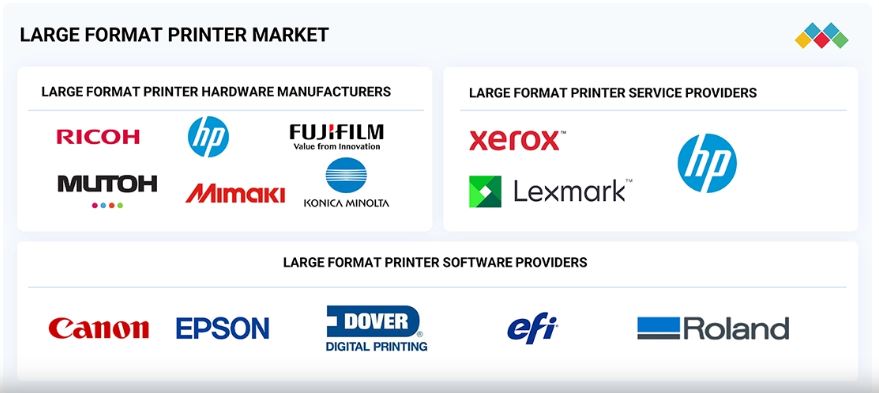
The competitive landscape includes established global printer manufacturers with extensive product portfolios and technology capabilities. Major companies identified by MarketsandMarkets include HP Development Company, Canon, Seiko Epson, Brother Industries, and Mimaki Engineering.
Companies are focusing on product development, strategic partnerships, workflow integration, sustainable printing technologies, and application-specific solutions to strengthen their market positions.
The competitive environment is also creating opportunities for specialized manufacturers and emerging companies serving niche applications such as textile printing, décor, vehicle graphics, and industrial printing.
Future Outlook for Wide Format Printers Market Growth
The future of Wide Format Printers Market Growth will be shaped by the convergence of digital printing, automation, connectivity, sustainability, and customization. Businesses increasingly require printing technologies that can deliver high-quality graphics quickly while supporting diverse substrates and shorter production runs.
The expansion of décor, textile, packaging, vehicle graphics, retail displays, and in-plant printing will create new opportunities beyond traditional advertising and signage. At the same time, innovations in UV-cured inks, latex inks, automated workflows, wireless connectivity, and energy-efficient equipment will continue to improve the value proposition of wide format printers.
With the global large format printer market projected to reach USD 10.36 billion by 2030 from USD 7.94 billion in 2025, the industry is positioned for continued expansion. The 5.5% CAGR during 2025–2030 reflects sustained demand for customized, high-quality, flexible, and increasingly sustainable digital printing solutions.
As commercial printing continues to move toward on-demand production and personalized visual communication, digital printing innovations will remain central to Wide Format Printers Market Growth, creating opportunities across advertising, retail, textiles, packaging, décor, and industrial applications.
Frequently Asked Questions
1. What is the projected size of the Wide Format Printers Market?
The global large format printer market is projected to grow from USD 7.94 billion in 2025 to USD 10.36 billion by 2030, at a CAGR of 5.5%.
2. What are the key applications driving Wide Format Printers Market Growth?
Advertising, signage, textiles, packaging, décor, retail, vehicle graphics, and industrial printing are key applications supporting Wide Format Printers Market Growth.
3. Which application segment is expected to grow at the highest CAGR?
The décor application segment is projected to register the highest CAGR of 12.3% from 2025 to 2030, driven by demand for customized wallpapers, interior graphics, floor graphics, and other decorative products.
4. Which region is expected to experience the fastest market growth?
Asia Pacific is expected to register the highest CAGR during the forecast period, supported by growth in advertising, textiles, packaging, retail, and digital printing adoption.
5. Who are the major companies in the Wide Format Printers Market?
Major companies include HP Development Company, Canon, Seiko Epson, Brother Industries, and Mimaki Engineering.
