The rapid advancement of artificial intelligence and autonomous networking technologies is fundamentally transforming modern military operations. AI-enabled long-range attritable drone communication systems are emerging as one of the most disruptive innovations in contemporary defense strategy, enabling militaries to deploy scalable autonomous drone fleets capable of operating across contested, multi-domain battlefields.
These next-generation communication architectures are redefining how unmanned systems conduct intelligence, surveillance, reconnaissance (ISR), electronic warfare, precision strike missions, and coordinated swarm operations. By combining resilient connectivity with AI-driven autonomy, defense organizations are creating highly adaptive combat ecosystems designed for speed, survivability, and operational scale.
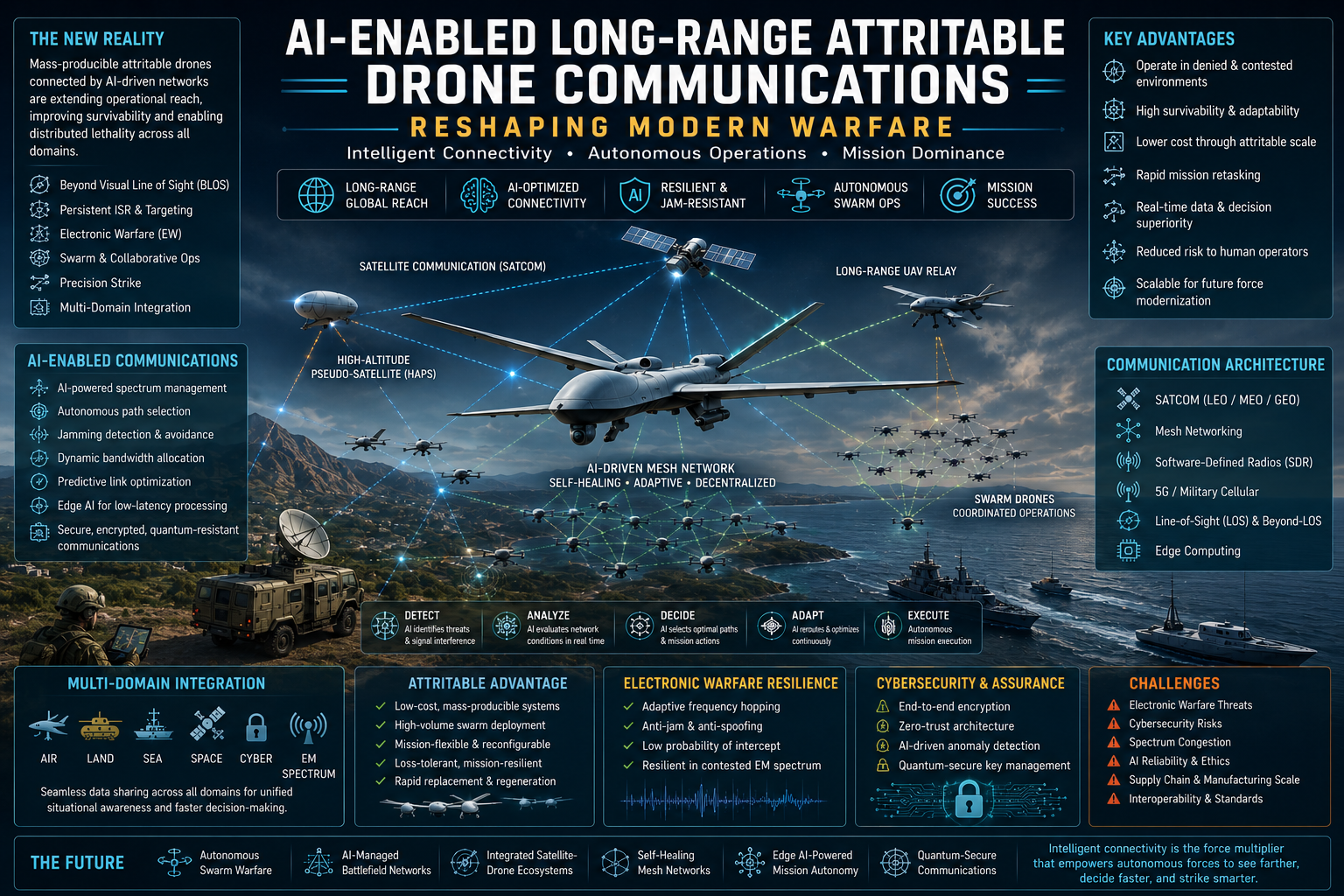
The Emergence of Attritable Autonomous Warfare
Attritable drones represent a new class of military unmanned systems engineered to balance affordability with advanced operational capability. Unlike high-cost strategic UAVs, attritable drones are designed to be mass-produced and deployed in large numbers while remaining expendable if lost during combat operations.
Modern military planners increasingly favor attritable systems because they provide:
- Lower procurement costs
- Rapid battlefield scalability
- Distributed operational resilience
- Reduced risk to human operators
- High-volume swarm deployment capability
- Faster manufacturing turnaround
However, the true effectiveness of these systems depends heavily on advanced long-range communication infrastructures capable of maintaining connectivity in highly contested environments.
Download PDF Brochure @ https://www.marketsandmarkets.com/pdfdownloadNew.asp?id=139489979
AI as the Core of Next-Generation Drone Communications
Artificial intelligence is becoming central to military drone communication systems. AI-powered communication architectures now enable drones to operate with significantly greater autonomy, flexibility, and survivability.
AI-enabled systems can autonomously:
- Detect signal interference and jamming
- Select optimal communication pathways
- Dynamically reroute network traffic
- Coordinate autonomous swarm behavior
- Prioritize mission-critical data
- Maintain operations despite signal degradation
- Optimize bandwidth allocation in real time
This evolution is reducing dependence on centralized command structures while improving the ability of autonomous systems to function independently across rapidly changing combat environments.
Long-Range Connectivity Expanding Operational Reach
Traditional military drone operations were often restricted by line-of-sight communication limitations. Next-generation long-range communication technologies are removing these barriers by enabling beyond-line-of-sight (BLOS) operations across extended operational theaters.
Modern drone communication systems now incorporate:
Satellite Communication (SATCOM)
Satellite-based links provide global operational reach and support persistent drone operations across remote regions.
Mesh Networking
Self-healing mesh networks allow drones to relay communications dynamically across distributed fleets.
Software-Defined Radios (SDR)
Adaptive radio technologies enable drones to switch frequencies and communication protocols automatically.
AI-Driven Spectrum Management
Artificial intelligence continuously optimizes spectrum usage to avoid congestion and hostile interference.
Edge Computing
Onboard AI processing enables drones to analyze and filter data locally before transmission.
These technologies collectively support resilient communication ecosystems capable of surviving electronic warfare threats and maintaining operational continuity under hostile conditions.
Autonomous Swarm Warfare Becoming Reality
One of the most transformative applications of AI-enabled long-range communications is autonomous swarm warfare. Defense organizations worldwide are accelerating development of coordinated drone swarms capable of conducting collaborative military missions with limited human oversight.
AI-enabled swarms can perform:
- Saturation attacks against air defenses
- Persistent ISR surveillance
- Distributed electronic warfare operations
- Cooperative target identification
- Dynamic battlefield mapping
- Decentralized strike coordination
Advanced communication systems allow these swarms to maintain synchronized operations even when portions of the network experience disruption or drone losses.
The ability of swarms to self-organize and adapt in real time significantly enhances battlefield resilience while complicating enemy defensive strategies.
AI-enabled drone communication systems are becoming a foundational component of this doctrine by enabling seamless data sharing and coordination between autonomous systems, satellites, manned platforms, naval forces, and battlefield command networks.
This integration enhances:
- Real-time situational awareness
- Decision-making speed
- Precision targeting capability
- Distributed command-and-control
- Electronic warfare responsiveness
As military operations become increasingly network-centric, communication resilience is evolving into a decisive battlefield advantage.
Electronic Warfare Resilience and Cybersecurity
One of the primary challenges facing autonomous military operations is the growing sophistication of electronic warfare and cyber threats.
Adversaries increasingly deploy:
- GPS spoofing systems
- Communication jammers
- Cyber intrusion tools
- Spectrum denial technologies
- Electromagnetic attack capabilities
AI-enabled communication systems help counter these threats through:
Adaptive Frequency Hopping
Systems dynamically shift communication frequencies to avoid jamming attempts.
Autonomous Path Selection
AI identifies the safest and most reliable communication routes in real time.
Self-Healing Networks
Distributed mesh architectures automatically restore damaged communication pathways.
Quantum-Resistant Encryption
Advanced encryption protocols strengthen protection against future cyber threats.
These capabilities significantly improve the survivability of autonomous drone operations in contested electromagnetic environments.
Defense Innovation and Strategic Competition
Global defense powers are rapidly investing in AI-enabled autonomous communication systems as geopolitical competition intensifies. Nations are increasingly recognizing that future battlefield superiority will depend not only on weapon systems themselves, but on the resilience and intelligence of the communication networks connecting autonomous forces.
Key drivers accelerating market growth include:
- Rising defense modernization programs
- Increasing demand for autonomous warfare capabilities
- Expansion of military satellite networks
- Development of low-cost drone manufacturing
- Advancements in AI and machine learning
- Growing emphasis on distributed operations
- Escalating electronic warfare threats
The integration of AI with long-range drone communications is also enabling defense organizations to achieve greater operational efficiency while reducing risks to personnel.
Challenges Limiting Large-Scale Deployment
Despite rapid technological progress, several critical challenges remain.
Spectrum Congestion
Large-scale drone deployments require substantial communication bandwidth.
AI Reliability and Decision Transparency
Autonomous systems must operate safely and predictably under complex battlefield conditions.
Supply Chain Constraints
Semiconductor shortages and component dependencies continue affecting defense production capacity.
Ethical and Regulatory Concerns
The growing role of autonomous weapons raises international legal and ethical debates regarding human oversight and rules of engagement.
Interoperability Issues
Coalition operations require communication systems capable of functioning across diverse military platforms and standards.
Addressing these challenges will remain a priority for defense agencies and industry leaders over the coming decade.
Future Outlook
AI-enabled long-range attritable drone communication systems are poised to become one of the defining technologies of next-generation warfare. As artificial intelligence, satellite communications, autonomous networking, and edge computing continue to advance, military drone ecosystems will become increasingly intelligent, scalable, and resilient.
Future battlefield networks are expected to feature:
- Fully autonomous tactical drone swarms
- AI-managed battlefield communication grids
- Integrated satellite-drone ecosystems
- Self-healing mesh architectures
- Quantum-secure communication protocols
- Real-time multi-domain operational coordination
- Edge AI-driven mission autonomy
These advancements will fundamentally reshape how military operations are conducted across the global defense landscape.
In the emerging era of autonomous warfare, communication resilience is becoming as strategically important as firepower itself. Militaries capable of maintaining secure, adaptive, and intelligent autonomous communication networks will possess a decisive operational advantage in future conflicts.
