The Future of Attritable Drone Communications in Long-Range Military and ISR Missions Market is rapidly emerging as one of the most strategically important segments within the global defense technology ecosystem. As of 2025, the market is estimated to be valued at approximately USD 5.36 billion, driven by increasing investments in autonomous military systems, AI-enabled battlefield communications, and long-range ISR operations. The market is projected to reach USD 13.26 billion by 2030, expanding at a CAGR of 19.9% during the forecast period.
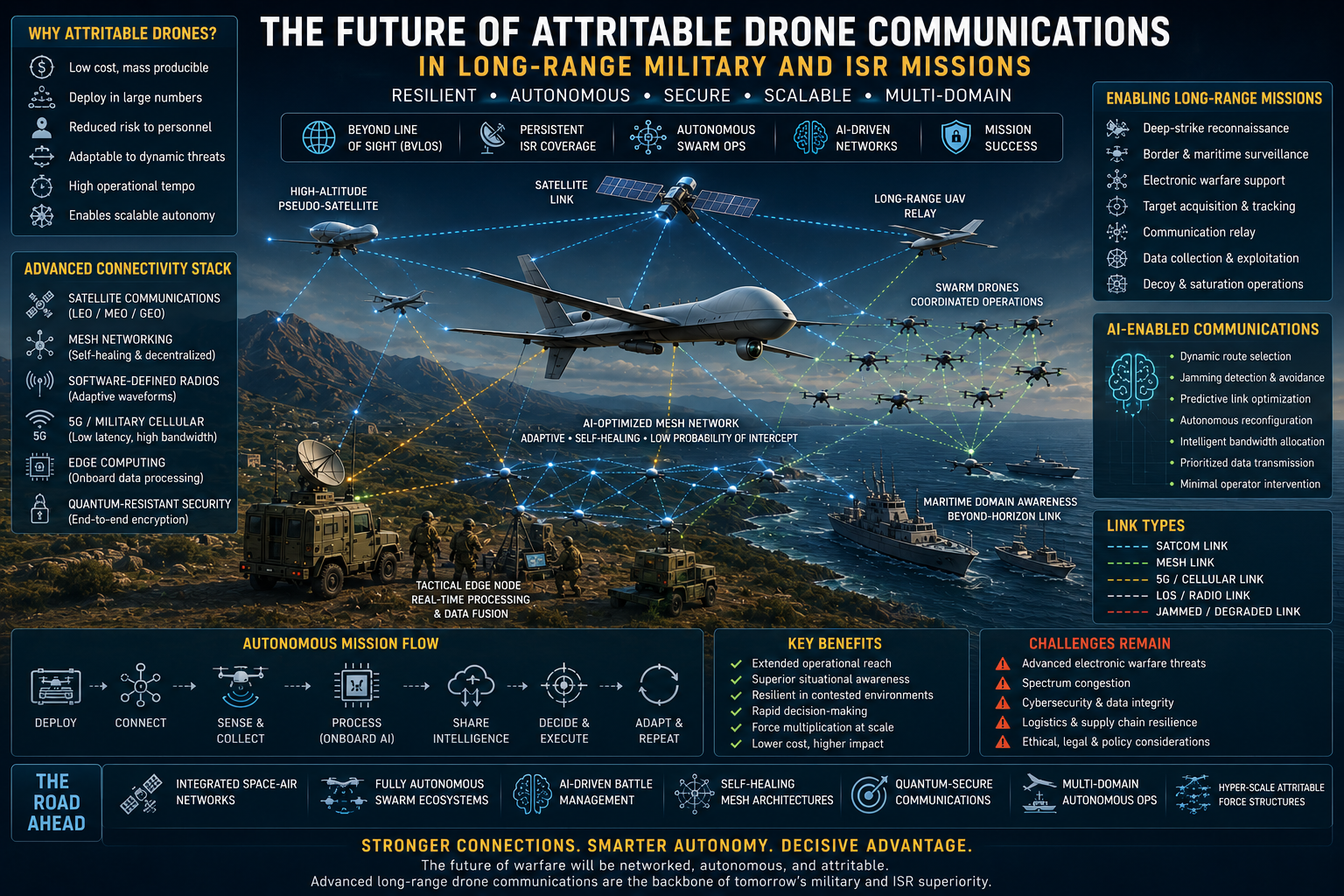
The growth of this market is being fueled by the rising adoption of attritable drones capable of conducting surveillance, electronic warfare, tactical strike missions, and intelligence gathering in contested environments. Modern military operations increasingly rely on resilient long-range communication systems that support autonomous coordination, Beyond Visual Line of Sight (BVLOS) capabilities, and secure real-time data transfer. Artificial intelligence, IoT-enabled battlefield networking, automation, and software-defined communication architectures are becoming essential for maintaining operational superiority in modern warfare. Defense organizations worldwide are prioritizing digital battlefield transformation programs, driving demand for secure and adaptive communication infrastructures for autonomous drone fleets.
Access 100+ Data Tables & Charts @ https://www.marketsandmarkets.com/pdfdownloadNew.asp?id=139489979
Key Market Trends & Insights
North America currently dominates the market due to high defense spending, extensive UAV deployment, and advanced military communication infrastructure. Asia Pacific is expected to witness the fastest growth owing to rising geopolitical tensions, expanding indigenous drone programs, and military modernization initiatives.
Long-range tactical communication systems remain the dominant segment because they enable secure and continuous connectivity across distributed drone operations. AI-powered adaptive networking technologies are rapidly emerging as a major innovation area.
Another important trend is the integration of mesh networking and edge computing capabilities into military drone ecosystems. These technologies allow autonomous drones to communicate directly with one another while reducing dependency on centralized command systems.
Automation and AI are significantly enhancing mission coordination, autonomous swarm communication, predictive signal optimization, and anti-jamming capabilities. Additionally, satellite-enabled communication systems and low-earth orbit (LEO) connectivity solutions are becoming increasingly important for ISR and cross-domain operations.
Market Size & Forecast
- Base year market size (2025): USD 5.36 billion
- Forecast value by 2030: USD 13.26 billion
- CAGR (2025–2030): 19.9%
- Growth is driven by AI-enabled tactical networking, increasing drone deployments, and rising investments in autonomous ISR missions and electronic warfare systems
Attritable Drone Market Top 10 key takeaway
- The market is projected to more than double by 2030 due to rising autonomous warfare adoption
- North America leads global investments in long-range drone communications
- Asia Pacific is the fastest-growing regional market
- AI-enabled communication systems are transforming autonomous operations
- Mesh networking is becoming critical for swarm coordination
- BVLOS communication infrastructure is a major growth driver
- Electronic warfare resilience is increasingly shaping communication technologies
- Satellite-based connectivity solutions are gaining strategic importance
- Edge computing is enabling real-time mission autonomy
- Defense modernization initiatives worldwide are accelerating market expansion
Product Insights
The market is primarily dominated by long-range tactical communication systems designed for autonomous drone operations in highly contested military environments. These systems enable secure real-time communication between drones, command centers, satellites, and ground forces. Their dominance is attributed to growing military demand for resilient communication infrastructure capable of supporting ISR, surveillance, and coordinated swarm operations across extended operational ranges.
Satellite communication (SATCOM) modules represent another major product segment due to their ability to provide Beyond Visual Line of Sight connectivity across remote and denied environments. Modern ISR missions increasingly depend on multi-layered communication architectures that combine satellite connectivity, tactical radio systems, and mesh networks.
Emerging product categories include AI-driven autonomous communication platforms capable of adaptive signal routing and intelligent spectrum allocation. These systems can automatically optimize bandwidth usage, reroute signals under electronic attack conditions, and maintain connectivity during communication disruption.
Edge-enabled communication gateways and software-defined radio systems are also witnessing strong demand as defense organizations prioritize flexible and scalable communication infrastructures. AI-powered anti-jamming technologies and self-healing network architectures are becoming core differentiators in next-generation military drone communication systems.
Technology / Component Insights
The Future of Attritable Drone Communications in Long-Range Military and ISR Missions Market is heavily driven by advanced technologies that improve connectivity, resilience, and mission autonomy. Artificial intelligence is playing a transformative role by enabling autonomous network management, adaptive signal processing, and predictive communication optimization.
AI-powered communication systems can dynamically allocate frequencies, identify interference patterns, and autonomously reroute communication pathways to maintain operational continuity. These capabilities are especially important in electronic warfare-heavy combat environments.
The Internet of Things is enabling seamless interconnectivity between drones, sensors, satellites, and command systems. IoT-enabled battlefield ecosystems provide real-time situational awareness and coordinated mission execution across distributed autonomous platforms.
Cloud and edge computing technologies are also reshaping communication architectures. Cloud platforms support centralized intelligence analysis and mission planning, while edge computing enables ultra-low latency processing directly on the battlefield. This significantly enhances autonomous response capabilities and reduces communication dependency on remote command centers.
Automation technologies are supporting autonomous swarm communication, real-time mission coordination, and predictive maintenance systems. Future innovation trends include quantum-resistant encryption, autonomous spectrum management, decentralized mesh communication frameworks, and integrated 5G tactical networking.
Application Insights
ISR (Intelligence, Surveillance, and Reconnaissance) operations currently represent the leading application segment in the market. Modern military forces increasingly rely on autonomous drones equipped with long-range communication systems to conduct persistent surveillance, target tracking, and battlefield intelligence gathering in contested environments.
Electronic warfare applications are also growing rapidly due to increasing concerns regarding signal disruption, cyberattacks, and communication jamming. Advanced communication systems capable of resisting electronic warfare attacks are becoming essential for future combat operations.
Combat strike missions and autonomous swarm operations are emerging as high-growth application areas. Attritable drones equipped with resilient communication systems can execute coordinated strikes, decoy missions, and electronic suppression operations while minimizing risk to human personnel.
Future opportunities are expected in naval ISR operations, border security, maritime surveillance, and multi-domain autonomous battlefield coordination. The growing adoption of autonomous combat ecosystems is likely to create sustained demand for advanced drone communication infrastructures.
Regional Insights
North America dominates the market due to extensive defense modernization programs, high UAV deployment rates, and significant investments in AI-enabled military communications. The United States continues to lead global innovation in autonomous warfare technologies and resilient tactical networking systems.
Europe is experiencing steady growth driven by increasing investments in defense sovereignty, collaborative military programs, and indigenous drone development initiatives. Regional governments are prioritizing secure autonomous communication capabilities amid rising geopolitical instability.
Asia Pacific is projected to be the fastest-growing market owing to rising defense expenditures, military modernization initiatives, and increasing focus on indigenous drone production. China, Japan, South Korea, and India are heavily investing in autonomous ISR systems and long-range tactical communication technologies.
- North America leads due to strong military communication infrastructure
- Europe benefits from collaborative defense modernization initiatives
- Asia Pacific is witnessing the fastest growth due to geopolitical tensions
- AI-driven tactical networking adoption is increasing globally
- Government investments are accelerating autonomous communication system development
Country Specific Market Trends
China is aggressively expanding its military drone ecosystem through investments in AI-enabled tactical communication systems and autonomous swarm technologies. The country is prioritizing indigenous development of resilient communication infrastructures for electronic warfare and ISR operations. China’s market is expected to grow at a CAGR of 10%–12%.
Japan is focusing on autonomous defense modernization and AI-enabled surveillance technologies. The country is investing in advanced mesh networking systems and integrated tactical communication platforms, with projected CAGR growth of 8%–10%.
The United States remains the global leader in long-range autonomous drone communications due to extensive defense budgets and continuous innovation in AI-driven warfare technologies. The U.S. market is projected to grow at a CAGR of 7%–9%.
Canada and Mexico are also strengthening military surveillance and border security capabilities through increasing adoption of advanced ISR communication systems.
Germany and France are leading Europe’s autonomous defense communication market through collaborative drone development programs and strategic military modernization initiatives. Both countries are expected to grow at a CAGR of 7%–8%.
- China leads APAC growth with AI-enabled autonomous networking investments
- Japan focuses on ISR modernization and resilient communication systems
- United States dominates due to advanced defense innovation capabilities
- Germany and France are strengthening collaborative drone communication programs
- Border security and ISR applications are driving adoption globally
Key Attritable Drone Company Insights
The competitive landscape is characterized by major defense technology companies focusing on AI-enabled communication architectures, autonomous tactical networking, and advanced ISR connectivity solutions. Companies are heavily investing in research and development to strengthen secure communication capabilities for autonomous military systems.
Leading organizations are integrating artificial intelligence, software-defined radio technologies, and edge computing into communication platforms to improve resilience and operational efficiency. Modular communication architectures are gaining popularity because they allow defense organizations to rapidly upgrade systems without extensive infrastructure replacement.
Strategic partnerships between defense contractors, satellite providers, and AI technology companies are accelerating innovation across the market. Cybersecurity and anti-jamming capabilities are also becoming critical competitive differentiators.
Major companies operating in the market include Lockheed Martin, Northrop Grumman, RTX Corporation, L3Harris Technologies, BAE Systems, Thales Group, Saab AB, Leonardo S.p.A., Elbit Systems, and General Atomics.
- Companies are prioritizing AI-enabled tactical communication systems
- Software-defined communication platforms are gaining strong adoption
- Strategic partnerships are accelerating innovation capabilities
- Anti-jamming and cybersecurity technologies are key competitive areas
- Investment in autonomous networking solutions is increasing rapidly
Recent Developments
Several defense companies have recently introduced AI-enabled drone communication systems capable of autonomous spectrum optimization and adaptive anti-jamming operations. These systems are designed to maintain operational continuity during contested missions.
Partnerships between satellite communication providers and defense contractors are also increasing, particularly for low-earth orbit (LEO) connectivity integration into autonomous ISR operations. These collaborations are enhancing long-range communication resilience and expanding mission flexibility.
Additionally, defense organizations are launching autonomous swarm communication programs focused on decentralized mesh networking and collaborative AI-driven battlefield coordination.
Market Segmentation
The market is segmented by product, technology/component, application, and region. By product, the market includes tactical communication systems, satellite communication systems, mesh networking platforms, and software-defined radio systems. Tactical communication systems currently dominate due to their critical role in ISR and autonomous combat missions.
By technology/component, the market is segmented into AI-enabled communication systems, IoT battlefield networking, cloud and edge computing platforms, autonomous mesh networking, and cybersecurity systems. AI-driven communication technologies are expected to witness the fastest growth due to increasing battlefield automation requirements.
By application, the market includes ISR missions, electronic warfare, combat strike operations, swarm coordination, maritime surveillance, and border security. ISR operations remain the dominant segment due to increasing demand for persistent battlefield intelligence.
Regionally, the market is divided into North America, Europe, Asia Pacific, and the rest of the world, with North America leading and Asia Pacific emerging as the fastest-growing region.
- Tactical communication systems dominate the product segment
- AI-enabled networking technologies are witnessing the fastest growth
- ISR operations remain the largest application area
- Swarm communication systems are emerging rapidly
- Asia Pacific is expected to record the highest regional growth
Conclusion
The Future of Attritable Drone Communications in Long-Range Military and ISR Missions Market is positioned for substantial growth through 2035 as defense organizations increasingly prioritize autonomous warfare, AI-driven battlefield coordination, and resilient ISR operations. Advanced communication systems are becoming the foundation of modern military drone ecosystems, enabling secure, adaptive, and decentralized operations across contested environments.
The integration of artificial intelligence, IoT-enabled battlefield networking, edge computing, and autonomous swarm communication technologies is reshaping military operational strategies worldwide. Companies investing in resilient communication architectures, anti-jamming systems, and autonomous tactical networking will be best positioned to capitalize on emerging opportunities.
As autonomous military systems become central to future warfare strategies, long-range drone communication technologies will continue to evolve as a critical strategic capability for defense organizations globally.
