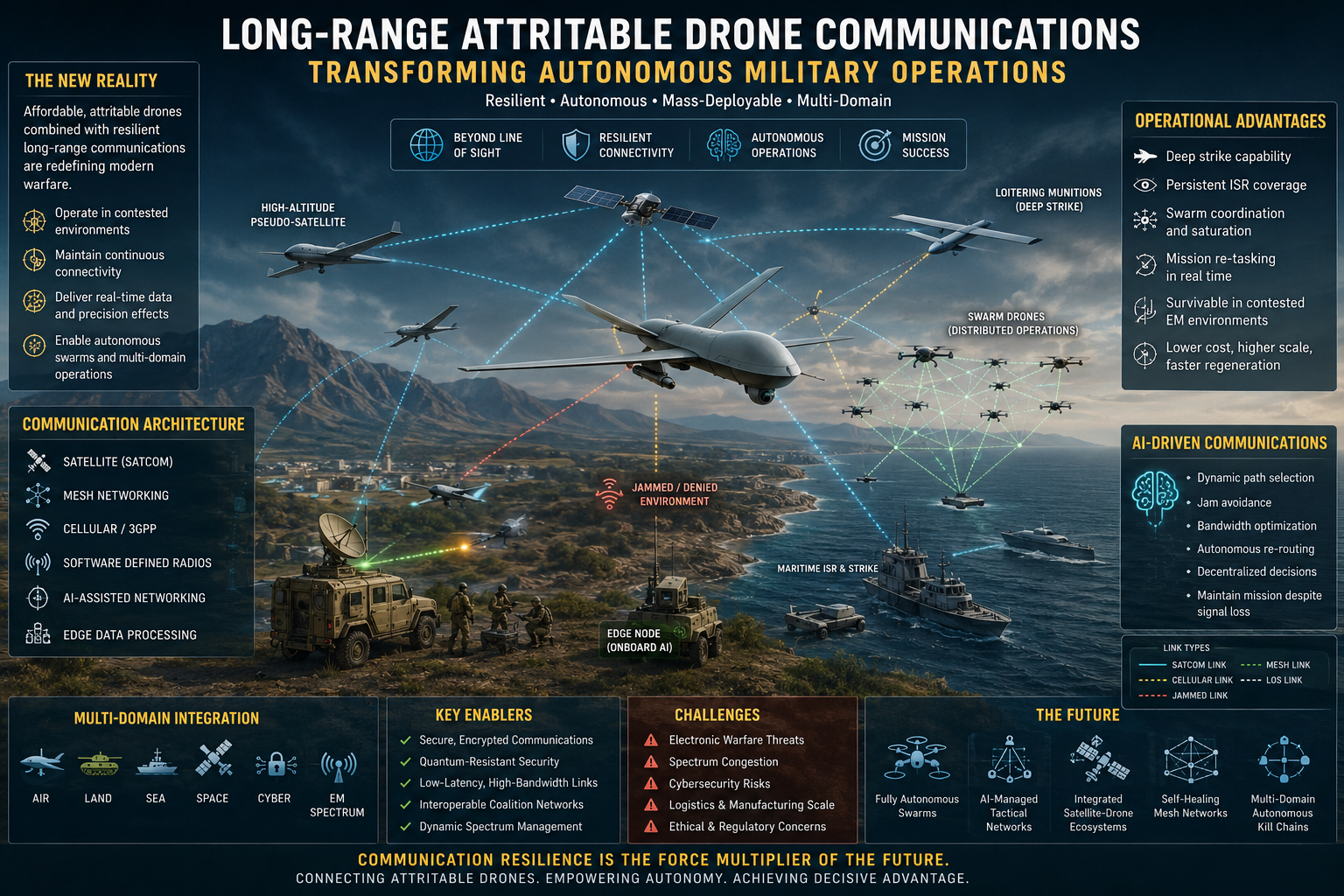
The future of autonomous warfare is being reshaped by a new generation of long-range, attritable drone communication systems. Modern military forces are increasingly investing in low-cost unmanned aerial vehicles (UAVs) capable of operating in contested environments while maintaining secure, resilient, and beyond-line-of-sight (BLOS) connectivity. These systems are redefining how militaries conduct intelligence, surveillance, reconnaissance (ISR), electronic warfare, loitering missions, and coordinated swarm operations.
The Loitering Munitions / Attritable Drones Industry is projected to grow from USD 5.36 billion in 2025 to USD 13.26 billion by 2030 at a CAGR of 19.9% from 2025 to 2030.
Download PDF Brochure @ https://www.marketsandmarkets.com/pdfdownloadNew.asp?id=139489979
Recent developments in military drone communication networks highlight the growing importance of resilient connectivity as a force multiplier. Companies such as Somewear Labs are introducing multi-network radios designed specifically for attritable unmanned systems that can automatically transition between line-of-sight and satellite communications during signal degradation.
The Rise of Attritable Autonomous Systems
Attritable drones occupy a strategic middle ground between disposable tactical UAVs and highly expensive advanced combat aircraft. These systems are affordable enough to be deployed in large numbers while still carrying sophisticated sensors, AI-driven autonomy, and precision payloads. Defense planners increasingly favor attritable platforms because they can absorb battlefield losses without significantly impacting operational capability.
The ongoing evolution of warfare in regions such as Eastern Europe and the Indo-Pacific has accelerated the demand for scalable drone fleets capable of operating autonomously across distributed battlefields. European and U.S. defense modernization programs are now prioritizing low-cost autonomous systems, swarm tactics, and rapidly deployable drone ecosystems.
Modern drone warfare no longer depends solely on platform performance. Instead, operational success increasingly relies on how effectively drones integrate into resilient communication architectures capable of supporting high-speed decision-making, real-time data transfer, and autonomous mission execution.
Connectivity as the Core of Autonomous Warfare
Advanced communications infrastructure is becoming the backbone of autonomous military operations. Military experts increasingly recognize that autonomy alone is insufficient without uninterrupted command-and-control (C2) connectivity.
According to defense industry analyses, future military drone effectiveness will depend heavily on secure long-range communication links capable of supporting:
- Beyond Visual Line of Sight (BVLOS) operations
- Autonomous swarm coordination
- Real-time ISR data streaming
- Mission re-tasking during flight
- Distributed battlefield networking
- Electronic warfare resilience
- Multi-domain interoperability
Defense communication technologies are now evolving toward hybrid architectures that combine:
- Satellite communication (SATCOM)
- Mesh networking
- Cellular-based military networking
- Software-defined radios
- AI-assisted spectrum management
- Edge-based data processing
Research into cellular-enabled unmanned aircraft systems also demonstrates how 3GPP communication standards are enabling scalable autonomous operations for future networked drone ecosystems.
Beyond-Line-of-Sight Operations Expanding Mission Capabilities
Beyond-line-of-sight communication capabilities are transforming the operational reach of autonomous drone fleets. Traditional UAVs depended heavily on direct radio links, limiting operational range and increasing vulnerability to electronic interference.
New communication systems now allow autonomous drones to maintain operational continuity even when direct radio contact is disrupted. Systems can dynamically switch between communication pathways, ensuring survivability in contested electromagnetic environments.
This evolution enables several strategic capabilities:
Deep Strike Operations
Long-range autonomous drones can penetrate heavily defended territories while remaining connected to command networks.
Persistent ISR Missions
Military forces can maintain continuous reconnaissance coverage across extended operational theaters without requiring nearby control stations.
Distributed Swarm Warfare
Large autonomous drone swarms can coordinate collectively using decentralized communication frameworks.
Autonomous Maritime Operations
Naval forces increasingly deploy autonomous carrier-based drones and unmanned maritime ISR systems. The recent milestone achieved by the MQ-25 Stingray demonstrates the growing integration of autonomous aircraft into future naval combat structures.
Artificial Intelligence Driving Communication Autonomy
Artificial intelligence is rapidly becoming central to military drone communication systems. AI-enabled networking allows drones to autonomously:
- Select optimal communication pathways
- Avoid jamming zones
- Reconfigure swarm formations
- Prioritize critical data traffic
- Maintain coordinated operations despite signal loss
China’s recently demonstrated AI-controlled drone swarm showcased how autonomous systems can continue coordinated missions even after partial communication disruption.
Similarly, the Royal Air Force is accelerating deployment of AI-powered autonomous combat drones capable of operating alongside crewed aircraft in electronic warfare and combat support roles.
The integration of AI into communication architectures is enabling drones to make decentralized decisions at the tactical edge, reducing dependency on centralized command structures and improving operational resilience.
Multi-Domain Military Integration
Long-range drone communications are also supporting the broader transition toward multi-domain operations (MDO). Future military conflicts are expected to involve synchronized actions across:
- Air
- Land
- Sea
- Space
- Cyber
- Electromagnetic spectrum
Advanced unmanned systems must therefore communicate seamlessly with satellites, manned aircraft, naval assets, battlefield sensors, and command centers simultaneously.
Emerging secure military communication technologies now emphasize:
- Encrypted mesh networking
- Quantum-resistant cybersecurity
- Low-latency edge communications
- Interoperable coalition networking
- Dynamic spectrum allocation
These capabilities are becoming essential for maintaining operational superiority in highly contested theaters.
Swarm Operations and Mass Deployment
Military strategy is shifting from reliance on small numbers of expensive platforms toward mass-deployable autonomous drone fleets. Analysts increasingly refer to this transition as the “attritable math war,” where scale, adaptability, and manufacturing throughput become decisive strategic advantages.
Swarm-enabled attritable drones offer several advantages:
- Saturation attacks against air defenses
- Distributed ISR coverage
- Redundant battlefield networking
- Lower operational costs
- Faster force regeneration
The U.S. Department of Defense and allied militaries are accelerating programs aimed at deploying hundreds of thousands of autonomous systems over the next several years.
Challenges Facing Long-Range Autonomous Drone Communications
Despite rapid innovation, several challenges continue to shape the development of long-range attritable drone communications:
Electronic Warfare Threats
Adversaries increasingly deploy sophisticated jamming, spoofing, and cyberattack capabilities.
Spectrum Congestion
Large drone swarms require efficient bandwidth management to prevent communication overload.
Cybersecurity Risks
Autonomous communication systems present expanded attack surfaces for cyber intrusions.
Logistics and Manufacturing Scale
Scaling autonomous fleets requires resilient supply chains and high-volume production infrastructure.
Ethical and Regulatory Concerns
Growing deployment of AI-driven autonomous weapons continues to raise international legal and ethical debates.
Explore In-Depth Industry Analysis @ https://www.marketsandmarkets.com/Market-Reports/loitering-munition-market-139489979.html
Future Outlook
The convergence of AI, resilient networking, satellite communications, and autonomous drone technologies is fundamentally transforming military operations. Attritable drone communications are enabling militaries to field highly adaptive, scalable, and survivable autonomous forces capable of operating deep inside contested environments.
Over the next decade, key trends likely to shape this market include:
- Fully autonomous drone swarms
- AI-managed tactical communication networks
- Integrated satellite-drone ecosystems
- Self-healing battlefield mesh networks
- Multi-domain autonomous kill chains
- Low-cost mass-manufactured combat drones
- Edge-computing-enabled autonomous coordination
As defense budgets increasingly prioritize autonomous warfare capabilities, communication resilience will remain one of the most critical determinants of operational success in future conflicts. The battlefield advantage will increasingly belong not only to the most advanced drones, but to the forces capable of sustaining secure, scalable, and adaptive autonomous communication networks under the harshest operational conditions.
