The impact of the coronavirus pandemic and the nationwide lockdowns it triggered is visible in various industries, including the microscopy market. The overall growth of various sectors has been heavily impacted, specifically in countries with a high incidence rate of COVID-19, such as India, China, the US, and several European countries (Russia, Italy, and Spain, among others).
While industries such as oil and petroleum, aeronautics, and mining are experiencing a steep fall in revenues, the healthcare, biotechnology, and pharmaceutical industries are optimizing this situation to serve a maximum number of patients and healthcare professionals. The COVID-19 outbreak has disrupted business and economic activities globally. However, it is expected to have a positive impact on the microscopy market for the healthcare industry.
Recent developments in microscopes include expansion microscopes, scanning helium microscopes (SHeM), multi-view microscopes, and integrated microscopy workflows. Digital microscopy is the latest trend in the microscopy market. Digital imaging offers enhanced image resolution with greater precision, leading to fewer distorted images and allowing for better viewing of samples.
Download PDF Brochure @ https://www.marketsandmarkets.com/pdfdownloadNew.asp?id=399
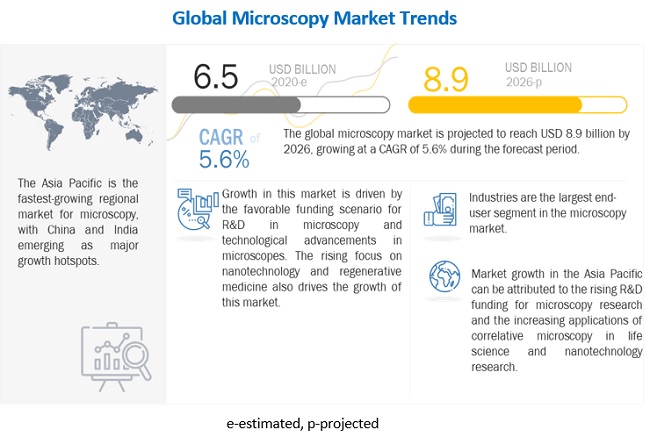
The development of whole-slide scanning systems is a major factor that has accelerated the adoption of digital microscopy. These systems offer deep visualization of specimens with 2D and 3D images used in R&D, forensics, quality control, as well as failure analysis. Market players offer various digital microscopy products such as ShuttlePix P-400R (Nikon), Leica DVM6 (Danaher), and Celldiscoverer 7 (Carl Zeiss).
Conventional microscopes are gradually losing their popularity to high-end microscopes such as electron microscopes, scanning probe microscopes, and digital microscopes due to their advanced features, higher resolution, and magnification power. However, these microscopes cost between USD 25,000 to USD 2 million, which is a major factor limiting their adoption in hospitals, pathology laboratories, and small-scale industries.
The complexity of advanced microscopes makes the shortage of skilled professionals a key challenge to their use and adoption. The demand for skilled medical laboratory technologists and technicians is expected to grow at a rate of 13% during 2016–2026 in the US (Source: Bureau of Labor Statistics).
According to the European Centre for the Development of Vocational Training (CEDEFOP), science and engineering are among the top industries in terms of occupational shortage of skilled labor. Similarly, in 2017, there was a deficit of about 40% of laboratory technicians in primary health centers (PHCs) and community health centers (CHCs) in India (Source: Health Ministry of India).
Key Market Players
The major companies in the microscopy market include Carl Zeiss (Germany), Danaher Corporation (US), Thermo Fisher Scientific (US), Nikon (Japan), Bruker Corporation (US), Olympus (Japan), Oxford Instruments (UK), JEOL (Japan), and Hitachi High-Technologies (Japan), among others.
