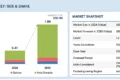
The global encoder market is experiencing rapid growth as industries worldwide increasingly demand precise motion control, automation, and advanced robotics solutions. Encoders—devices that convert motion into measurable electrical signals—are essential for monitoring position, speed, and rotation in machinery, ensuring operational accuracy and efficiency.
Understanding Encoders
Encoders are critical components in motion control systems, providing feedback that allows machines to perform with high precision. They are broadly categorized into:
Rotary Encoders: Measure rotational position or motion.
Incremental Rotary Encoders: Provide relative position information.
Absolute Rotary Encoders: Provide exact position information.
Linear Encoders: Measure linear displacement for positioning applications.
Encoders are widely used in robotic arms, CNC machines, conveyor systems, elevators, and electric vehicles, making them indispensable in modern industrial and manufacturing environments.
Market Segmentation
By Type
Rotary Encoders – Dominates the market due to widespread application in motors, robotics, and automation systems.
Linear Encoders – Growing in adoption for industrial automation, medical imaging, and precision machining.
By Output Signal
Digital Encoders – Preferred for integration with modern PLCs and automation systems.
Analog Encoders – Used in legacy systems and specific industrial applications.
By Technology
Optical Encoders – Provide high accuracy and are extensively used in robotics and automation.
Magnetic Encoders – Resistant to dust and vibration, making them ideal for harsh industrial environments.
Capacitive Encoders – Gaining traction in niche applications requiring compact form factors.
Download PDF Brochure @ https://www.marketsandmarkets.com/pdfdownloadNew.asp?id=14566162
Key Market Drivers
1. Growth of Industrial Automation
Encoders are central to automation systems, enabling precise control over motors, robotics, and manufacturing equipment. The global push toward smart factories and Industry 4.0 is fueling encoder adoption.
2. Expansion of Robotics Industry
Robotics demand highly accurate motion feedback systems. Encoders are critical in industrial robots, collaborative robots (cobots), and automated guided vehicles (AGVs) to ensure precise and repeatable movements.
3. Rising Adoption in Automotive Applications
Encoders are essential in electric vehicles (EVs), advanced driver-assistance systems (ADAS), and autonomous vehicles, supporting motor control and position feedback for safety and performance.
4. Increasing Focus on Precision Manufacturing
Sectors like aerospace, medical devices, and electronics manufacturing rely on encoders for high-precision processes, ensuring quality and minimizing errors.
- Regional Insights
- North America
North America leads the encoder market due to advanced industrial automation infrastructure, strong presence of robotics manufacturers, and growing adoption of smart manufacturing technologies.
Europe
Europe follows closely, driven by automation in automotive and manufacturing sectors, with Germany, France, and Italy leading encoder adoption.
Asia Pacific
The Asia Pacific market is the fastest-growing region, fueled by industrialization, automotive manufacturing, and robotics adoption in countries like China, Japan, South Korea, and India.
Rest of the World
The Middle East, Africa, and Latin America are gradually adopting encoders for industrial and automation applications, though growth is slower compared to APAC and North America.
Key Players
Leading companies in the global encoder market include:
Renishaw PLC – UK-based leader in high-precision optical encoders.
Heidenhain Corporation – Germany-based provider of rotary and linear encoders.
Rockwell Automation, Inc. – US-based industrial automation solutions provider.
Baumer Group – Swiss manufacturer of sensors and encoder systems.
Omron Corporation – Japanese leader in automation and sensor technology.
Sick AG – Germany-based company offering magnetic and optical encoders.
Honeywell International Inc. – US-based provider of industrial and aerospace encoders.
These companies are focusing on innovation, miniaturization, and integration with IoT and automation platforms to strengthen their market presence.
Emerging Trends
Integration with IoT and Smart Factory Systems
Encoders are increasingly integrated into industrial IoT networks, enabling real-time monitoring and predictive maintenance.
Miniaturization and High-Performance Designs
Compact and high-resolution encoders are gaining adoption for robotics, drones, and medical equipment.
Advanced Magnetic and Optical Technologies
Next-generation magnetic and optical encoders provide higher accuracy, durability, and resistance to harsh environments.
Collaborative Robotics and Cobots
Cobots require high-precision motion feedback, driving demand for compact, high-resolution encoders.
Automotive Electrification
Electric vehicles and autonomous systems require encoders for motor control, battery management, and ADAS applications.
Challenges in the Market
High cost of high-precision encoders.
Integration challenges with legacy systems.
Need for skilled personnel for installation and maintenance.
Competition from alternative sensing technologies in some niche applications.
Addressing these challenges will be critical for sustained growth.
Future Outlook
The global encoder market is expected to continue its upward trajectory, driven by industrial automation, robotics, EV adoption, and precision manufacturing. By 2030, digital and smart encoders integrated with IoT platforms will dominate the market, supporting real-time monitoring, predictive maintenance, and advanced robotics operations.
With innovation in miniaturization, magnetic sensing, and AI-enabled motion control, encoders will continue to be a vital component in the global drive toward automation and smart manufacturing.
The global encoder market is a key enabler of precision and automation across industries. Rotary, linear, optical, and magnetic encoders are driving advancements in robotics, manufacturing, automotive, and aerospace applications. As the world moves toward smart factories, autonomous mobility, and connected industrial systems, encoders will remain indispensable for ensuring accuracy, efficiency, and reliability.
The market’s future lies in high-resolution, compact, and digitally integrated encoders capable of supporting the next wave of industrial automation and intelligent robotics.
FAQ
1. What is an encoder and why is it important in industrial applications?
An encoder is a device that converts motion or position into electrical signals, providing feedback for speed, position, or rotation. It is crucial for precision, automation, and control in robotics, manufacturing, automotive systems, and industrial machinery.
2. What are the main types of encoders used in the market?
The market primarily consists of rotary encoders (incremental and absolute) and linear encoders. Rotary encoders measure rotational motion, while linear encoders measure linear displacement for positioning applications.
3. Which industries are driving the growth of the encoder market?
Key industries include industrial automation, robotics, automotive (including electric vehicles), aerospace, and precision manufacturing. Growth in smart factories and Industry 4.0 initiatives is a significant driver.
4. What technologies are used in encoders?
Encoders use optical, magnetic, and capacitive technologies. Optical encoders are known for high accuracy, magnetic encoders are durable in harsh environments, and capacitive encoders are increasingly used in compact or specialized applications.
About MarketsandMarkets™
MarketsandMarkets™ has been recognized as one of America’s Best Management Consulting Firms by Forbes, as per their recent report.
MarketsandMarkets™ is a blue ocean alternative in growth consulting and program management, leveraging a man-machine offering to drive supernormal growth for progressive organizations in the B2B space. With the widest lens on emerging technologies, we are proficient in co-creating supernormal growth for clients across the globe.
Today, 80% of Fortune 2000 companies rely on MarketsandMarkets, and 90 of the top 100 companies in each sector trust us to accelerate their revenue growth. With a global clientele of over 13,000 organizations, we help businesses thrive in a disruptive ecosystem.
The B2B economy is witnessing the emergence of $25 trillion in new revenue streams that are replacing existing ones within this decade. We work with clients on growth programs, helping them monetize this $25 trillion opportunity through our service lines – TAM Expansion, Go-to-Market (GTM) Strategy to Execution, Market Share Gain, Account Enablement, and Thought Leadership Marketing.
Built on the ‘GIVE Growth’ principle, we collaborate with several Forbes Global 2000 B2B companies to keep them future-ready. Our insights and strategies are powered by industry experts, cutting-edge AI, and our Market Intelligence Cloud, KnowledgeStore™, which integrates research and provides ecosystem-wide visibility into revenue shifts.
To find out more, visit www.MarketsandMarkets™.com or follow us on Twitter , LinkedIn and Facebook .
Contact:
Mr. Rohan Salgarkar
MarketsandMarkets™ INC.
1615 South Congress Ave.
Suite 103, Delray Beach, FL 33445
USA: +1-888-600-6441