The global wearable technology landscape is evolving rapidly, and smart glasses are emerging as one of the most transformative segments. Fueled by advances in augmented reality (AR), artificial intelligence (AI), and miniaturized display technologies, the Smart Glasses Market Growth is accelerating as industries and consumers increasingly demand hands-free computing solutions. The global smart glasses industry is projected to reach USD 4,129.3 million by 2030 from USD 878.8 million in 2024; it is expected to grow at a CAGR of 29.4%
Rising Demand for Hands-Free Computing
A major driver behind Smart Glasses Market Growth is the increasing need for hands-free access to digital information. In industries such as logistics, manufacturing, healthcare, and field services, workers require real-time data without interrupting physical tasks.
Smart glasses enable users to view instructions, receive alerts, and interact with digital systems while keeping their hands free. This capability improves productivity, reduces errors, and enhances workplace efficiency, making them a valuable tool across multiple sectors.
Augmented Reality and AI Integration Driving Adoption
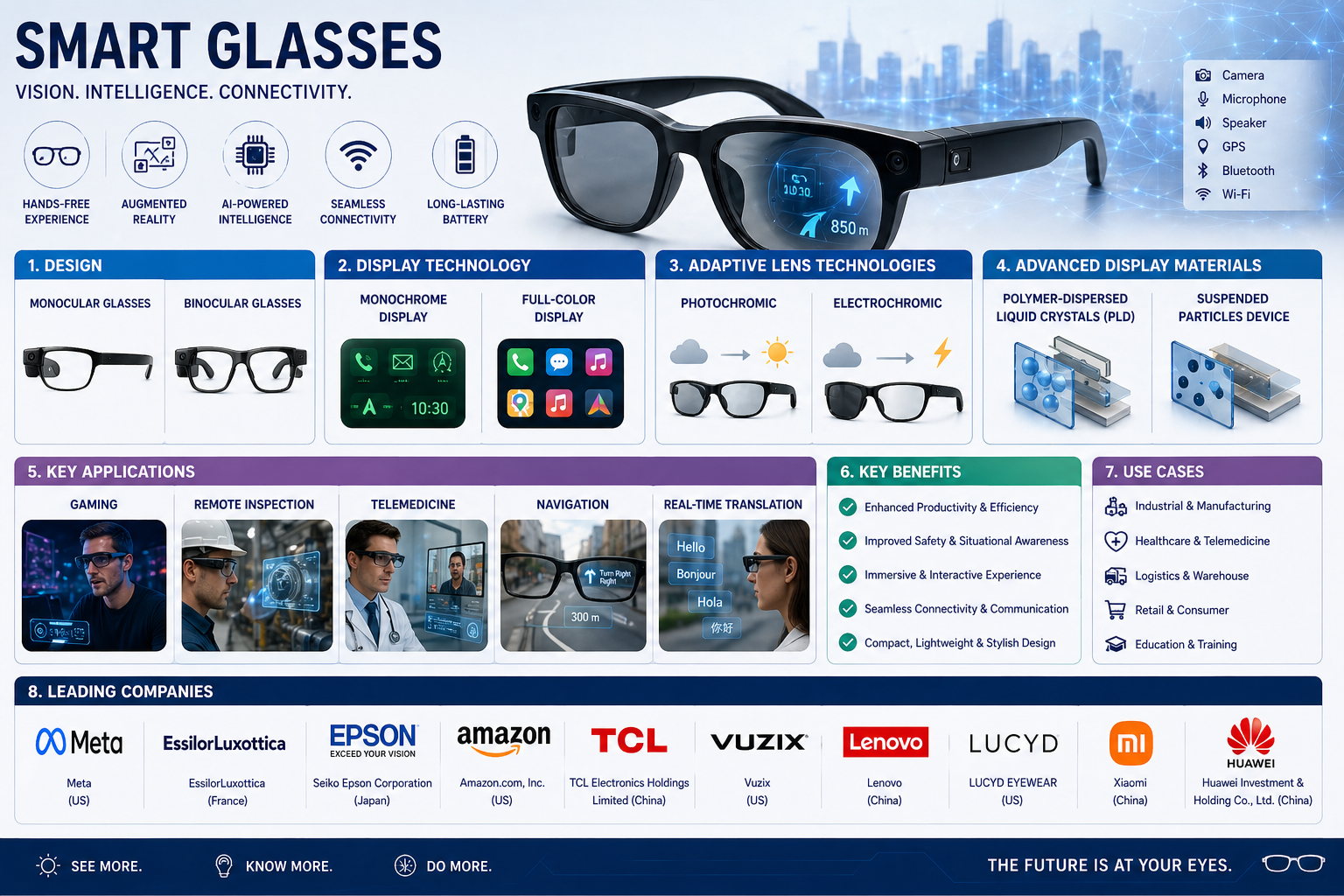
The integration of AR and AI is significantly shaping Smart Glasses Market Growth. AR overlays digital content onto the physical world, enabling immersive and interactive experiences. AI enhances functionality by enabling voice commands, object recognition, and real-time data processing.
Together, these technologies are transforming smart glasses from simple display devices into intelligent assistants capable of supporting complex workflows and decision-making processes.
Download PDF Brochure @ https://www.marketsandmarkets.com/pdfdownloadNew.asp?id=148134046
Enterprise Applications Leading Market Expansion
While early adoption was largely consumer-focused, enterprise use cases are now driving most of the Smart Glasses Market Growth. Industries such as manufacturing, logistics, healthcare, and construction are adopting smart glasses to improve operational efficiency.
In warehouses, employees use smart glasses for inventory tracking and navigation. In healthcare, surgeons and medical staff use them for hands-free access to patient data during procedures. These applications are expanding rapidly as organizations recognize the productivity benefits.
Technological Advancements Enhancing Performance
Continuous improvements in hardware are also accelerating Smart Glasses Market Growth. Advances in lightweight materials, battery efficiency, optical waveguides, and micro-displays are making devices more comfortable and practical for long-term use.
At the same time, improvements in connectivity, including 5G and edge computing, are enabling faster data processing and real-time collaboration, further enhancing user experience.
Consumer Market and Lifestyle Applications
Beyond enterprise use, the consumer segment is also contributing to Smart Glasses Market Growth. Applications such as navigation, fitness tracking, gaming, and social media integration are gaining popularity.
Tech companies are investing in stylish, lightweight designs to make smart glasses more appealing for everyday use. As costs decrease and functionality improves, consumer adoption is expected to rise significantly.
Challenges Impacting Market Expansion
Despite strong growth, the smart glasses industry faces several challenges. High device costs, limited battery life, privacy concerns, and social acceptance remain barriers to mass adoption.
Additionally, ensuring seamless integration between hardware and software ecosystems is critical for sustaining long-term Smart Glasses Market Growth.
Competitive Landscape and Innovation
The market is becoming increasingly competitive, with major technology companies and startups investing heavily in AR eyewear development. Innovation in display technology, gesture control, and AI-powered assistants is driving differentiation.
Partnerships between hardware manufacturers and software developers are also accelerating product development cycles and expanding application possibilities.
Future Outlook
The future of smart glasses looks promising as demand for immersive, hands-free computing continues to rise. With ongoing advancements in AR, AI, and wearable design, the technology is expected to become more mainstream across both enterprise and consumer markets.
Overall, Smart Glasses Market Growth is poised for strong expansion, driven by increasing adoption in productivity-focused industries and growing interest in next-generation wearable experiences.
Smart glasses are evolving from niche wearable devices into essential tools for modern computing. As industries prioritize efficiency, mobility, and real-time data access, the demand for hands-free solutions will continue to rise.
With continuous innovation and expanding use cases, Smart Glasses Market Growth is set to remain a key trend shaping the future of wearable technology and digital interaction.
Frequently Asked Questions (FAQs): Smart Glasses Market Growth
1. What are smart glasses?
Smart glasses are wearable devices that look like regular eyewear but include digital displays, sensors, and connectivity features. They enable users to access information, receive notifications, and interact with digital content hands-free.
2. Why is Smart Glasses Market Growth increasing rapidly?
The Smart Glasses Market Growth is driven by rising demand for hands-free computing, advancements in AR and AI technologies, and increasing adoption across enterprise sectors such as logistics, healthcare, and manufacturing.
3. What does “hands-free computing” mean in smart glasses?
Hands-free computing refers to accessing and interacting with digital information without using hands. Smart glasses allow users to view data, receive instructions, and communicate while performing physical tasks simultaneously.
4. Which industries are driving Smart Glasses Market Growth?
Key industries include logistics, healthcare, manufacturing, construction, retail, and field services. These sectors use smart glasses to improve efficiency, safety, and real-time decision-making.
5. How do AR and AI contribute to smart glasses?
Augmented reality (AR) overlays digital information onto the real world, while AI enables features like voice control, object recognition, and real-time data processing. Together, they significantly enhance Smart Glasses Market Growth.
About MarketsandMarkets™
MarketsandMarkets™ has been recognized as one of America’s Best Management Consulting Firms by Forbes, as per their recent report.
MarketsandMarkets™ is a blue ocean alternative in growth consulting and program management, leveraging a man-machine offering to drive supernormal growth for progressive organizations in the B2B space. With the widest lens on emerging technologies, we are proficient in co-creating supernormal growth for clients across the globe.
Today, 80% of Fortune 2000 companies rely on MarketsandMarkets, and 90 of the top 100 companies in each sector trust us to accelerate their revenue growth. With a global clientele of over 13,000 organizations, we help businesses thrive in a disruptive ecosystem.
The B2B economy is witnessing the emergence of $25 trillion in new revenue streams that are replacing existing ones within this decade. We work with clients on growth programs, helping them monetize this $25 trillion opportunity through our service lines – TAM Expansion, Go-to-Market (GTM) Strategy to Execution, Market Share Gain, Account Enablement, and Thought Leadership Marketing.
Built on the ‘GIVE Growth’ principle, we collaborate with several Forbes Global 2000 B2B companies to keep them future-ready. Our insights and strategies are powered by industry experts, cutting-edge AI, and our Market Intelligence Cloud, KnowledgeStore™, which integrates research and provides ecosystem-wide visibility into revenue shifts.
To find out more, visit www.MarketsandMarkets™.com or follow us on Twitter , LinkedIn and Facebook .
Contact:
Mr. Rohan Salgarkar
MarketsandMarkets™ INC.
1615 South Congress Ave.
Suite 103, Delray Beach, FL 33445
USA: +1-888-600-6441
