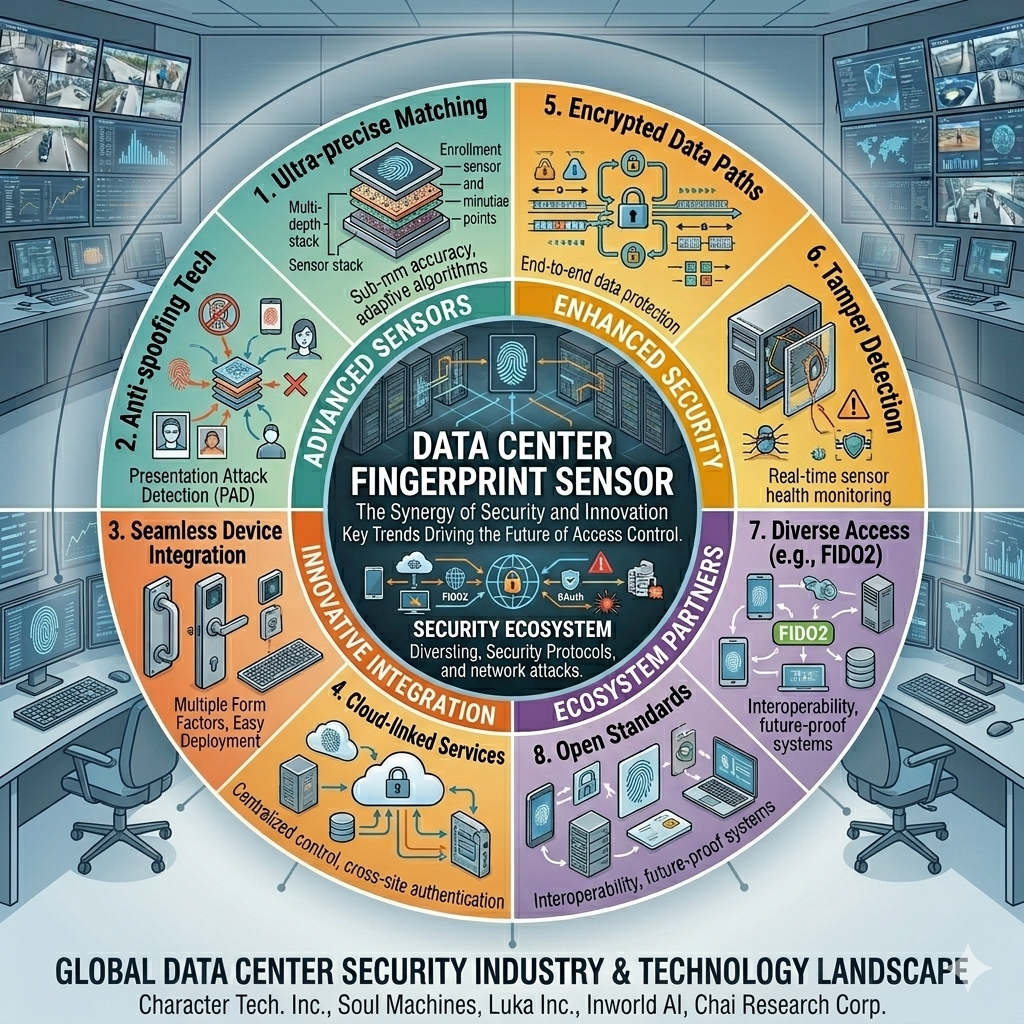
The data center fingerprint sensor market is emerging as a critical segment within the broader biometric security and data center infrastructure ecosystem. As organizations increasingly rely on data centers to store, process, and manage sensitive information, the need for robust, reliable, and tamper-proof security systems has become more urgent than ever. Fingerprint sensor technology, powered by advancements in biometrics, artificial intelligence, and edge computing, is playing a key role in strengthening physical access control in modern data centers.
Rising cybersecurity threats, stricter compliance requirements, and rapid digital transformation are collectively driving the adoption of fingerprint-based authentication systems. These systems are not only enhancing security but also improving operational efficiency and reducing risks associated with traditional access methods such as keycards and passwords.
Growing Demand for Advanced Data Center Security
Data centers are the backbone of the digital economy, supporting cloud computing, financial transactions, government operations, and enterprise IT systems. As the value of stored data increases, so does the risk of unauthorized access and physical breaches.
Traditional security systems such as PIN codes, access cards, and surveillance cameras are no longer sufficient to prevent sophisticated intrusions. This has led to a growing demand for biometric authentication systems, particularly fingerprint sensors, which offer a higher level of accuracy and uniqueness.
Fingerprint sensors provide an added layer of identity verification that is extremely difficult to replicate or forge. As a result, data center operators are increasingly integrating biometric systems into multi-factor authentication frameworks to strengthen access control mechanisms
Integration of Biometrics with Multi-Factor Authentication Systems
One of the most significant trends in the data center fingerprint sensor market is the integration of biometric systems with multi-factor authentication (MFA). MFA combines two or more verification methods, such as passwords, smart cards, and biometric data, to enhance security.
Fingerprint authentication is becoming a preferred biometric factor due to its ease of use, speed, and reliability. When combined with other authentication methods, it significantly reduces the risk of unauthorized access, even if one credential is compromised.
Data centers are increasingly deploying layered security architectures where fingerprint sensors are used at critical entry points, including server rooms, control centers, and restricted infrastructure zones. This trend is expected to continue as security requirements become more stringent across industries
Download PDF Brochure @ https://www.marketsandmarkets.com/pdfdownloadNew.asp?id=183637899
Rising Cybersecurity Concerns Driving Physical Security Investments
While cybersecurity is often associated with digital threats, physical security breaches remain a major concern for data centers. Unauthorized physical access can lead to data theft, hardware manipulation, or complete system shutdowns.
Fingerprint sensors provide a strong defense against such risks by ensuring that only verified personnel can access sensitive areas. Unlike traditional access cards, biometric credentials cannot be easily shared, lost, or stolen.
As cyberattacks become more sophisticated, organizations are recognizing the importance of integrating physical and digital security systems. This convergence is driving increased investment in biometric access control technologies, including fingerprint sensors
Advancements in Sensor Technology and Accuracy
Technological innovation is a major driver of growth in the fingerprint sensor market. Modern sensors have significantly improved in terms of speed, accuracy, and durability.
Capacitive, optical, and ultrasonic fingerprint sensors are widely used in data center environments. Among these, ultrasonic sensors are gaining popularity due to their ability to capture highly detailed fingerprint images, even in challenging conditions such as dirt, moisture, or minor skin damage.
Additionally, advancements in artificial intelligence and machine learning are enhancing the accuracy of fingerprint recognition systems. AI algorithms are capable of learning and adapting to changes in fingerprint patterns over time, reducing false acceptance and rejection rates.
These technological improvements are making fingerprint sensors more reliable for high-security environments like data centers.
Growth of Cloud Computing and Hyperscale Data Centers
The rapid expansion of cloud computing and hyperscale data centers is significantly contributing to the growth of the fingerprint sensor market. Companies such as Amazon Web Services, Microsoft Azure, and Google Cloud are continuously expanding their global data center infrastructure.
As data centers scale in size and complexity, managing physical access for large numbers of employees, contractors, and vendors becomes increasingly challenging. Fingerprint-based authentication provides a scalable and efficient solution for managing access control in such environments.
In hyperscale facilities, biometric systems are often integrated with centralized security platforms, enabling real-time monitoring and control of personnel movement. This improves both security and operational transparency.
Regulatory Compliance and Data Protection Standards
Governments and regulatory bodies across the world are implementing stricter data protection and security standards. Regulations such as GDPR in Europe and various national cybersecurity frameworks require organizations to adopt strong access control mechanisms.
Fingerprint sensors help organizations comply with these regulations by providing accurate audit trails and identity verification records. Each access attempt can be logged and verified, ensuring accountability and transparency.
Compliance requirements are particularly strict in industries such as banking, healthcare, and government services, where sensitive data must be protected at all times. This is further accelerating the adoption of biometric security systems in data centers serving these sectors.
Adoption of AI and Machine Learning in Biometric Systems
Artificial intelligence and machine learning are transforming the capabilities of fingerprint sensor systems. AI-powered biometric systems can analyze large datasets of fingerprint patterns to improve recognition accuracy and reduce false matches.
Machine learning algorithms also help in detecting anomalies in access behavior, such as unusual login times or repeated failed attempts. This allows security systems to respond proactively to potential threats.
In advanced data centers, AI-driven security platforms are increasingly being used to combine fingerprint authentication with behavioral analytics, creating a more intelligent and adaptive security environment.
Increasing Use of Touchless and Hygienic Biometric Solutions
The demand for touchless biometric systems has increased in recent years, particularly following global health concerns. Although fingerprint sensors are inherently contact-based, newer technologies are being developed to reduce physical interaction and improve hygiene.
Some modern systems use contactless fingerprint scanning, where users simply hover their finger above a sensor. This not only improves hygiene but also enhances user convenience and speeds up authentication processes.
Data centers are adopting these advanced solutions to ensure both security and operational efficiency, especially in high-traffic environments.
Challenges in Market Adoption
Despite strong growth potential, the data center fingerprint sensor market faces several challenges. One of the key concerns is the risk of biometric data breaches. Unlike passwords, biometric data cannot be changed once compromised, making data protection critical.
High installation and maintenance costs can also be a barrier for smaller organizations. Additionally, integration with legacy security systems may require significant infrastructure upgrades.
Environmental factors such as dust, temperature variations, and humidity in data centers can also impact sensor performance, although modern devices are increasingly designed to mitigate these issues.
Future Outlook of the Market
The future of the data center fingerprint sensor market looks highly promising, driven by continuous innovation in biometric technology and increasing demand for secure digital infrastructure. As data centers become more complex and globally distributed, the need for reliable and scalable access control systems will continue to grow.
The integration of fingerprint sensors with AI, cloud-based security platforms, and IoT-enabled infrastructure is expected to redefine how physical security is managed in data centers. In the coming years, biometric authentication is likely to become a standard component of data center security architecture.
With rising investments in digital infrastructure, cybersecurity, and automation, fingerprint sensor technology is set to play a pivotal role in shaping the next generation of secure data center environments.
FAQs – Data Center Fingerprint Sensor Market Key Trends Driving Security Innovation
1. What is driving the growth of the data center fingerprint sensor market?
The market is growing due to increasing cybersecurity threats, rising demand for secure data center access, and the adoption of biometric authentication systems for enhanced physical security.
2. Why are fingerprint sensors preferred in data centers?
Fingerprint sensors provide highly accurate and unique identity verification, reducing risks associated with lost access cards, password theft, and unauthorized entry.
3. How does fingerprint authentication improve data center security?
It adds a strong biometric layer to access control systems, ensuring only authorized personnel can enter sensitive areas and providing detailed access logs for monitoring.
4. What technologies are used in fingerprint sensors for data centers?
Common technologies include capacitive, optical, and ultrasonic sensors, often enhanced with AI and machine learning for improved accuracy and reliability.
5. What is the future outlook of the data center fingerprint sensor market?
The market is expected to grow steadily with advancements in AI, cloud-based security systems, and increasing demand for scalable, high-security data center infrastructure.
