Photonic chips are emerging as one of the most transformative technologies in the semiconductor industry, offering a revolutionary alternative to traditional electronic chips. Instead of using electrons to transmit information, photonic chips use light (photons), enabling significantly faster data transfer, lower power consumption, and higher bandwidth. As artificial intelligence (AI), cloud computing, high-performance computing (HPC), and data centers continue to scale, photonic chips are increasingly viewed as a critical technology for overcoming the limitations of conventional semiconductor architectures.
According to MarketsandMarkets, global photonic chip market was valued at approximately USD 4.00 billion in 2025 and is projected to reach USD 9.30 billion by 2032, expanding at a compound annual growth rate (CAGR) of 12.9% during the forecast period 2026–2032 . the broader silicon photonics market is expected to witness substantial growth through 2030, driven by rising demand for high-speed data communication, AI workloads, and next-generation networking infrastructure.
Understanding Photonic Chips
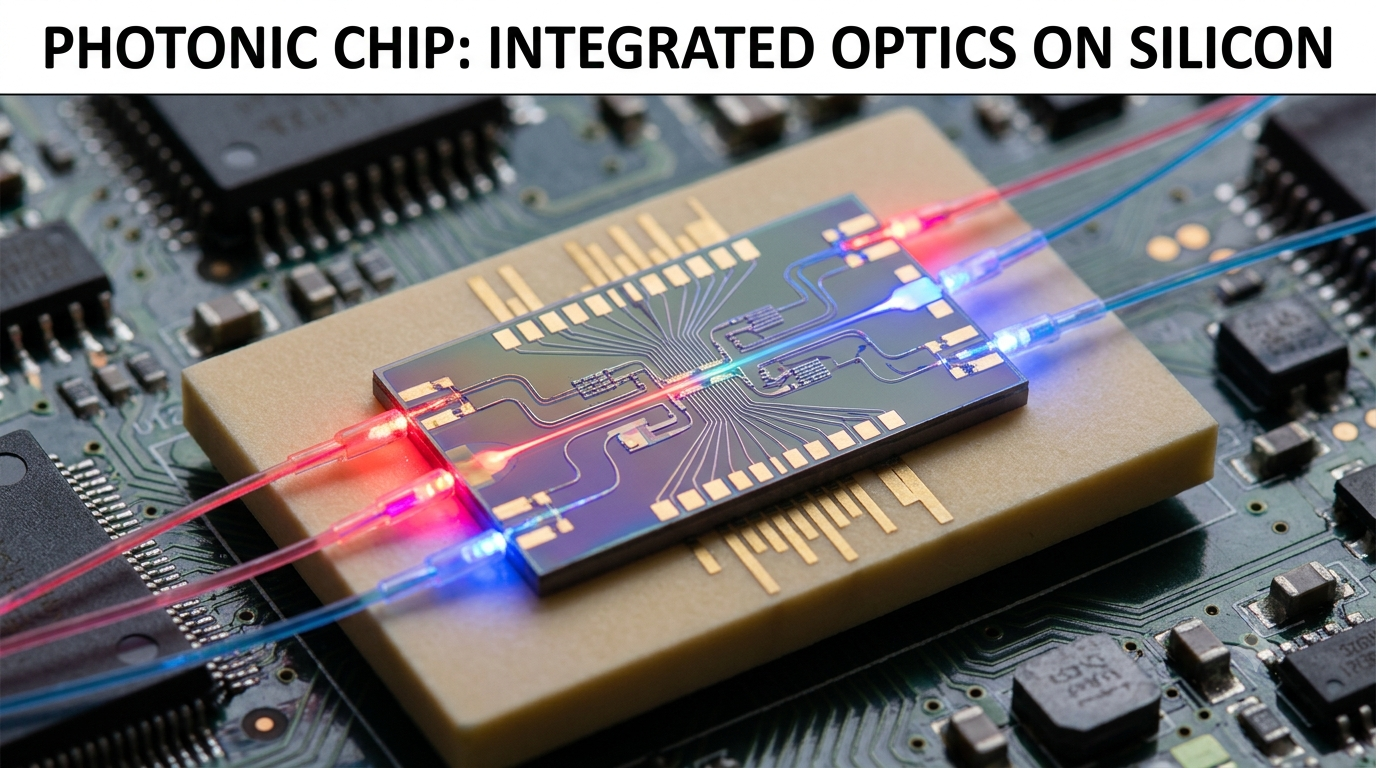
Photonic chips, also known as optical chips or photonic integrated circuits (PICs), integrate optical components such as lasers, modulators, detectors, waveguides, and optical amplifiers onto a single semiconductor substrate. Unlike traditional chips that transmit signals electrically, photonic chips process and transfer information using light.
This fundamental difference provides several advantages:
- Extremely high data transmission speeds
- Lower latency
- Reduced energy consumption
- Higher bandwidth capacity
- Improved thermal performance
- Enhanced scalability for AI and cloud applications
As modern computing systems process increasingly massive volumes of data, these benefits are becoming essential rather than optional.
Why Photonic Chips Are the Future
Breaking the Limits of Moore’s Law
For decades, the semiconductor industry relied on Moore’s Law to increase computing performance through transistor miniaturization. However, physical limitations, rising fabrication costs, and thermal challenges are making further scaling increasingly difficult.
Photonic chips provide an alternative path forward by enabling data transmission through light rather than electrical signals. This significantly reduces energy losses and removes many of the bottlenecks associated with traditional interconnects.
As AI models grow larger and more complex, optical communication is expected to become increasingly important in future computing architectures.
AI Is Creating Massive Demand
Artificial intelligence is rapidly becoming one of the biggest drivers of photonic chip adoption.
Training large language models and running advanced AI workloads require enormous data movement between processors, memory, and networking infrastructure. Traditional copper-based interconnects consume significant power and generate excessive heat.
Photonic chips address these challenges by enabling:
- Faster processor-to-processor communication
- High-bandwidth optical networking
- Reduced energy consumption
- Scalable AI cluster architectures
Recent industry investments by major technology companies highlight growing confidence in photonic technologies for future AI infrastructure
Data Centers Will Be the Largest Growth Engine
Global data traffic continues to expand due to cloud computing, streaming services, AI applications, and enterprise digital transformation.
Data centers increasingly require:
- Faster optical interconnects
- High-bandwidth switching systems
- Energy-efficient networking
- Low-latency communication
Photonic integrated circuits are becoming essential for meeting these requirements.
Industry research indicates that data centers currently represent one of the largest application segments for photonic integrated circuits, and this trend is expected to accelerate over the next decade.
Silicon Photonics Will Lead the Market
Among various photonic technologies, silicon photonics is expected to dominate future deployments.
Silicon photonics combines optical functionality with conventional CMOS manufacturing processes, enabling:
- Lower production costs
- High-volume manufacturing
- Compatibility with existing semiconductor fabs
- Easier integration with electronic circuits
MarketsandMarkets projects rapid growth in the silicon photonics segment as hyperscale data centers, AI platforms, and telecom networks increasingly adopt optical communication solutions.
Download PDF Brochure @ https://www.marketsandmarkets.com/pdfdownloadNew.asp?id=95537757
Emerging Applications Beyond Data Centers
Telecommunications and 6G Networks
Future telecom infrastructure will require unprecedented bandwidth and ultra-low latency.
Photonic chips can support:
- High-capacity fiber-optic networks
- Advanced optical switching
- 5G and future 6G deployments
- Network edge computing
Growing demand for high-speed communication is expected to remain a major market catalyst.
Medical and Biophotonics
Healthcare applications are increasingly adopting photonic technologies for:
- Diagnostic imaging
- Biosensing
- Optical coherence tomography
- Precision medical devices
Photonic integrated circuits enable compact, highly accurate, and energy-efficient medical systems.
Automotive and LiDAR
Autonomous vehicles rely heavily on sensing technologies.
Photonic chips are becoming critical components in:
- LiDAR systems
- Autonomous navigation
- Advanced driver-assistance systems (ADAS)
- Environmental sensing
The growth of autonomous mobility is expected to create significant long-term opportunities for photonic chip manufacturers.
Quantum Computing and Optical Computing Opportunities
One of the most exciting future opportunities lies in optical computing and quantum technologies.
Researchers and startups are actively developing photonic processors capable of performing computational tasks using light-based architectures.
Potential benefits include:
- Massive parallel processing
- Higher computing efficiency
- Reduced power consumption
- Accelerated AI inference
Recent breakthroughs in optical processing units suggest photonic computing may eventually complement or even replace certain electronic computing workloads.
Regional Outlook
North America
North America currently leads photonic chip innovation due to:
- Strong semiconductor ecosystem
- AI infrastructure investments
- Presence of major technology companies
- Significant R&D spending
The region remains a hub for silicon photonics development and commercialization.
Asia-Pacific
Asia-Pacific is expected to witness the fastest growth due to:
- Expanding semiconductor manufacturing
- Rapid AI adoption
- Growth in telecommunications infrastructure
- Increasing government support for photonics research
Countries such as China, Japan, South Korea, and Taiwan are investing heavily in photonic technologies.
Europe
Europe continues to strengthen its position through:
- Advanced photonics research programs
- Industrial automation initiatives
- Telecommunications modernization projects
The region remains an important center for photonic innovation and commercialization.
Key Challenges Facing the Market
Despite significant potential, the photonic chip market faces several obstacles.
Manufacturing Complexity
Photonic devices require precise fabrication processes and specialized materials, increasing production complexity.
Material Supply Constraints
Certain photonic technologies depend on materials such as indium phosphide (InP). Supply chain disruptions and geopolitical restrictions could affect future production capacity.
High Initial Costs
Although costs are declining, photonic chips remain more expensive than many traditional electronic solutions.
Integration Challenges
Combining optical and electronic components on a single platform requires advanced engineering expertise and packaging technologies.
Competitive Landscape
The photonic chip ecosystem includes semiconductor giants, networking companies, and innovative startups.
Key industry participants include:
- Intel Corporation
- Cisco Systems
- Marvell Technology
- Coherent Corporation
- Lumentum Holdings
- GlobalFoundries
- IBM
- STMicroelectronics
Strategic investments, acquisitions, and partnerships are accelerating commercialization efforts across the industry.
Future Outlook: The Decade of Light-Based Computing
The next decade is likely to witness a major shift from purely electronic computing toward hybrid electronic-photonic architectures.
Several trends support this outlook:
- Explosive growth in AI workloads
- Expansion of hyperscale data centers
- Increasing demand for energy-efficient computing
- Growth of autonomous systems
- Evolution of 6G communications
- Advancements in optical computing
Industry experts increasingly view photonic chips as a foundational technology for future digital infrastructure. As organizations seek faster, more sustainable, and scalable computing solutions, photonic chips are positioned to become a core component of next-generation technology ecosystems.
The future of the photonic chip market is exceptionally promising. Driven by AI, cloud computing, telecommunications, autonomous systems, and next-generation networking requirements, photonic chips are poised to redefine how data is processed, transmitted, and analyzed. While manufacturing and supply chain challenges remain, ongoing innovation and investment are rapidly accelerating commercialization.
As the world moves toward an increasingly data-intensive future, photonic chips will play a pivotal role in delivering the speed, efficiency, and scalability required for tomorrow’s digital economy.
