The global Swarm Robotics market is entering a transformative growth phase as artificial intelligence (AI), edge computing, collaborative robots (cobots), and autonomous decision-making reshape industrial automation. While traditional robotics focused on individual machine performance, the next decade will be defined by intelligent fleets of robots capable of communicating, learning, and coordinating in real time without centralized control.
Recent developments across the robotics industry—including NVIDIA’s continued investment in physical AI platforms, rapid AI-enabled factory automation in China, and growing enterprise adoption of edge AI—highlight a broader shift toward distributed robotic intelligence. These trends are accelerating commercial deployment of swarm robotics in warehouses, manufacturing facilities, agriculture, defense, healthcare, mining, and smart infrastructure.
For technology providers, manufacturers, logistics companies, and investors, swarm robotics is evolving from an experimental research concept into a commercially viable automation platform capable of improving productivity, resilience, scalability, and operational efficiency.
Download PDF Brochure @ https://www.marketsandmarkets.com/pdfdownloadNew.asp?id=208095486
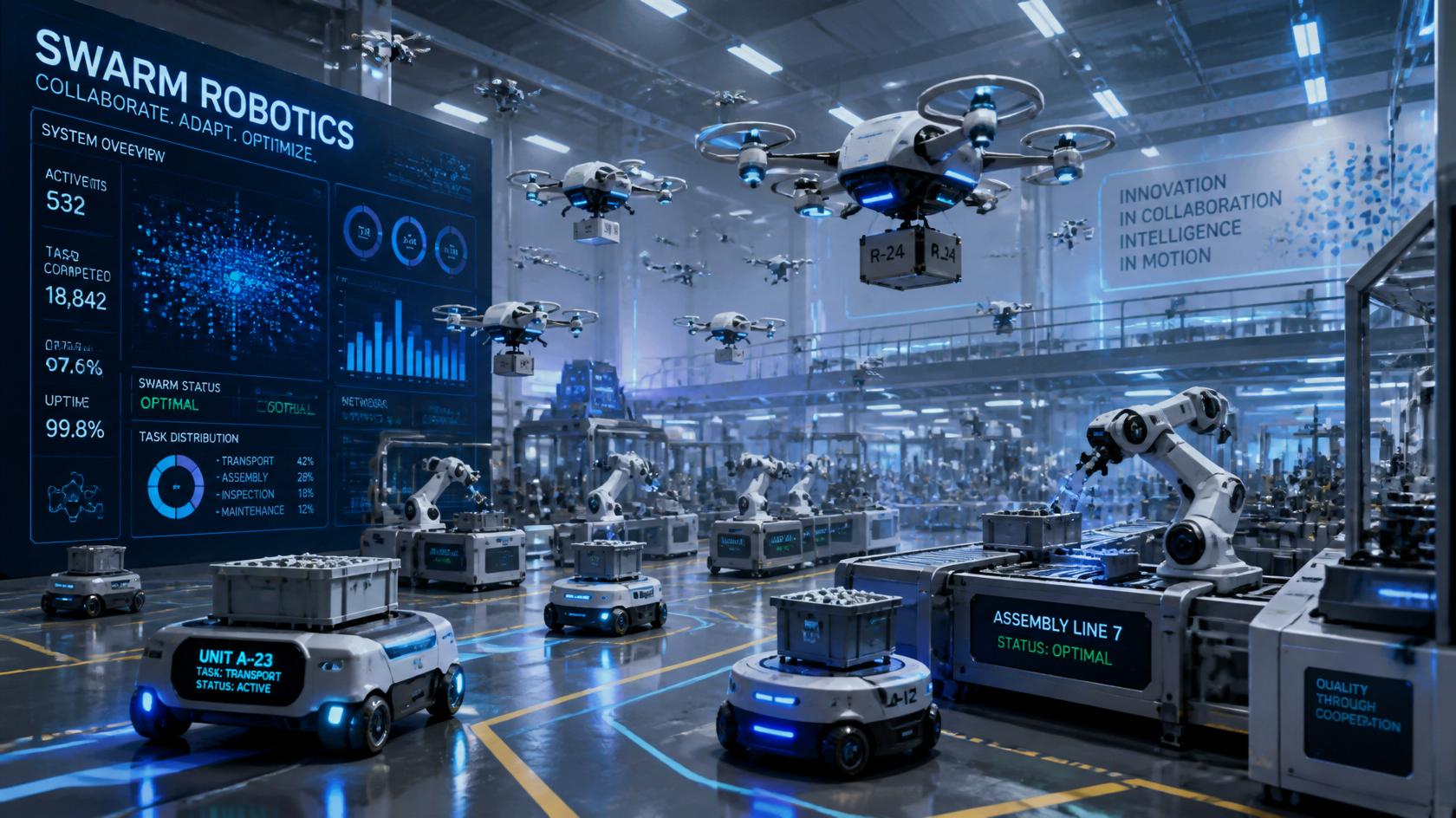
Why Swarm Robotics Is Becoming the Future of Industrial Automation
Unlike conventional robotic systems that depend on centralized controllers, swarm robotics enables hundreds or even thousands of autonomous robots to cooperate using decentralized intelligence. Inspired by biological swarms such as ants and bees, each robot makes localized decisions while collectively achieving complex industrial tasks.
This decentralized architecture offers several advantages:
- High fault tolerance
- Dynamic task allocation
- Faster warehouse operations
- Reduced operational bottlenecks
- Lower infrastructure dependency
- Improved scalability
- Real-time adaptive behavior
As industrial environments become increasingly dynamic, manufacturers require automation systems that continuously optimize themselves without human intervention.
AI Is Giving Robot Swarms Collective Intelligence
Artificial Intelligence has become the brain behind modern swarm robotics.
Earlier swarm systems followed predefined algorithms with limited adaptability. Today’s AI-powered robotic swarms utilize:
- Deep Learning
- Reinforcement Learning
- Computer Vision
- Multi-Agent AI
- Autonomous Path Planning
- Predictive Analytics
- Intelligent Task Scheduling
Each robot continuously learns from sensor data while exchanging information with neighboring robots. Instead of relying on one master controller, the entire robotic fleet collectively optimizes movement, inventory handling, inspection, navigation, and decision-making.
The emergence of Agentic AI and embodied multi-agent intelligence is further advancing autonomous collaboration, enabling robot teams to share context, coordinate actions, and adapt collectively to changing environments.
Edge Computing Eliminates Latency
One of the biggest technological shifts driving the Swarm Robotics Market is the rapid adoption of edge computing.
Traditional cloud robotics introduces communication delays that become problematic in mission-critical operations.
Edge AI solves this challenge by enabling robots to process:
- Vision data
- LiDAR information
- Environmental sensing
- Object recognition
- Motion planning
- Collision avoidance
locally and instantly.
This enables:
- Millisecond response times
- Reduced bandwidth costs
- Greater operational reliability
- Enhanced cybersecurity
- Continuous operation even during network interruptions
Edge-enabled swarms are particularly valuable in warehouses, autonomous factories, ports, airports, and mining operations where real-time decision-making is essential. Recent robotics research and commercial deployments increasingly emphasize edge AI as a core enabler of scalable autonomous systems.
Collaborative Robots Expand Swarm Intelligence
Collaborative robots (Cobots) are no longer isolated automation tools.
By 2030, cobots are expected to operate as intelligent swarm participants capable of working alongside:
- Human workers
- Autonomous Mobile Robots (AMRs)
- Automated Guided Vehicles (AGVs)
- Industrial drones
- Warehouse robots
- Inspection robots
AI-enhanced cobots can dynamically share workloads, reroute tasks, and optimize production without centralized intervention, improving safety, flexibility, and productivity in manufacturing and logistics environments.
Warehousing Is Becoming the Largest Commercial Opportunity
E-commerce growth has dramatically increased demand for flexible warehouse automation.
Modern fulfillment centers require robots that can:
- Coordinate inventory movement
- Optimize picking routes
- Balance workloads
- Reduce congestion
- Minimize idle time
- Recover automatically from failures
Instead of deploying a few expensive robotic systems, companies are increasingly evaluating fleets of smaller autonomous robots that collectively improve throughput and resilience.
This distributed approach significantly enhances warehouse productivity while reducing operational costs.
Manufacturing Is Entering the Era of Distributed Automation
Smart factories increasingly require robotic systems capable of adapting instantly to production changes.
Future manufacturing facilities will deploy robot swarms for:
- Material handling
- Assembly
- Quality inspection
- Machine tending
- Predictive maintenance
- Internal logistics
- Digital twin synchronization
AI-powered robotic swarms continuously exchange production data, enabling faster response to equipment failures and demand fluctuations.
Industry trends show manufacturers integrating AI into robotics to improve programming, visual guidance, remote monitoring, and flexible automation across both advanced and traditional industries.
Defense and Disaster Response Create High-Value Applications
Swarm robotics is rapidly gaining attention in defense, border security, emergency response, and disaster management because decentralized robot teams can continue operating even if individual units fail.
Potential applications include:
- Autonomous reconnaissance
- Mine detection
- Search and rescue
- Firefighting
- Hazardous material inspection
- Environmental monitoring
Research is also advancing safer decentralized exploration methods inspired by natural swarm behavior, improving coordination while reducing collision risks in large robot fleets.
Technology Trends Shaping the Swarm Robotics Market Through 2030
Several converging technologies will accelerate market expansion:
- Artificial Intelligence
- Edge Computing
- 5G and future 6G connectivity
- Digital Twins
- Cloud Robotics
- Multi-Agent Reinforcement Learning
- Computer Vision
- Advanced Sensors
- Autonomous Navigation
- Human-Robot Collaboration
- Physical AI Platforms
Together, these technologies are enabling robotic swarms to become more autonomous, adaptive, and commercially scalable.
Regional Outlook
North America
North America continues leading robotics software innovation through investments in AI platforms, cloud robotics, semiconductor technologies, and warehouse automation.
Europe
European manufacturers remain strong adopters of collaborative robotics, Industry 4.0 initiatives, and intelligent manufacturing systems emphasizing flexible automation.
Asia-Pacific
Asia-Pacific is expected to experience the fastest growth due to:
- Massive manufacturing expansion
- Smart factory investments
- Semiconductor production
- Government automation initiatives
- E-commerce logistics
- AI infrastructure deployment
China, Japan, South Korea, and Singapore continue investing heavily in intelligent industrial automation and AI-enabled robotics.
Competitive Landscape
The competitive ecosystem is expanding beyond traditional industrial robotics companies to include:
- AI software developers
- Edge computing platform providers
- Semiconductor manufacturers
- Autonomous mobile robot companies
- Cloud robotics providers
- Warehouse automation specialists
- Industrial IoT vendors
Competition increasingly centers on intelligent software, perception, coordination algorithms, and edge AI capabilities rather than hardware alone.
Opportunities for Technology Vendors
Organizations investing in swarm robotics can unlock opportunities across:
- Warehouse automation
- Smart manufacturing
- Healthcare logistics
- Agriculture
- Mining
- Construction
- Defense
- Smart cities
- Energy infrastructure
- Ports and airports
The growing demand for flexible, scalable automation is creating long-term opportunities for AI developers, robotics integrators, and industrial technology providers.
Swarm Robotics Market Outlook 2030
By 2030, swarm robotics is expected to transition from pilot deployments to large-scale commercial adoption across multiple industries. The convergence of AI, edge computing, collaborative robots, and high-speed connectivity is enabling decentralized robotic systems that are more adaptive, resilient, and efficient than conventional automation.
Organizations that invest early in intelligent multi-robot systems will be better positioned to improve productivity, reduce operational costs, and build resilient supply chains. As enterprises pursue autonomous operations and digital transformation, swarm robotics is poised to become a foundational technology for next-generation industrial automation.
For organizations evaluating market opportunities, competitive positioning, technology roadmaps, and growth strategies, the comprehensive MarketsandMarkets Swarm Robotics Market report provides in-depth analysis of market size, segmentation, regional trends, emerging technologies, and strategic developments across the global ecosystem.
For more info: https://www.marketsandmarkets.com/Market-Reports/swarm-robotics-market-208095486.html
