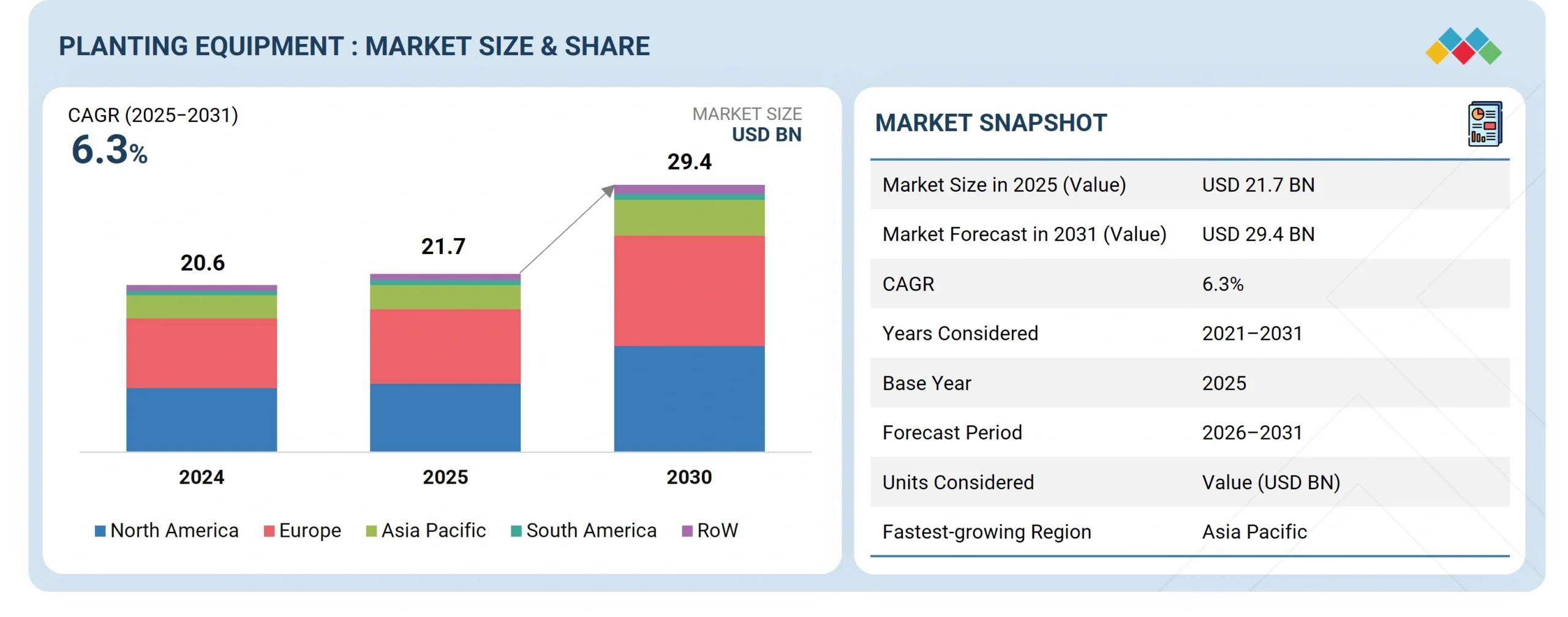
The global planting equipment market is witnessing steady growth as farmers increasingly adopt mechanized and precision-based agricultural practices. The planting equipment market is projected to grow from USD 21.74 billion in 2026 to USD 29.4 billion by 2031, registering a CAGR of 6.3% during the forecast period.
The growing adoption of modern planting technologies, increasing farm mechanization, and the need to improve crop productivity are among the key factors driving market expansion. Equipment such as planters, seed drills, and air seeders enables farmers to achieve accurate seed placement, uniform spacing, and optimized planting depth. These capabilities contribute to better crop establishment while reducing labor requirements and improving overall operational efficiency.
Government initiatives supporting agricultural mechanization and sustainable farming practices are also creating favorable conditions for market growth. At the same time, the integration of GPS technology, automation, and variable-rate seeding into precision farming is transforming conventional planting operations. Precision planting allows farmers to optimize the use of seeds, fertilizers, water, and other agricultural inputs, helping reduce operational costs while improving crop yields.
Download PDF Brochure: https://www.marketsandmarkets.com/pdfdownloadNew.asp?id=26629474
Planting Equipment Market by Type
Based on type, the planting equipment market is segmented into planters, seed drills, air seeders, and others. Each equipment category serves different crop types and farming requirements.
Planters account for a significant share of the market due to their ability to provide precise seed placement, consistent spacing, and accurate planting depth. These capabilities make planters particularly suitable for row crops such as corn and soybeans. The growing emphasis on precision agriculture is further encouraging farmers to adopt technologically advanced planters equipped with monitoring and automation capabilities.
Seed drills are widely used for planting cereals and grains. They enable efficient sowing across large agricultural areas and help maintain consistent seed distribution. Their ability to improve planting efficiency makes them an important component of mechanized farming operations.
Air seeders are gaining traction, particularly among large-scale commercial farms, because of their high operating capacity and ability to handle different types of seeds. Their compatibility with large-acreage farming operations makes them valuable for producers seeking to improve productivity and reduce planting time.
Planting Equipment Market by Crop Type
Based on crop type, the planting equipment market is segmented into cereals & grains, oilseeds & pulses, fruits & vegetables, and others.
Cereals & grains account for the largest share of the market, supported by their extensive cultivation worldwide and the need for efficient planting across large agricultural areas. Crops such as wheat, rice, and corn require timely and uniform planting, increasing demand for mechanized planting equipment.
The oilseeds & pulses segment also represents a significant portion of the market. Rising cultivation of crops such as soybeans and pulses, coupled with increasing demand for efficient planting methods, is encouraging the adoption of specialized equipment.
Meanwhile, the fruits & vegetables segment is increasingly adopting precision planting technologies. Uniform seed spacing and accurate planting depth are particularly important in high-value horticultural crops, where improved crop establishment can contribute to better quality and productivity.
Request Sample Pages: https://www.marketsandmarkets.com/requestsampleNew.asp?id=26629474
North America Planting Equipment Market
North America held the second-largest share of the planting equipment market, supported by the region’s high level of agricultural mechanization and the widespread presence of large-scale commercial farms.
The region has significant cultivation of crops such as corn, soybeans, and wheat, creating strong demand for advanced planting equipment capable of delivering precise and efficient planting operations. The established presence of agricultural equipment manufacturers and dealer networks also contributes to market development.
Leading companies such as Deere & Company and AGCO Corporation have contributed to the development and adoption of advanced agricultural machinery in the region. Furthermore, the increasing integration of GPS guidance, automation, precision planting, and data-driven farming technologies is expected to create additional growth opportunities for the North American planting equipment market.
Leading Planting Equipment Companies
The planting equipment market is characterized by the presence of established agricultural machinery manufacturers and specialized planting equipment companies. Key players profiled in the market include:
- Deere & Company (United States)
- AGCO Corporation (United States)
- CNH Industrial N.V. (United Kingdom)
- Väderstad AB (Sweden)
- Kinze Manufacturing (United States)
- Bourgault Industries Ltd. (Canada)
- KUHN Group (France)
- SeedMaster Manufacturing Ltd. (Canada)
- HORSCH Maschinen GmbH (Germany)
- MaterMacc S.p.A. (Italy)
- LEMKEN GmbH & Co. KG (Germany)
- Maschio Gaspardo (Italy)
- Kubota Corporation (Japan)
- Sfoggia Agriculture Division (Italy)
- Yanmar Co., Ltd. (Japan)
These companies are focusing on product innovation, technological advancements, strategic partnerships, and the development of precision agriculture solutions to strengthen their market positions.
Future Outlook for the Planting Equipment Market
The future of the planting equipment market is closely linked to the continued mechanization and digitalization of agriculture. As farmers face challenges related to labor availability, input costs, resource efficiency, and the need for higher crop yields, demand for automated and precision-enabled planting equipment is expected to increase.
Technologies such as GPS-based guidance, variable-rate seeding, automated row monitoring, smart sensors, and data-driven planting systems are expected to play an increasingly important role in modern farming. These technologies can help farmers make more informed planting decisions, optimize input utilization, and improve field-level productivity.
With the increasing adoption of precision agriculture and government support for farm mechanization, the global planting equipment market is expected to maintain its growth trajectory through 2031.