Humanoid robots are emerging as an important technology in the evolution of artificial intelligence (AI), robotics, and industrial automation. Designed to replicate selected aspects of human movement, perception, and interaction, these robots can perform tasks in environments originally built for people. Their potential applications range from manufacturing and warehouse operations to healthcare, education, hospitality, retail, and personal assistance.
The growing interest in humanoid robots is closely connected to advances in AI, computer vision, motion planning, sensors, actuators, and robotic control systems. These technologies are helping robots recognize objects, understand their surroundings, manipulate materials, and execute increasingly complex tasks. Businesses are exploring humanoid robots to improve productivity, address workforce constraints, and automate repetitive or physically demanding activities.
According to MarketsandMarkets, the global Humanoid Robot Market is estimated to reach USD 5.41 billion in 2026 and is projected to grow to USD 50.27 billion by 2035, registering a compound annual growth rate (CAGR) of 28.1% during 2026–2035. This outlook reflects rising interest in flexible automation and the development of more capable, commercially deployable robotic systems.
As humanoid robots move from research laboratories into industrial and commercial environments, technological progress, investment, and real-world deployment requirements are expected to shape the market’s growth trajectory.
Humanoid Robot Market Growth: What Is Driving Demand?
The expansion of the Humanoid Robot Market is supported by several connected developments, including advances in artificial intelligence, rising automation requirements, improvements in robotic hardware, and increasing demand for flexible machines.
1. Advancements in Artificial Intelligence and Physical AI
Artificial intelligence is transforming humanoid robots from machines that follow predefined instructions into systems capable of interpreting information and responding to changing conditions. AI-based perception enables robots to identify objects, recognize their surroundings, and understand the spatial relationships between people, equipment, and materials.
Physical AI is particularly important because it connects AI reasoning with actions in the physical world. Humanoid robots must do more than generate responses or process digital information. They need to maintain balance, move safely, grasp objects, coordinate their limbs, and adjust their behavior when conditions change.
Robot foundation models and multimodal AI systems are helping developers combine visual, language, and sensor information to support more flexible task execution. These capabilities can allow robots to interpret instructions, identify relevant objects, and perform tasks with less dependence on manually programmed sequences.
Continued progress in AI models, perception, and robotic learning is therefore creating new opportunities for humanoid robots across manufacturing, logistics, and service applications.
2. Increasing Demand for Industrial Automation
Manufacturers are looking for ways to improve productivity, maintain consistent quality, and reduce the burden of repetitive or physically demanding tasks. Traditional industrial robots are highly effective in structured production environments, but they may require specialized layouts, fixtures, and safety arrangements.
Humanoid robots offer a different approach by combining mobility and manipulation capabilities in a form that can potentially operate within existing human-centered workspaces. Depending on their capabilities, they may assist with material handling, machine tending, inspection, assembly support, and the movement of components between workstations.
The ability to work in environments designed for human workers is an important potential advantage. Businesses may be able to introduce selected robotic tasks without completely redesigning their facilities.
However, successful deployment depends on factors such as task reliability, cycle time, operating costs, safety, and integration with existing production systems. As these factors improve, manufacturing is expected to remain an important application area for the Humanoid Robot Market.
Download PDF Brochure @ https://www.marketsandmarkets.com/pdfdownloadNew.asp?id=99567653
3. Labor Constraints and Workplace Productivity
Labor shortages, workforce aging in some economies, and difficulties filling physically demanding roles are encouraging businesses to evaluate alternative approaches to workforce management.
Humanoid robots could support workers by handling repetitive lifting, transporting materials, performing routine inspections, and assisting with standardized operational tasks. In logistics facilities, for example, robots may help move items or support material-handling workflows. In manufacturing, they may assist with repetitive activities that require movement between different work areas.
These applications are not intended to suggest that humanoid robots can replace workers in every situation. Many tasks require human judgment, contextual understanding, dexterity, and accountability that remain difficult to reproduce reliably.
Instead, the near-term opportunity lies in workforce augmentation. Humanoid robots can potentially take on selected repetitive or strenuous activities, allowing employees to focus on supervision, problem-solving, maintenance, and other higher-value responsibilities.
4. Improvements in Sensors, Actuators, and Robotic Hardware
The performance of humanoid robots depends on the quality and integration of their hardware components. Sensors provide information about the environment and the robot’s movements, while actuators and motors convert control commands into physical motion.
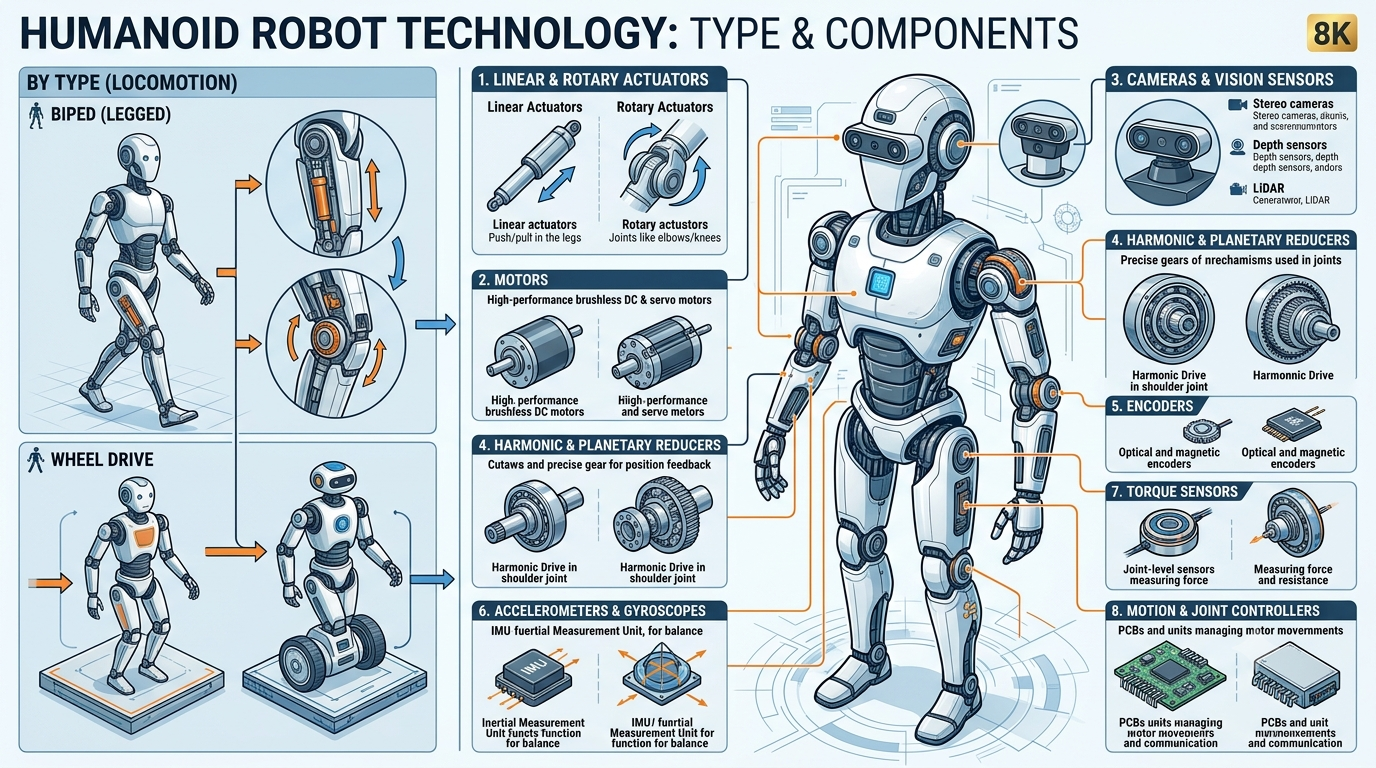
Linear and rotary actuators support movement across robotic joints. Harmonic and planetary reducers help deliver controlled motion and torque. Encoders measure position and movement, while accelerometers provide information about acceleration and orientation. Torque sensors help robots assess the forces involved in physical interactions.
Cameras and vision sensors support object recognition, navigation, and environmental perception. Motion and joint controllers coordinate these components to help the robot maintain balance and execute movements accurately.
Improvements in component design can enhance dexterity, movement precision, energy efficiency, and reliability. At the same time, developers must manage competing requirements involving weight, payload, battery life, heat, durability, and manufacturing cost.
Progress across these hardware categories is an important factor supporting the commercialization of humanoid robots.
Key Trends Shaping the Humanoid Robot Market
1. Integration of AI and Robot Foundation Models
AI integration is one of the most influential trends in humanoid robotics. Advanced models can help robots interpret instructions, recognize objects, and select actions based on contextual information.
Combining AI models with robotic control systems can improve adaptability when a robot encounters unfamiliar objects or changes in its operating environment. Nevertheless, reliable physical execution requires extensive testing, real-time control, and safeguards against unsafe actions.
As AI capabilities improve, developers are focusing on systems that connect perception, planning, and manipulation within a unified robotic architecture.
2. Simulation-Based Training and Digital Twins
Training humanoid robots in real-world environments can be expensive and time-consuming. Physical testing also creates risks when robots handle heavy objects, move at speed, or operate near people.
Simulation provides an alternative by allowing developers to test movements, train control policies, and evaluate robot behavior in virtual environments. Large numbers of simulated scenarios can help robots learn how to respond to different conditions before being deployed in physical facilities.
Digital twins can further support development by representing equipment, workspaces, and operational processes in digital environments. These tools can help organizations evaluate deployment strategies, identify potential issues, and improve the coordination of robotic systems.
Simulation does not eliminate the need for real-world testing. Differences between virtual and physical environments must still be addressed, particularly when dealing with friction, sensor noise, unpredictable objects, and human interaction.
3. Advances in Bipedal and Wheel-Drive Robots
Humanoid robots can use different mobility configurations depending on their intended applications.
Biped robots use two legs to move through environments in a human-like manner. Their design may be suitable for facilities containing stairs, narrow passages, and workspaces designed around human movement. However, maintaining balance and walking reliably on uneven surfaces remains technically demanding.
Wheel-drive humanoid robots use wheels for mobility, potentially offering advantages in speed, energy efficiency, and stability on suitable surfaces. They may be appropriate for warehouses, commercial buildings, and facilities with relatively smooth floors.
The choice between bipedal and wheel-drive configurations depends on operating conditions, task requirements, safety, maintenance, and cost. Continued development in both categories is expanding the range of potential applications.
4. Development of More Capable Robotic Manipulation
Manipulation is a central challenge in humanoid robotics. A robot must not only reach an object but also recognize its shape, estimate the required grip, apply an appropriate amount of force, and respond when an object moves unexpectedly.
Advances in tactile sensing, torque measurement, vision systems, and coordinated joint control are helping developers improve these capabilities. Better manipulation can support tasks such as picking components, handling tools, moving packages, and interacting with equipment.
The ability to perform a wider range of tasks with fewer changes to the surrounding environment could strengthen the business case for humanoid robots.
5. Growth of Robotics-as-a-Service Models
High initial costs can limit adoption, particularly among small and medium-sized businesses. Robotics-as-a-Service (RaaS) offers an alternative by allowing customers to access robotic capabilities through subscription or service-based arrangements rather than purchasing all the equipment upfront.
Depending on the provider and contract, these models may include hardware access, maintenance, software updates, remote monitoring, and technical support.
RaaS can help businesses evaluate automation with lower initial capital commitments. It can also allow suppliers to generate recurring revenue and maintain closer relationships with customers.
For humanoid robots, the commercial success of service-based models will depend on measurable productivity improvements, predictable operating costs, system availability, and the ability to scale deployments efficiently.
6. Greater Focus on Safety and Human-Robot Collaboration
Humanoid robots are often designed for environments where people are already present. This creates opportunities for collaboration but also introduces significant safety requirements.
Robots must detect obstacles, control their movements, manage physical contact, and respond appropriately to unexpected situations. Applications involving healthcare, caregiving, public spaces, or close interaction with workers require particularly careful assessment.
Developers are investing in better perception, collision avoidance, force control, emergency-stop mechanisms, and monitoring systems. Businesses must also consider cybersecurity, data privacy, employee training, and applicable safety standards.
Reliable and transparent safety practices will be essential for building trust and supporting wider adoption.
Humanoid Robot Market Segmentation and Opportunities
The Humanoid Robot Market can be examined through robot type, components, and application areas. Each category offers different growth opportunities.
By Type: Biped and Wheel-Drive Robots
Biped humanoid robots are designed to move using two legs, making them potentially suitable for environments where human-like mobility is useful. Their applications may include manufacturing, logistics, inspection, and service tasks that require movement through human-oriented workspaces.
Wheel-drive robots can offer efficient movement across flat surfaces and may be useful in facilities where speed, stability, and operational efficiency are priorities.
Selecting the right configuration depends on the required mobility, task complexity, environmental conditions, and total cost of ownership.
By Component: Critical Technologies Enabling Robot Performance
Components represent a major technology opportunity because humanoid robots depend on tightly integrated mechanical, sensing, and control systems.
- Linear and rotary actuators: Enable controlled movement across joints and robotic mechanisms.
- Motors: Provide the power needed for movement and manipulation.
- Cameras and vision sensors: Support perception, object recognition, and navigation.
- Harmonic and planetary reducers: Help deliver controlled speed and torque.
- Encoders: Measure position and rotational movement.
- Accelerometers: Provide motion and acceleration data.
- Torque sensors: Help monitor forces during movement and physical interaction.
- Motion and joint controllers: Coordinate movement and maintain control accuracy.
Component suppliers that deliver compact, reliable, energy-efficient, and cost-effective technologies may benefit as robot manufacturers increase production and improve system performance.
By Application: Manufacturing, Logistics, Healthcare, and Services
Manufacturing provides opportunities for material handling, machine tending, assembly assistance, and inspection. Warehousing and distribution centers may use humanoid robots for selected movement and handling tasks.
Healthcare applications include potential assistance with logistics, facility operations, and certain support activities. Clinical and caregiving roles require additional safeguards, dependable performance, and appropriate human oversight.
Education, hospitality, entertainment, retail, and personal assistance offer other potential use cases, particularly where interaction and mobility are important. The suitability of each application will depend on the robot’s capabilities, cost, reliability, and ability to meet sector-specific requirements.
Regional Outlook: Asia Pacific and Global Competition
Regional market development is influenced by robotics manufacturing capabilities, AI research, industrial automation investment, government initiatives, and access to component suppliers.
According to MarketsandMarkets, Asia Pacific is expected to account for more than 50% of the Humanoid Robot Market throughout the forecast period. The region benefits from established electronics and robotics supply chains, strong manufacturing ecosystems, and investment in automation across countries such as China, Japan, and South Korea.
China is an important participant in humanoid robot development, supported by domestic robotics companies, component manufacturers, and investment in embodied intelligence. Japan and South Korea also have established capabilities in robotics, precision engineering, electronics, and industrial automation.
North America remains important because of its AI research, technology investment, robotics development, and demand for automation across industrial and commercial environments. Europe contributes through advanced manufacturing, engineering expertise, and industrial robotics adoption.
The pace of growth across regions will depend on commercialization, cost reductions, safety requirements, and the ability of suppliers to demonstrate reliable performance in real operating environments.
Competitive Landscape and Key Companies
Competition in the Humanoid Robot Market includes established technology companies, specialized robotics manufacturers, and emerging developers focused on AI-enabled robotic systems.
Companies identified in the MarketsandMarkets report include:
- Unitree Robotics
- AGIBOT Innovation
- UBTECH Robotics
- Leju Robotics
- EngineAI
- Fourier
- Figure AI
- Agility Robotics
- Tesla
- Boston Dynamics
Competitive differentiation increasingly depends on more than robot appearance or mobility. Companies must demonstrate dependable task execution, effective AI integration, component reliability, manageable operating costs, and the ability to deploy robots at scale.
Manufacturers are also exploring partnerships with AI developers, semiconductor suppliers, industrial customers, and system integrators. Such collaborations can help connect robotic hardware with software, training infrastructure, and real-world operating requirements.
As the market develops, performance benchmarks, service networks, software capabilities, and the availability of application-specific solutions are likely to influence commercial success.
Challenges Limiting Humanoid Robot Market Growth
Despite its growth potential, the market faces several challenges.
High development and deployment costs: Advanced actuators, sensors, compute platforms, batteries, and AI software can make humanoid robots expensive to develop and operate. Businesses need a clear return on investment before adopting them at scale.
Reliability in real-world environments: A robot that performs well in a controlled demonstration may struggle with unpredictable objects, changing lighting, uneven surfaces, or complex human interactions. Consistent performance across extended operating periods remains essential.
Battery life and energy efficiency: Walking, balancing, and manipulating objects can require substantial energy. Battery capacity, charging time, heat management, and operating duration affect productivity.
Safety and regulatory requirements: Robots operating near people need dependable motion control, collision avoidance, and emergency-response capabilities. Compliance requirements can add time and cost to commercialization.
Integration and workforce readiness: Businesses may need to update workflows, train employees, redesign processes, and integrate robots with existing software and equipment. Successful deployment requires both technical preparation and organizational planning.
Addressing these challenges will be critical to converting market interest into sustainable commercial demand.
Future Outlook: What Comes Next for the Humanoid Robot Market?
The future of the Humanoid Robot Market will depend on whether developers can move from impressive demonstrations to repeatable, economically viable applications. Progress in physical AI, robot foundation models, perception, manipulation, and simulation is expected to improve the range of tasks humanoid robots can perform.
Manufacturing and logistics may offer opportunities for early commercial deployment because they contain repetitive workflows and measurable productivity targets. Service applications may expand as robots become more reliable, affordable, and capable of safe interaction.
The development of RaaS offerings, fleet-management platforms, and remote monitoring tools may also make it easier for businesses to evaluate and scale deployments. Meanwhile, improvements in motors, actuators, reducers, sensors, and power systems could help lower costs and enhance performance.
For investors and technology providers, opportunities extend beyond complete robots to include components, AI software, simulation platforms, integration services, and maintenance. However, market participants will need to evaluate actual deployment results, customer demand, and operating economics rather than relying solely on projected technological capabilities.
Conclusion
The Humanoid Robot Market is growing as advances in AI, robotic hardware, and automation create new possibilities for machines that can operate in human-designed environments. Rising demand for industrial productivity, flexible automation, and workforce support is encouraging businesses to explore applications across manufacturing, logistics, healthcare, education, hospitality, and retail.
MarketsandMarkets estimates that the market will increase from USD 5.41 billion in 2026 to USD 50.27 billion by 2035, at a CAGR of 28.1%. Realizing this potential will depend on overcoming challenges related to cost, reliability, safety, battery life, and integration.
As the technology matures, companies that combine capable robotic hardware with effective AI, dependable task execution, and commercially viable deployment models may be well positioned to benefit from the next phase of intelligent automation.
Frequently Asked Questions (FAQs)
1. What is the projected size of the Humanoid Robot Market?
The Humanoid Robot Market is estimated to reach USD 5.41 billion in 2026 and is projected to reach USD 50.27 billion by 2035, according to MarketsandMarkets.
2. What is the expected CAGR of the Humanoid Robot Market?
The market is projected to grow at a CAGR of 28.1% from 2026 to 2035.
3. What are the major growth drivers of the Humanoid Robot Market?
Key growth drivers include advances in artificial intelligence and physical AI, increasing industrial automation, demand for flexible robotics, improvements in sensors and actuators, and growing interest in Robotics-as-a-Service models.
4. Which technologies are shaping the Humanoid Robot Market?
Important technologies include robot foundation models, computer vision, simulation-based training, advanced actuators, motors, reducers, encoders, torque sensors, motion controllers, and AI-enabled perception systems.
5. Which companies are key players in the Humanoid Robot Market?
Companies identified in the MarketsandMarkets report include Unitree Robotics, AGIBOT Innovation, UBTECH Robotics, Leju, EngineAI, Fourier, Figure AI, Agility Robotics, Tesla, and Boston Dynamics.
About MarketsandMarkets™
MarketsandMarkets™ has been recognized as one of America’s Best Management Consulting Firms by Forbes, as per their recent report.
MarketsandMarkets™ is a blue ocean alternative in growth consulting and program management, leveraging a man-machine offering to drive supernormal growth for progressive organizations in the B2B space. With the widest lens on emerging technologies, we are proficient in co-creating supernormal growth for clients across the globe.
Today, 80% of Fortune 2000 companies rely on MarketsandMarkets, and 90 of the top 100 companies in each sector trust us to accelerate their revenue growth. With a global clientele of over 13,000 organizations, we help businesses thrive in a disruptive ecosystem.
The B2B economy is witnessing the emergence of $25 trillion in new revenue streams that are replacing existing ones within this decade. We work with clients on growth programs, helping them monetize this $25 trillion opportunity through our service lines – TAM Expansion, Go-to-Market (GTM) Strategy to Execution, Market Share Gain, Account Enablement, and Thought Leadership Marketing.
Built on the ‘GIVE Growth’ principle, we collaborate with several Forbes Global 2000 B2B companies to keep them future-ready. Our insights and strategies are powered by industry experts, cutting-edge AI, and our Market Intelligence Cloud, KnowledgeStore™, which integrates research and provides ecosystem-wide visibility into revenue shifts.
To find out more, visit www.MarketsandMarkets™.com or follow us on Twitter , LinkedIn and Facebook .
Contact:
Mr. Rohan Salgarkar
MarketsandMarkets™ INC.
1615 South Congress Ave.
Suite 103, Delray Beach, FL 33445
USA: +1-888-600-6441
