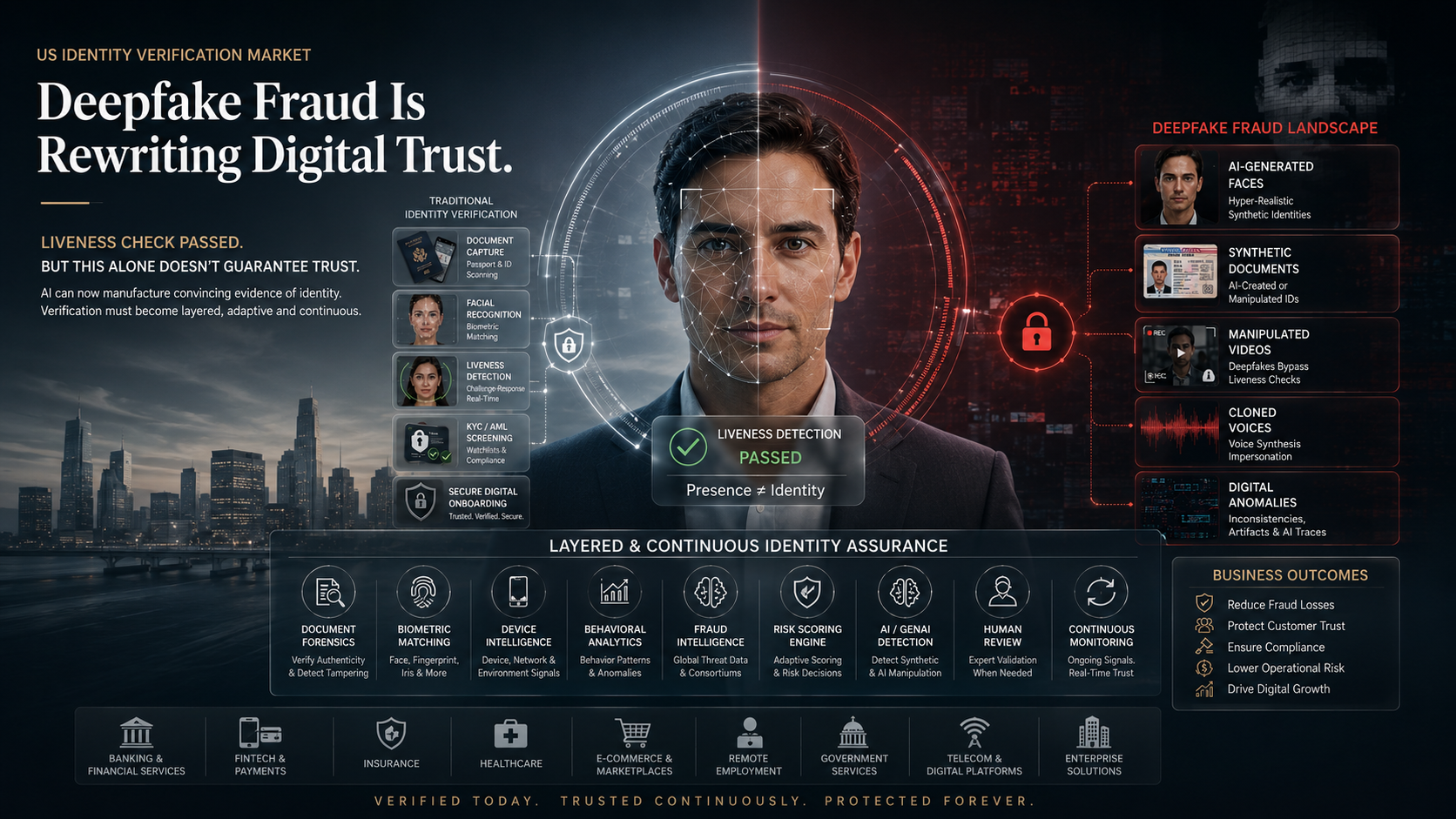
The US Identity Verification Market is entering a tough era of digital trust. Generative AI can create convincing faces, voices, documents, and videos, challenging traditional verification.
Liveness detection remains valuable because it determines whether a live person is present. Opportunity is shifting toward layered identity assurance combining biometrics, document intelligence, device signals, behavioral analytics, fraud intelligence, and continuous risk assessment.
Strategic Introduction: Why Deepfake Fraud Changes the Rules
Deepfake identity fraud uses AI-generated or manipulated media to impersonate individuals, bypass verification controls, create fraudulent accounts, or gain unauthorized access.
Traditional onboarding followed a familiar sequence: document, selfie, liveness, and decision. Attackers increasingly target the connections between these signals.
- Synthetic identities can combine documents, faces, and video.
- Manipulated media can challenge automated checks.
The US Identity Verification Market is moving toward risk-based trust.
Market research indicates strong trends Download the PDF to uncover business insights.
Market Context & Growth Narrative: AI Raises the Stakes
Digital onboarding is expanding identity-verification demand while generative AI increases the sophistication and scalability of identity fraud.
U.S. identity verification market at $4.34 billion in 2025 and projects $8.16 billion by 2030, representing a 13.5% CAGR.
- KYC and KYB remain demand drivers.
- Digital onboarding expands verification volumes.
Every online account and automated onboarding process creates another attack surface. In July 2026, LexisNexis Risk Solutions reported a 180% year-over-year increase in deepfake attacks and said one in every 100 failed identity checks involved a deepfake document, image, or liveness video. These are global observations, not U.S.-specific measurements.
The US Identity Verification Market analysis must consider fraud sophistication.
This Sample Report is designed to fuel your business growth—download it today.
Business Value Proposition: Beyond the Liveness Check
A resilient verification strategy combines liveness with document authentication, biometric matching, device intelligence, behavioral analysis, fraud signals, and continuous risk scoring.
Liveness can identify presentation attacks involving static images or replayed material, but it answers only one part of the identity question.
- Document intelligence detects inconsistencies and manipulation.
- Facial matching compares the face with the claimed identity.
- Device and behavioral signals reveal suspicious context.
- Risk orchestration triggers stronger controls when evidence conflicts.
Trust can therefore be reassessed through risk-based controls.
That shift is central to US Identity Verification Market trends: value is moving beyond speed toward measurable fraud reduction and continuous trust.
Industry Use Cases: Where Deepfake Risk Becomes Material
Banking, fintech, healthcare, insurance, e-commerce, government, telecommunications, and digital platforms face distinct deepfake and synthetic-identity risks.
Financial services remain a use case. Attackers can target account opening, credit applications, payments, money movement, and account recovery. Synthetic identities can create losses when initial verification is treated as permanent.
- Fintech must balance rapid onboarding with adaptive controls.
- Remote hiring faces deepfake personas, documents, and voice manipulation.
- Healthcare must protect patient identity and sensitive access.
- Marketplaces face seller fraud, payment abuse, and account takeover.
For the US Identity Verification Market growth story, opportunities emerge where identity assurance affects financial exposure or compliance.
Technology Architecture Overview: Building a Layered Defense
A modern anti-deepfake architecture combines secure capture, liveness, document forensics, biometric matching, device intelligence, behavioral analytics, fraud intelligence, and human escalation.
Secure capture protects the session while collecting reliable signals. Document and biometric intelligence provide evidence, while liveness operates as one control rather than the final verdict.
- Evidence: document forensics and biometric matching.
- Context: device, network, velocity, and account signals.
- Behavior: transaction patterns and interaction signals.
- Decision: adaptive risk scoring and escalation.
AI can help investigators summarize cases and prioritize alerts. Generative AI should not independently make high-impact identity decisions without governance.
NIST’s SP 800-63-4 provides guidance on identity proofing and assurance.
Regulatory & Compliance Landscape: Making Trust Defensible
Identity-verification programs must balance fraud prevention with privacy, security, accessibility, data minimization, governance, auditability, and human oversight.
Compliance is becoming more than a checklist. Enterprises need evidence that controls match risk.
- Financial institutions must address KYC and AML obligations.
- Healthcare organizations must protect sensitive information.
- Digital businesses must consider privacy and fair treatment.
Privacy should be embedded through justified data collection and controlled access.
The US Identity Verification Market outlook will favor providers that explain fraud detection alongside data governance and human oversight.
Implementation Roadmap: From Pilot to Enterprise Scale
Enterprises can strengthen anti-deepfake controls through threat modeling, layered technology, risk-based workflows, controlled testing, and continuous measurement.
Start by identifying the highest-risk identity threats.
- Map verification steps, data sources, vendors, and manual reviews.
- Combine liveness with document, biometric, device, behavioral, and fraud intelligence.
- Test realistic attacks against legitimate customer traffic.
- Measure detection, false positives, abandonment, review rates, latency, and cost.
- Refresh models, rules, datasets, and escalation policies as threats evolve.
A credible US Identity Verification Market forecast will favor organizations that demonstrate measurable performance rather than simply promote AI-powered verification.
Challenges & Risk Considerations: Security Without Friction
The key challenge is stopping sophisticated fraud without turning onboarding into a slow, invasive, or unreliable experience.
No single technology offers permanent protection. Deepfake generation evolves quickly, while detection models can struggle with unseen manipulation.
- Aggressive controls can increase false positives.
- Camera, lighting, accessibility, and document quality can affect users.
- Vendor concentration can make outages disruptive.
Enterprises should measure fraud prevented, false positives, abandonment, manual reviews, decision time, and post-onboarding fraud.
The goal is targeted friction when risk justifies it.
Competitive Advantage & Future Outlook
Competitive advantage will increasingly come from platforms uniting biometrics, fraud intelligence, AI, behavioral signals, authentication, and continuous assurance within one decision layer.
Leading providers will move beyond isolated features. Enterprises need document verification, biometrics, liveness, device intelligence, fraud analytics, authentication, and case management to operate as one connected system.
- Interoperability will matter across channels.
- Identity signals must move securely across onboarding, payments, recovery, and support.
- AI should improve decision quality, not simply accelerate verification.
The US Identity Verification Market report landscape is broadening. US Identity Verification Market share will increasingly reflect fraud intelligence, integration depth, orchestration, and enterprise trust—not verification volume alone.
Continuous Identity Assurance: The Next Frontier
The future of identity verification is shifting from one-time proof toward continuous, context-aware assurance throughout the customer and employee lifecycle.
Liveness proves presence, but presence is not the same as identity.
A resilient strategy connects the person, credential, device, behavior, transaction, and context.
- Verification becomes less visible to users.
- Risk assessment becomes more adaptive after onboarding.
- Assurance extends across banking, fintech, healthcare, commerce, government, employment, and digital platforms.
That evolution will shape US Identity Verification Market trends and expand the US Identity Verification Market size opportunity beyond document and biometric checks toward orchestration, fraud intelligence, behavioral analytics, digital identity, and continuous authentication.
The future is not about replacing liveness. It is about putting liveness in the right place.
Organizations that adapt fastest will invest in layered defenses, governance, adaptive AI, privacy, and monitoring.

