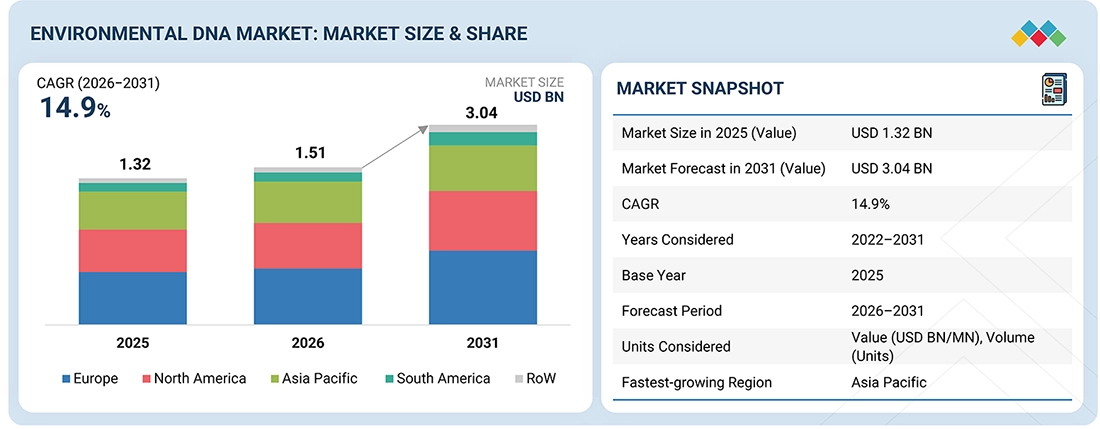
The Environmental DNA Market is projected to reach USD 3.04 billion by 2031, up from USD 1.51 billion in 2026, at a CAGR of 14.9%. The market is growing as organizations increasingly adopt molecular methods for faster, accurate, and non-invasive environmental monitoring. eDNA is used for biodiversity tracking, invasive species detection, conservation, water quality testing, and climate impact studies. Its ability to detect species from small DNA traces in water, soil, and sediment is driving adoption across research institutes, environmental agencies, and industries such as aquaculture. Advances in PCR, sequencing, data analysis, and standardized workflows, along with stricter biodiversity regulations and increased research funding, are further supporting market growth.
Download PDF Brochure: https://www.marketsandmarkets.com/pdfdownloadNew.asp?id=87204702
Services Segment Holds a Significant Share
By type of solution, the services segment accounts for a significant market share. Services include sample collection, laboratory analysis, sequencing, bioinformatics, data interpretation, and end-to-end project support. Many environmental agencies, research institutes, and companies prefer these services to avoid developing in-house expertise and investing in complex laboratory infrastructure. Integrated services provide complete workflows, improve consistency, and support large-scale biodiversity monitoring, regulatory compliance, and environmental impact assessments.
Metabarcoding Segment to Witness Strong Growth
By detection method, the metabarcoding segment is expected to maintain strong growth. Metabarcoding uses high-throughput sequencing to identify multiple species from a single sample, unlike targeted methods such as qPCR. It is widely used for biodiversity monitoring, ecosystem studies, and environmental impact assessments. Improvements in sequencing technologies, lower costs, expanding reference databases, and better bioinformatics tools are supporting the segment’s growth.
Request Sample Pages: https://www.marketsandmarkets.com/requestsampleNew.asp?id=87204702
Europe Holds a Substantial Share
Europe holds a substantial share of the environmental DNA market, supported by strict environmental regulations and ongoing monitoring requirements. Frameworks such as the EU Water Framework Directive and EU Biodiversity Strategy support the assessment of water bodies and ecosystems. eDNA is used across the region for river and lake monitoring, invasive species detection, and ecological assessments. The UK, Germany, France, and Nordic countries have strong research activity, supported by established research institutions, funding, laboratory networks, and environmental service providers.
Leading Environmental DNA Companies:
The report profiles key players such as Thermo Fisher Scientific Inc. (US), QIAGEN (Netherlands), Illumina, Inc. (US), Eurofins Scientific (Luxembourg), SGS Société Générale de Surveillance SA (Switzerland), NatureMetrics (UK), EnviroDNA (Australia), EDNAtec (Canada), SPYGEN (France), ID-GENE ecodiagnostics Ltd. (France), Takara Bio Inc. (Japan), Stantec (Canada), Applied Genomics (UK), AllGenetics (Spain), and Jonah Ventures (US).
Overall, growing demand for biodiversity monitoring, conservation, water quality assessment, and environmental impact studies, combined with advances in sequencing and data analysis, is expected to create strong growth opportunities for the environmental DNA market through 2031.

