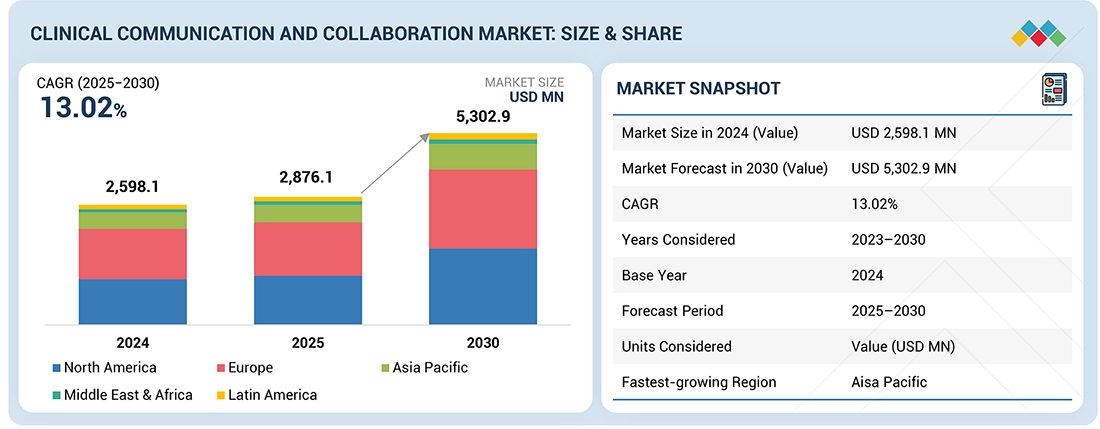
The global clinical communication and collaboration (CC&C) market is projected to grow from USD 2,876.1 million in 2025 to USD 5,302.9 million by 2030, registering a CAGR of 13.02% during the forecast period. Market growth is being driven by the increasing need for real-time communication, coordinated care delivery, improved clinical workflows, and enhanced patient safety across healthcare organizations.
Download PDF Brochure:- https://www.marketsandmarkets.com/pdfdownloadNew.asp?id=118830286
Hospitals and health systems are increasingly adopting secure communication and collaboration platforms to streamline clinician workflows, accelerate response times, and facilitate multidisciplinary care. Modern CC&C solutions integrate secure messaging, role-based communication, critical alerts, workflow automation, and mobile communication capabilities, helping healthcare organizations reduce communication delays and improve operational efficiency.
The growing adoption of cloud-based communication platforms, AI-driven alert routing, intelligent workflow orchestration, and mobile-first care team solutions is further transforming clinical communication. In addition, the expansion of virtual care, increasing clinician workload, and the need to replace fragmented legacy systems such as pagers and overhead paging are creating new opportunities for market growth.
On-Premises Segment Holds Largest Market Share
By deployment model, the on-premises segment accounted for the largest share of the clinical communication and collaboration market in 2024. Healthcare organizations continue to favor internally managed platforms because they provide greater control over data security, regulatory compliance, system integration, and communication workflows.
On-premises solutions enable hospitals to centrally manage messaging, alerting, and care team communication while integrating with existing hospital IT infrastructure. The growing emphasis on protecting sensitive clinical data and maintaining reliable communication across departments continues to support adoption of these platforms.
Nurse Communication Segment Registers Fastest Growth
By application, the nurse communication segment was the fastest-growing segment in 2024. The increasing complexity of patient care and growing workloads among nursing teams are driving demand for real-time communication and workflow coordination tools.
Nurse communication platforms support instant messaging, task management, critical alerts, streamlined handoffs, and integration with EHRs, nurse call systems, and clinical monitoring devices. These capabilities enable faster responses to patient needs while helping reduce communication errors and improve patient safety.
Speak To Analyst:- https://www.marketsandmarkets.com/speaktoanalystNew.asp?id=118830286
North America Dominates the Market
North America dominated the global clinical communication and collaboration market in 2024. The region’s leadership is supported by advanced healthcare infrastructure, high adoption of clinical mobility solutions, and the presence of leading healthcare IT and technology providers.
Hospitals across the region are increasingly investing in modern communication platforms to improve care coordination, clinician efficiency, and patient safety. Strong digital healthcare infrastructure, growing adoption of AI-enabled alerting and workflow automation, and the replacement of fragmented communication systems further contribute to regional market growth.
Competitive Landscape
Key players in the clinical communication and collaboration market include Cisco Systems, Inc., Oracle, Baxter (Hill-Rom Holdings, Inc.), Avaya LLC, Spok Inc., Ascom, Stryker, Microsoft, symplr, NEC Corporation of America, Everbridge, Imprivata, Pulsara, Mobile Heartbeat, OnPage, TigerConnect, PerfectServe, QGenda, Andor Health, QliqSOFT, Connexall, and other market participants.
These companies are focusing on platform innovation, secure messaging, clinical mobility, workflow automation, interoperability, and AI-enabled communication capabilities to strengthen their market positions.

