The Non-Destructive Testing (NDT) Equipment Market is entering a new phase of transformation as manufacturers and asset owners increasingly combine advanced inspection technologies with artificial intelligence (AI), robotics, automation, Industrial Internet of Things (IIoT), and digital analytics. NDT enables companies to examine materials, components, machinery, and infrastructure without damaging them, making it essential for industries where safety, reliability, product quality, and asset performance are critical.
The NDT and inspection market is expected to reach USD 22.34 billion by 2030 from USD 14.99 billion in 2025 at a CAGR of 8.3.%
Top 10 Key Takeaways
- AI is transforming NDT by accelerating defect detection and data interpretation.
- Robotics and drones are expanding inspection into hazardous and difficult-to-access environments.
- Predictive maintenance is increasing demand for connected NDT equipment.
- Digital twins are linking inspection data with long-term asset health management.
- PAUT and digital radiography are strengthening advanced inspection capabilities.
- IoT connectivity is enabling real-time and continuous condition monitoring.
- Portable NDT devices are creating opportunities for flexible field inspection.
- Aerospace, energy, manufacturing, and infrastructure remain important application sectors.
- Asia Pacific is emerging as a high-growth regional market.
- The long-term direction of the industry is toward NDT 4.0—connected, automated, AI-assisted, and predictive inspection.
AI Is Changing the Way NDT Data Is Analyzed
One of the most important Non-Destructive Testing Equipment Market Trends is the integration of AI and machine learning into inspection workflows. Conventional NDT equipment can generate significant quantities of ultrasonic, radiographic, eddy-current, thermographic, and visual inspection data. Reviewing this information manually can be time-consuming and may introduce inconsistencies, particularly when inspectors must analyze thousands of images or signals.
AI-powered systems can help identify patterns, anomalies, and potential defects within large datasets. Machine learning algorithms can be trained to recognize indications associated with corrosion, cracks, voids, inclusions, delamination, and other forms of material degradation.
The objective is not necessarily to eliminate human inspectors. Instead, AI can act as an analytical assistant that prioritizes indications, reduces repetitive review tasks, and helps inspectors make faster and more consistent decisions. MarketsandMarkets identifies AI-powered analysis as a major trend affecting NDT and inspection, particularly as industries seek faster defect detection and data-driven asset management.
Automation Improves Inspection Efficiency
Industrial automation is another major factor supporting market growth. Automated NDT equipment can perform repetitive inspection activities with consistent parameters, reducing variations associated with manual processes.
Automated ultrasonic testing, phased-array ultrasonic testing (PAUT), digital radiography, eddy-current inspection, and automated visual inspection can be integrated into production lines or dedicated inspection stations.
This is particularly valuable in industries such as automotive, aerospace, metals, electronics, and manufacturing, where large numbers of components may need to be inspected rapidly.
MarketsandMarkets highlights the expansion of industrial automation and robotics in inspection as a key market driver. Automated systems can improve inspection efficiency while reducing human intervention in repetitive or hazardous environments.
Download PDF Brochure @ https://www.marketsandmarkets.com/pdfdownloadNew.asp?id=882
Robotics Enable Inspection in Hazardous Environments
Robotics is extending NDT capabilities into locations that may be difficult, dangerous, or expensive for personnel to access.
Robotic inspection platforms can operate around pipelines, storage tanks, aircraft, power-generation equipment, offshore infrastructure, and other complex assets. Drones can also collect visual and inspection data from structures such as bridges, wind turbines, transmission infrastructure, and industrial facilities.
This trend is particularly important for industries where inspection personnel may face risks from height, confined spaces, extreme temperatures, radiation, chemicals, or difficult terrain.
By combining robotic mobility with NDT sensors, companies can improve inspection coverage while reducing personnel exposure to hazardous environments. MarketsandMarkets identifies robotic and drone-based inspection systems as important areas of technology development.
Predictive Maintenance Creates New Demand
NDT equipment is increasingly becoming part of predictive maintenance strategies.
Traditional maintenance programs may rely on fixed schedules, while predictive maintenance uses real-time or historical information to determine when an asset may require attention. NDT data can provide critical information about material degradation, structural integrity, corrosion, fatigue, and other conditions.
When inspection results are combined with AI and analytics, organizations can identify deterioration earlier and prioritize maintenance according to asset condition and risk.
MarketsandMarkets notes that asset owners are increasingly shifting from purely periodic inspection toward risk-based and condition-based inspection programs. This transition creates opportunities for equipment manufacturers and service providers that can deliver not only inspection hardware but also data management, analytics, and asset-integrity solutions.
Digital Twins Connect Inspection With Asset Management
Digital twins are becoming increasingly relevant to NDT because they provide a digital representation of a physical asset or system.
Inspection information such as wall-thickness measurements, corrosion maps, dimensional scans, ultrasonic results, and radiographic images can potentially be incorporated into digital asset models. This allows organizations to track asset condition over time rather than treating each inspection as an isolated event.
The combination of NDT + IoT + AI + digital twins can provide a more comprehensive picture of asset health. Operators can use these insights to support maintenance planning, risk assessment, remaining-life analysis, and operational decision-making.
MarketsandMarkets identifies digital twin integration as one of the technologies contributing to the evolution of data-centric inspection and proactive maintenance.
Advanced Ultrasonic Testing Gains Momentum
Ultrasonic testing remains one of the most important NDT techniques, particularly for detecting internal flaws and assessing material thickness.
Advanced techniques such as phased-array ultrasonic testing (PAUT) and time-of-flight diffraction (TOFD) provide greater inspection capabilities for complex components and welds.
PAUT enables electronic control of ultrasonic beams, allowing inspectors to examine larger areas and complex geometries with fewer physical probe movements. Digital data can also be stored for later analysis, improving traceability.
MarketsandMarkets identifies ultrasonic testing as the leading technique in the broader NDT and Inspection Market, while advanced ultrasonic technologies are part of the wider shift toward automated and digital inspection.
Digital Radiography Modernizes Imaging
Radiographic testing is also undergoing digital transformation. Digital radiography can replace traditional film-based workflows with electronic image capture, storage, transmission, and analysis.
The transition to digital imaging can accelerate inspection workflows and simplify data management. When AI-based image analysis is added, inspection teams can potentially automate portions of defect recognition and prioritize images that require closer examination.
Digital radiography is particularly relevant to manufacturing, aerospace, automotive, electronics, and other industries requiring detailed internal inspection.
The broader NDT market is experiencing increasing adoption of digital radiographic testing, alongside automated ultrasonic inspection and phased-array technologies.
Remote and Contactless Inspection Expand
Another significant trend is the growing demand for remote and contactless inspection.
Industries such as oil & gas, aerospace, power generation, and manufacturing operate assets where physical access can be difficult or hazardous. Remote inspection technologies—including drones, robotic crawlers, remote visual inspection systems, and wireless sensors—can help collect data without requiring inspectors to enter dangerous areas.
This approach can also reduce downtime because inspections may be performed without extensive equipment disassembly or scaffolding.
MarketsandMarkets identifies remote and contactless NDT solutions as a major growth driver as organizations seek to improve safety while maintaining asset availability.
IoT Enables Connected Inspection
The Industrial Internet of Things is making NDT equipment more connected.
Sensors can continuously collect information about temperature, vibration, pressure, corrosion, structural conditions, and other parameters. Connected NDT equipment can transfer inspection information to centralized platforms where it can be analyzed and compared over time.
This creates an opportunity to move from isolated inspections toward continuous or near-real-time condition monitoring.
For asset owners, connected systems can provide better visibility across geographically distributed facilities and help maintenance teams prioritize assets requiring attention.
Portable NDT Equipment Creates Growth Opportunities
While automation is increasing, portable equipment remains highly important.
Compact ultrasonic testers, eddy-current instruments, thermal imaging systems, thickness gauges, and other portable devices allow technicians to perform inspections directly in the field.
MarketsandMarkets identifies growing demand for miniaturized and portable NDT devices as an important opportunity. Portable equipment can be particularly useful for infrastructure inspection, field maintenance, power generation, transportation, and construction applications.
The combination of portability and digital connectivity is especially valuable. Modern handheld equipment can increasingly store inspection data electronically, connect to software platforms, and support automated reporting.
Aerospace Drives Advanced Inspection Demand
Aerospace is one of the most demanding NDT application areas because aircraft components must meet stringent safety and reliability requirements.
Aircraft structures increasingly use lightweight composites, advanced alloys, and complex manufactured components. These materials can require specialized inspection techniques.
AI-assisted inspection, automated ultrasonic testing, digital radiography, computed tomography, and robotic systems can help aerospace manufacturers and maintenance organizations inspect components with greater consistency.
Fleet modernization and increased emphasis on aircraft availability are likely to support continued demand for advanced inspection technologies.
Energy and Power Infrastructure Offer Major Opportunities
Oil & gas and power generation represent important markets for NDT equipment because pipelines, pressure vessels, turbines, boilers, welds, and other infrastructure require regular integrity assessment.
Aging infrastructure is also creating demand for structural health monitoring and advanced inspection.
Renewable energy is expanding the opportunity further. Wind turbines, solar infrastructure, battery systems, and associated electrical infrastructure require inspection and maintenance throughout their operating lifecycles.
MarketsandMarkets identifies growing NDT demand in renewable energy and power sectors as an important market opportunity.
Manufacturing Moves Toward In-Line Inspection
Manufacturing companies increasingly want inspection to become part of production rather than a separate downstream activity.
Automated stationary NDT systems can inspect components at high speed while they move through manufacturing processes. This enables manufacturers to identify defects earlier and reduce the risk of producing large quantities of defective products.
MarketsandMarkets reports that demand for automated stationary NDT and inspection systems is being driven by the need for reliable, high-speed defect detection in industries including oil & gas, rail, aerospace, and metals.
In-line inspection is particularly attractive for high-volume manufacturing because automation can improve repeatability and reduce inspection cycle times.
Skill Shortages Encourage Automation
The shortage of skilled NDT technicians is another factor influencing the market.
Advanced NDT techniques require specialized knowledge, training, certification, and experience. At the same time, industries are facing increasingly complex materials and structures.
AI and automation can help address some workforce pressures by assisting with repetitive analysis, automated data collection, reporting, and defect classification.
However, qualified personnel will remain essential for interpreting complex results, validating findings, managing inspection programs, and making engineering decisions.
MarketsandMarkets identifies the shortage of skilled technicians for advanced NDT operations as a market restraint.
High Equipment Costs Remain a Challenge
Advanced NDT systems can require substantial investment. Equipment costs can increase when organizations adopt phased-array systems, automated platforms, industrial imaging, robotics, connected sensors, and AI-enabled analytics.
Integration with existing systems can also be challenging, particularly at facilities using legacy equipment and software.
MarketsandMarkets identifies high equipment costs and legacy-system incompatibility among the major restraints affecting NDT and inspection adoption.
This creates an opportunity for vendors offering modular, scalable, portable, and software-enabled solutions that allow customers to modernize gradually.
Asia Pacific Emerges as a Strong Growth Region
Asia Pacific is becoming an important growth market for NDT and inspection technologies. MarketsandMarkets projects the regional NDT and Inspection Market to increase from USD 4.30 billion in 2025 to USD 6.91 billion by 2030, representing a 10.0% CAGR.
Rapid industrialization, infrastructure development, manufacturing expansion, energy investments, and stricter safety requirements are supporting demand across the region.
The adoption of digital radiography, PAUT, robotics, IoT-enabled monitoring, and AI-based defect recognition is also helping organizations address productivity and workforce challenges.
Future Outlook
The future of the Non-Destructive Testing Equipment Market will be defined by the convergence of inspection hardware, AI, robotics, connectivity, and advanced analytics.
Inspection equipment is increasingly becoming a source of digital information rather than simply a measurement tool. Data generated during testing can be stored, analyzed, compared over time, and integrated into broader asset-management platforms.
This transformation will encourage the development of NDT 4.0, in which inspection becomes connected, automated, predictive, and increasingly integrated with industrial digital ecosystems.
AI will likely become particularly valuable for high-volume data interpretation, while robotics and drones will expand the ability to inspect hazardous or inaccessible environments. Digital twins and IoT will help connect individual inspection results to long-term asset health.
Conclusion
The Non-Destructive Testing Equipment Market is moving from traditional, manually intensive inspection toward a more intelligent and automated model. AI-powered analytics, robotics, drones, IoT connectivity, digital imaging, advanced ultrasonic technologies, and digital twins are changing how organizations detect defects and manage asset integrity.
The transformation is being driven by the need for greater safety, reduced downtime, predictive maintenance, higher inspection accuracy, and improved operational efficiency. At the same time, challenges such as equipment costs, legacy-system integration, data quality, and skilled-labor shortages will influence adoption.
As industries modernize their assets and embrace Industry 4.0, NDT equipment will increasingly serve as an integral component of connected industrial operations. The future of inspection will not simply involve finding defects—it will involve predicting risks, automating decisions, and continuously understanding asset health.
FAQs
1. What is the Non-Destructive Testing Equipment Market?
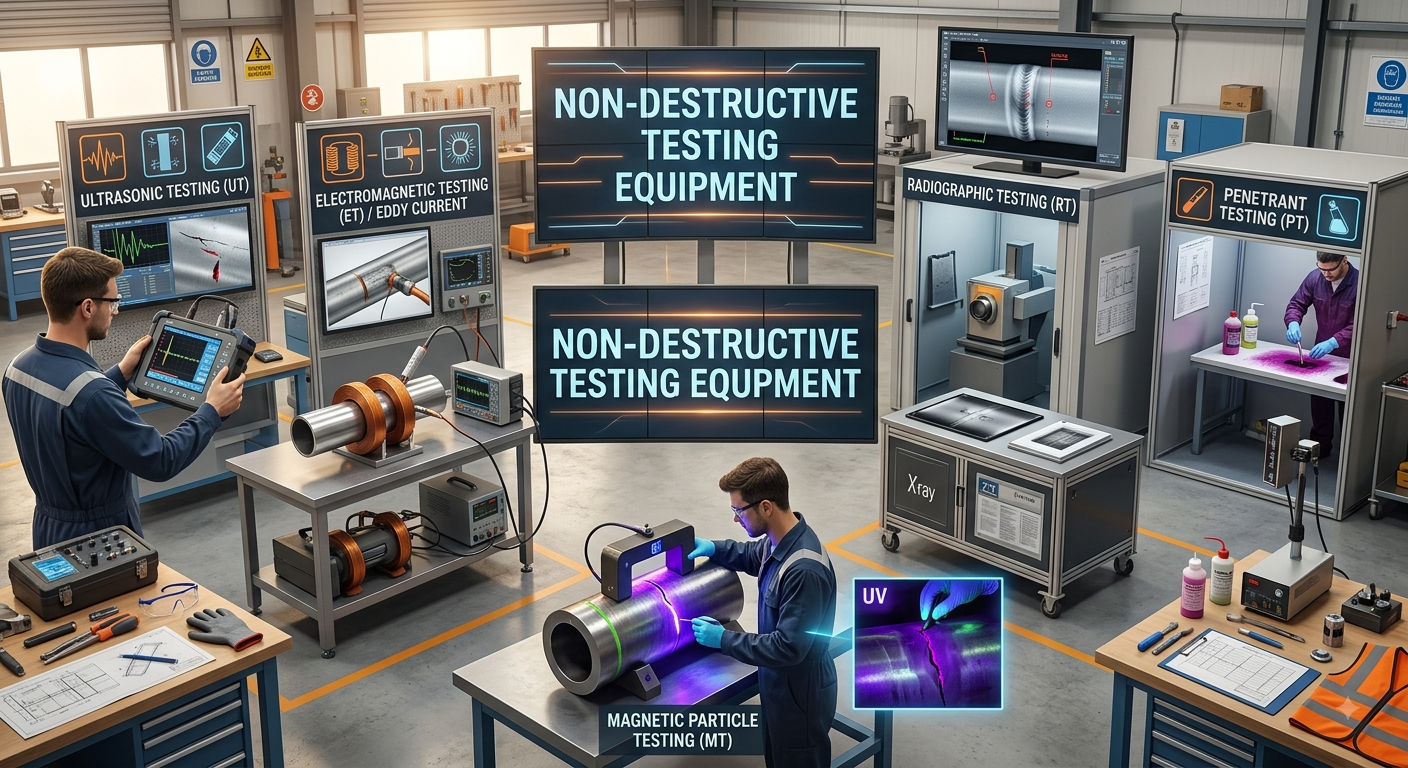
The market includes equipment used to inspect materials, components, and structures without damaging them. Major technologies include ultrasonic testing, radiographic testing, eddy-current testing, magnetic particle testing, liquid penetrant testing, and visual inspection systems.
2. How is AI transforming NDT equipment?
AI can analyze large volumes of inspection data, identify anomalies, assist with defect classification, and prioritize results for human review. This can improve inspection speed, consistency, and data-driven decision-making.
3. What are the major trends in NDT equipment?
Key trends include AI-powered inspection, robotics, drone-based testing, IoT connectivity, digital radiography, advanced ultrasonic testing, portable equipment, digital twins, and predictive maintenance.
4. Which industries use NDT equipment?
Major users include aerospace, automotive, oil & gas, power generation, manufacturing, transportation, construction, infrastructure, and renewable energy. These industries use NDT to improve safety, quality, asset integrity, and regulatory compliance.
5. What is the future of NDT equipment?
The market is moving toward connected and automated inspection systems that combine AI, robotics, IoT, cloud analytics, digital twins, and advanced sensors. This will support the transition from periodic inspection toward continuous, condition-based, and predictive asset management.
About MarketsandMarkets™
MarketsandMarkets™ has been recognized as one of America’s Best Management Consulting Firms by Forbes, as per their recent report.
MarketsandMarkets™ is a blue ocean alternative in growth consulting and program management, leveraging a man-machine offering to drive supernormal growth for progressive organizations in the B2B space. With the widest lens on emerging technologies, we are proficient in co-creating supernormal growth for clients across the globe.
Today, 80% of Fortune 2000 companies rely on MarketsandMarkets, and 90 of the top 100 companies in each sector trust us to accelerate their revenue growth. With a global clientele of over 13,000 organizations, we help businesses thrive in a disruptive ecosystem.
The B2B economy is witnessing the emergence of $25 trillion in new revenue streams that are replacing existing ones within this decade. We work with clients on growth programs, helping them monetize this $25 trillion opportunity through our service lines – TAM Expansion, Go-to-Market (GTM) Strategy to Execution, Market Share Gain, Account Enablement, and Thought Leadership Marketing.
Built on the ‘GIVE Growth’ principle, we collaborate with several Forbes Global 2000 B2B companies to keep them future-ready. Our insights and strategies are powered by industry experts, cutting-edge AI, and our Market Intelligence Cloud, KnowledgeStore™, which integrates research and provides ecosystem-wide visibility into revenue shifts.
To find out more, visit www.MarketsandMarkets™.com or follow us on Twitter , LinkedIn and Facebook .
Contact:
Mr. Rohan Salgarkar
MarketsandMarkets™ INC.
1615 South Congress Ave.
Suite 103, Delray Beach, FL 33445
USA: +1-888-600-6441
