The global Free Space Optics (FSO) and Visible Light Communication (VLC)/Li-Fi market is emerging as a high-growth segment within the broader wireless communications industry. As demand for high-speed, secure, low-latency, and reliable connectivity continues to increase, optical wireless communication technologies are gaining attention as alternatives and complements to conventional radio-frequency (RF), fiber-optic, and microwave networks.
According to MarketsandMarkets,The FSO & VLC/Li-Fi market was valued at USD 2.78 billion in 2024 and is projected to reach USD 7.39 billion by 2029, growing at a CAGR of 21.6% from 2024 to 2029. The rapid growth reflects rising demand for high-speed wireless connectivity, increasing connected devices, expansion of IoT networks, and the need for secure data transmission.
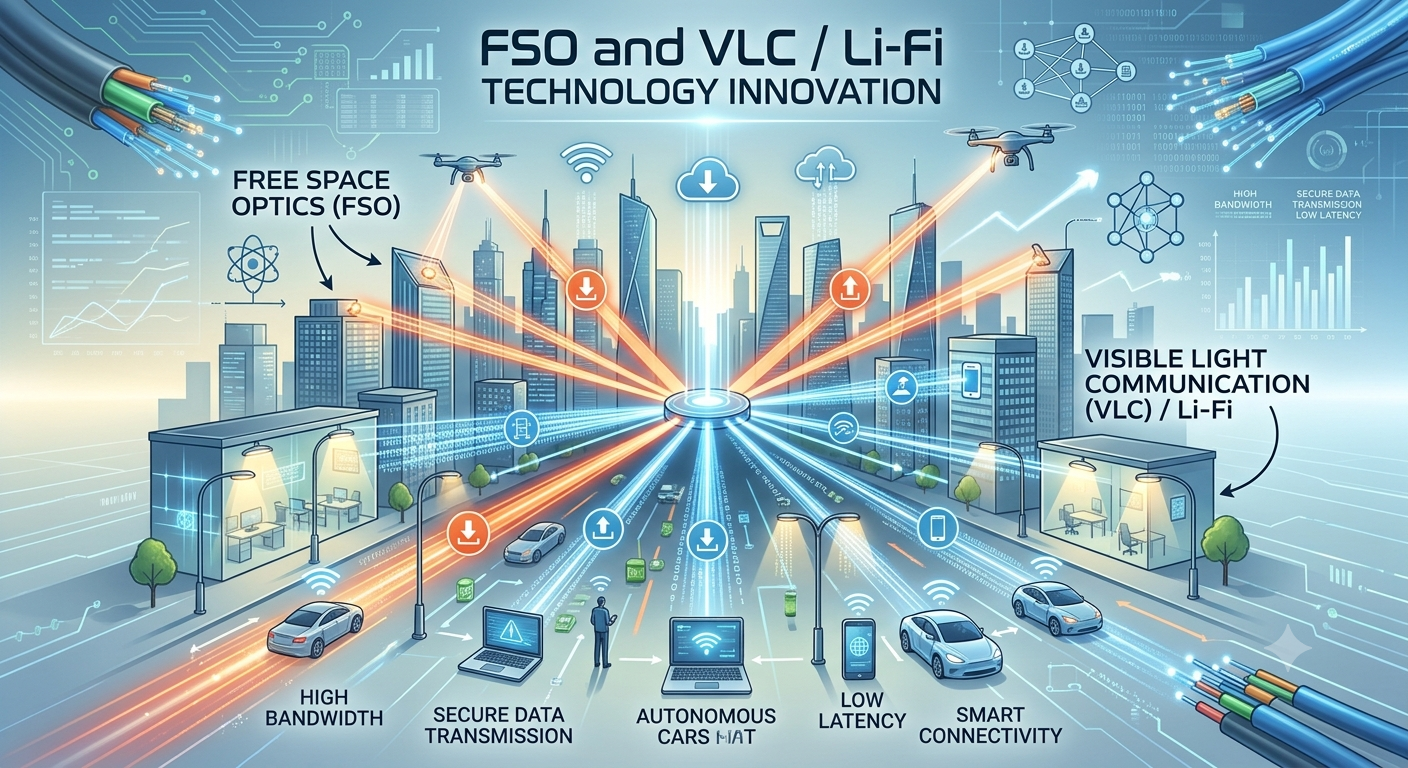
The market covers two closely related optical communication technologies. FSO uses light to transmit information through free space, typically between fixed points, while VLC/Li-Fi uses visible light—often from LED lighting systems—to provide wireless communication. Together, these technologies are creating new possibilities across telecommunications, healthcare, enterprise networking, smart retail, transportation, aerospace and defense, industrial automation, and other specialized environments.
FSO and VLC/Li-Fi Market Revenue Growth
The increase from USD 2.78 billion in 2024 to USD 7.39 billion in 2029 represents approximately USD 4.61 billion in additional market value over five years. A 21.6% CAGR makes this one of the faster-growing technology markets associated with next-generation wireless connectivity.
One of the central drivers is the rapid growth in connected devices. IoT applications are generating increasing volumes of data and require networks that can provide high bandwidth, low latency, reliability, and security. Optical wireless technologies can complement existing connectivity infrastructure by providing high-capacity links in environments where conventional wireless or wired solutions face limitations.
FSO is particularly relevant where organizations need high-bandwidth point-to-point connectivity without installing physical cables. VLC/Li-Fi, meanwhile, can use existing LED lighting infrastructure to deliver wireless communication indoors.
Top 10 Key Takeaways
- The global FSO and VLC/Li-Fi market is projected to reach USD 7.39 billion by 2029.
- The market is expected to grow from USD 2.78 billion in 2024 to USD 7.39 billion in 2029.
- The forecast CAGR is 21.6% from 2024 to 2029.
- High-speed wireless connectivity is a major driver of market expansion.
- North America accounted for 35.0% of market revenue in 2024. future will increasingly depend on software, intelligent network management, high-performance optical components, and integration with technologies such as IoT, 5G, AI, and smart-city infrastructure. MarketsandMarkets specifically identifies the emergence of IoT and 5G applications as important opportunities for the market.
- Asia Pacific is expected to register the fastest growth through 2029.
- FSO modulator and demodulator components are projected to record a 21.5% CAGR.
- VLC/Li-Fi software is expected to be the fastest-growing component segment, with a 25.6% CAGR.
- Smart stores are expected to represent the largest VLC/Li-Fi application segment, while healthcare and hospitals are among the fastest-growing opportunities.
- FSO backhaul, Li-Fi enterprise networking, smart retail, healthcare, industrial IoT, data centers, defense, and disaster recovery represent major business opportunities.
What Is Driving the FSO Market?
Growing Demand for High-Speed Wireless Connectivity
The increasing requirement for faster wireless connections is one of the strongest growth factors for FSO and VLC/Li-Fi. Organizations are looking for alternatives that can handle growing data volumes while reducing network congestion.
FSO can provide high-bandwidth connections without relying on physical cables or radio spectrum. MarketsandMarkets identifies limited last-mile connectivity as an important driver for FSO adoption. FSO can connect high-capacity networks to businesses and other endpoints, particularly where fiber deployment is difficult or time-consuming.
FSO can therefore serve as a complementary technology to fiber rather than necessarily replacing it. It can provide rapid point-to-point connections, temporary links, backup connectivity, or connections between buildings.
Faster and Safer Data Transfer With VLC/Li-Fi
VLC/Li-Fi is gaining attention because data can be transmitted through light rather than conventional radio waves. MarketsandMarkets highlights faster and safer data transfer as a key driver of the VLC/Li-Fi market.
Because light does not penetrate walls in the same manner as radio signals, VLC/Li-Fi can offer advantages in environments where localized and secure wireless communication is important.
This characteristic creates opportunities in offices, hospitals, industrial facilities, smart stores, aircraft, and other environments requiring controlled wireless connectivity.
FSO Market Segmentation
Modulators and Demodulators
Modulators and demodulators are key components of FSO systems. According to MarketsandMarkets, the modulator and demodulator segment is expected to register the highest CAGR within the FSO component market, at 21.5% during the forecast period.
As FSO deployments increase across backhaul networks, disaster recovery systems, and military communications, demand for efficient optical signal processing components is expected to rise.
For component manufacturers, this creates opportunities to develop products with improved transmission efficiency, higher data rates, greater reliability, and better performance under challenging environmental conditions.
IT and Telecommunications
The IT and telecommunications vertical is expected to dominate the FSO market during the forecast period.
FSO can provide high-bandwidth, low-latency connections and can also function as a redundant link when fiber networks experience failures. This makes it useful for data centers, enterprise networks, telecommunications infrastructure, and backhaul applications.
As network traffic continues to grow, FSO can provide an additional connectivity layer that helps organizations expand capacity without immediately undertaking extensive physical infrastructure projects.
VLC/Li-Fi Market Opportunities
Software
Software is becoming increasingly important to the VLC/Li-Fi ecosystem. MarketsandMarkets expects the software segment to record the highest CAGR, at 25.6%, among VLC/Li-Fi components.
This highlights a broader transition in the industry from hardware-focused communication systems toward software-enabled optical networking.
Software can support network management, device authentication, positioning, analytics, communication control, and integration with enterprise systems. Companies that develop intelligent software platforms may therefore capture significant value as Li-Fi deployments become more sophisticated.
Bidirectional Communication
The bidirectional segment is expected to dominate the VLC/Li-Fi market by transmission type.
Bidirectional communication enables devices to both transmit and receive data, allowing VLC/Li-Fi systems to operate as practical wireless networks rather than simple one-way information-delivery systems.
This is particularly important for enterprise networking, smart buildings, industrial IoT, healthcare, and connected retail applications.
Smart Stores: A Major Application Opportunity
MarketsandMarkets projects smart stores to account for the largest share of the VLC/Li-Fi market by application during the forecast period.
Retailers are increasingly adopting connected technologies to improve customer experiences, optimize operations, and manage inventory.
VLC/Li-Fi can support several smart-store applications, including:
- Indoor positioning
- Smart lighting
- Interactive displays
- Inventory management
- Customer engagement
- Location-based information
- High-speed indoor connectivity
The technology can potentially use existing LED lighting infrastructure for both illumination and communication, creating opportunities for retailers to integrate connectivity into their physical environments.
Download PDF Brochure @ https://www.marketsandmarkets.com/pdfdownloadNew.asp?id=946
Healthcare and Hospital Applications
Healthcare represents another promising market for optical wireless technologies. MarketsandMarkets expects healthcare to be the fastest-growing FSO application segment, while the hospital segment is expected to grow at the fastest rate within VLC/Li-Fi applications during 2024–2029.
Hospitals have complex connectivity requirements. They need reliable communication for medical equipment, patient monitoring, operational systems, and connected devices.
VLC/Li-Fi can be particularly attractive in locations where RF interference or security concerns are important considerations. Controlled optical communication can create localized networks while reducing reliance on conventional RF technologies.
Asia Pacific: The Fastest-Growing Region
Asia Pacific is expected to register the highest growth rate in the FSO and VLC/Li-Fi market during the forecast period. MarketsandMarkets attributes this outlook to rapid urban digitalization, smart-city initiatives, and government-led adoption of next-generation connectivity technologies in countries including China, Japan, South Korea, and Singapore.
Dense urban environments and challenges associated with fiber deployment are also creating opportunities for high-capacity wireless optical links.
The region is likely to remain an important market for companies developing FSO equipment, Li-Fi systems, optical components, smart lighting, enterprise connectivity, and industrial communication solutions.
North America Maintains a Strong Market Position
North America accounted for 35.0% of global FSO and VLC/Li-Fi market revenue in 2024, according to MarketsandMarkets.
The region benefits from a mature technology ecosystem, strong enterprise demand, telecommunications infrastructure, and investment in advanced connectivity technologies.
The US market alone was valued at approximately USD 150 million in 2024 and is projected to reach USD 369.7 million by 2029, corresponding to a 19.8% CAGR.
This creates opportunities for companies targeting enterprise networking, defense, data centers, healthcare, and other specialized applications.
Key Business Opportunities Through 2029
The rapid market expansion is creating opportunities across hardware, software, services, and integrated connectivity solutions.
1. FSO Backhaul and Last-Mile Connectivity
Telecommunications operators and enterprises can use FSO to establish high-bandwidth connections where fiber deployment is difficult. FSO can provide rapid deployment and support network expansion without extensive cabling.
2. Data Center Connectivity
Data centers require high-capacity connections and increasingly need alternatives or complements to conventional cabling. FSO can provide secure point-to-point optical links in appropriate environments.
3. Li-Fi for Enterprise Networks
Offices can integrate Li-Fi into lighting infrastructure to provide localized wireless connectivity. This creates opportunities for vendors offering integrated luminaires, access points, network management software, and installation services.
4. Smart Retail
Retailers can use VLC/Li-Fi for indoor positioning, inventory management, customer engagement, and location-based services. Smart stores are expected to remain one of the strongest VLC/Li-Fi applications.
5. Healthcare Connectivity
Hospitals represent an attractive application for secure, localized optical wireless networks. Companies can develop Li-Fi solutions for medical devices, patient monitoring, communications, and hospital infrastructure.
6. Industrial IoT
Factories increasingly require reliable communication between machines, sensors, robots, and monitoring systems. Li-Fi can provide localized communication in environments where conventional RF technologies may be less desirable.
7. Defense and Aerospace
Optical wireless communication can offer security and high-speed communication capabilities for specialized defense and aerospace applications. FSO is already being explored for military communication and related use cases.
8. Disaster Recovery Networks
FSO can be rapidly deployed to restore connectivity when conventional infrastructure is damaged or unavailable. This creates opportunities for emergency communication and temporary network deployments.
9. Software and Network Management
With software expected to be the fastest-growing VLC/Li-Fi component segment, companies developing network management, analytics, device control, positioning, and security software can capture increasing value.
10. Optical Communication Components
Manufacturers of LEDs, photodetectors, transmitters, receivers, modulators, demodulators, microcontrollers, and related components can benefit as optical communication deployments expand.
Competitive Landscape
The FSO and VLC/Li-Fi market is competitive and includes established lighting and communications companies alongside specialized optical technology providers.
MarketsandMarkets identifies Signify Holding, Acuity Brands, Panasonic Corporation, and Lucibel among major players. Other companies identified in the market include fSONA Networks, Wireless Excellence, Oledcomm, pureLiFi, Fraunhofer HHI, Trimble Hungary, JSC Mostcom, LVX System, Velmenni, LightBee, and VLNComm.
The competitive landscape is increasingly influenced by research and development, partnerships, product launches, and expansion into enterprise and industrial markets.
Emerging companies and startups are also developing specialized solutions. MarketsandMarkets highlights companies such as nextLiFi, Global LiFi Tech, Infinity Technology Services, and VLNComm among emerging players and SMEs.
Market Challenges and Restraints
Despite its strong growth potential, the market faces several obstacles.
High FSO Installation Costs
The relatively high initial installation cost of FSO systems can limit adoption. MarketsandMarkets estimates FSO hardware costs at approximately USD 3,000–15,000, with installation costs of approximately USD 500–1,000, although the economics can be more attractive than fiber deployment in certain large-scale environments.
Signal Reliability
FSO links can be affected by environmental conditions and signal fading during propagation. This can create reliability challenges, particularly for outdoor deployments.
Limited Technology Awareness
VLC/Li-Fi remains less familiar to many potential customers than Wi-Fi and other established wireless technologies. MarketsandMarkets identifies lack of technological awareness as an important challenge to wider adoption.
As commercial deployments increase and customers gain a better understanding of the technology’s benefits, awareness is expected to improve.
The FSO and VLC/Li-Fi market is positioned for rapid expansion as organizations search for faster, more secure, and more flexible alternatives and complements to traditional connectivity technologies.
MarketsandMarkets projects the market to grow from USD 2.78 billion in 2024 to USD 7.39 billion by 2029, representing a remarkable 21.6% CAGR.
FSO is particularly well positioned for high-bandwidth point-to-point connectivity, last-mile applications, backhaul, data centers, disaster recovery, and specialized communications. VLC/Li-Fi, meanwhile, is creating opportunities for secure and localized wireless communication through LED lighting infrastructure.
The industry’s future will increasingly depend on software, intelligent network management, high-performance optical components, and integration with technologies such as IoT, 5G, AI, and smart-city infrastructure. MarketsandMarkets specifically identifies the emergence of IoT and 5G applications as important opportunities for the market.
For technology vendors, the opportunity extends well beyond selling individual optical components. Businesses capable of delivering complete ecosystems—including transmitters, receivers, LEDs, photodetectors, software, access points, network management, and professional services—can position themselves to capture a larger portion of the rapidly expanding value chain.
With demand for high-speed connectivity continuing to rise, FSO and VLC/Li-Fi are increasingly moving from specialized technologies toward practical components of next-generation wireless infrastructure.
