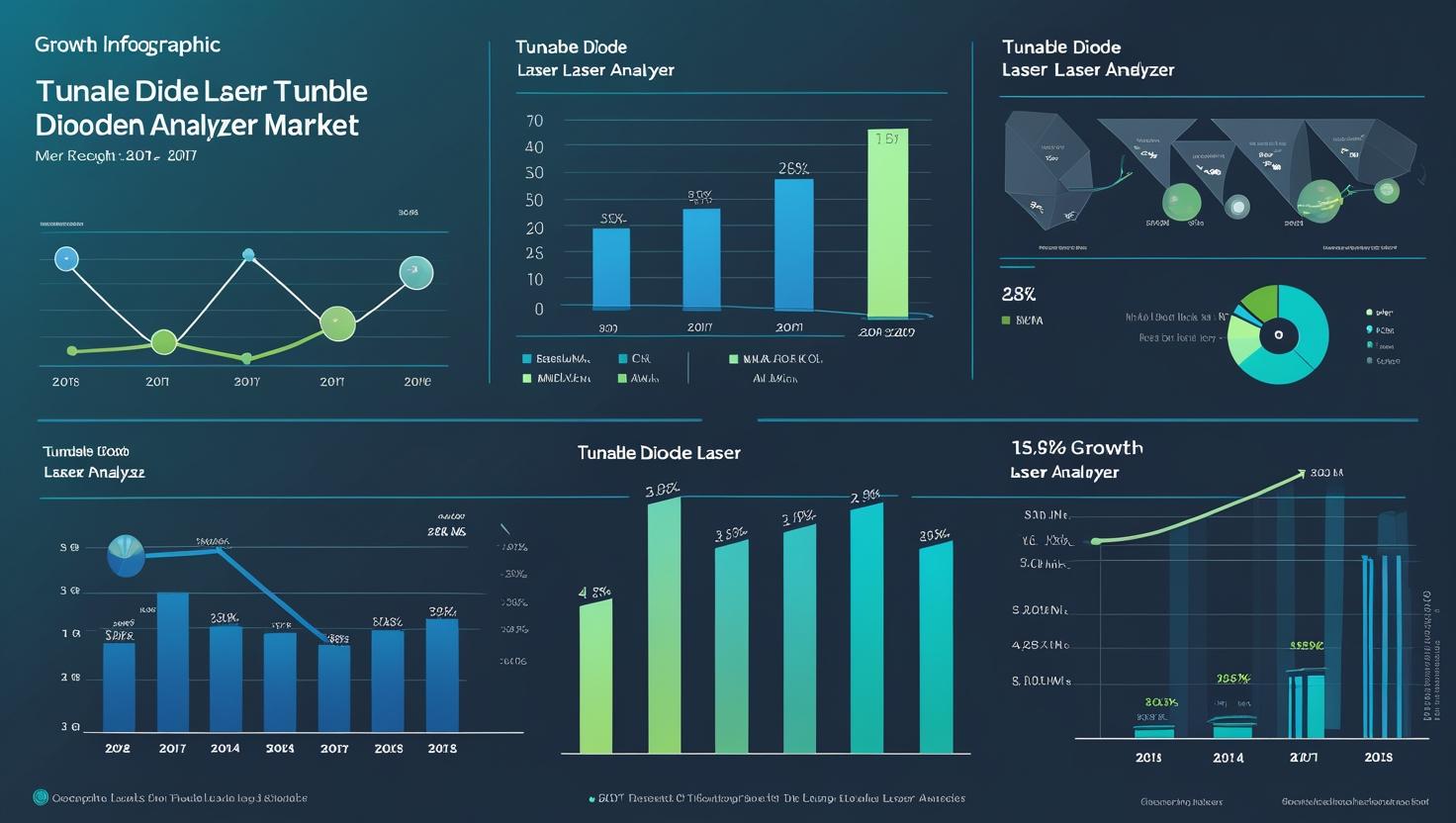
The global Tunable Diode Laser Analyzer (TDLA) market is entering a period of sustained expansion as industries increasingly require accurate, real-time, and reliable gas measurement for process optimization, emissions management, safety, and regulatory compliance. The global tunable diode laser analyzer (TDLA) market is expected to be valued at USD 546.2 million in 2024 and is projected to reach USD 884.4 million by 2031; it is expected to grow at a CAGR of 7.1% from 2024 to 2031.
The market’s development is closely linked to industrial automation, environmental monitoring, modernization of existing facilities, and the growing need to monitor gases with greater precision. Applications span oil & gas, power generation, chemicals and pharmaceuticals, metals and mining, pulp and paper, waste and water treatment, and semiconductor manufacturing.
Rising Demand for Real-Time Gas Monitoring
One of the principal factors supporting TDLA market growth is the increasing requirement for continuous and accurate gas analysis. Industrial facilities routinely monitor gases at multiple stages of production to optimize processes, improve safety, control emissions, and maintain product quality.
TDLAs use laser-based spectroscopy to detect specific gas molecules and can provide rapid measurements without relying on conventional sample-extraction processes in many applications. This capability makes the technology particularly relevant to facilities where gas composition needs to be monitored continuously and where delays in measurement can affect operational efficiency.
MarketsandMarkets identifies increasing industrialization and the development and modernization of power plants as important factors supporting demand. Industries including oil & gas, power, pulp and paper, cement, and chemicals and pharmaceuticals require gas measurement for both process control and environmental monitoring.
Environmental Regulations Strengthen Market Opportunities
Stricter environmental requirements are another important factor influencing adoption. Industrial operators are under increasing pressure to monitor emissions and demonstrate compliance with environmental standards, creating demand for technologies capable of accurate and timely measurement.
TDLAs can be used to monitor gases including oxygen, carbon monoxide, carbon dioxide, methane, hydrogen sulfide, nitrogen oxides, and moisture, depending on the analyzer configuration. These capabilities support applications ranging from combustion optimization to emissions monitoring and leak detection.
The emphasis on decarbonization and sustainability is also creating additional opportunities. MarketsandMarkets highlights applications related to carbon capture, renewable energy projects, and emissions control as areas supporting future TDLA demand.
Download PDF Brochure @ https://www.marketsandmarkets.com/pdfdownloadNew.asp?id=120588467
In Situ Measurement Gains Momentum
The in situ methodology represents an important growth area within the TDLA market. Unlike extractive approaches that remove a sample from the process for analysis, in situ systems can measure gases directly within a process stream.
According to MarketsandMarkets, in situ TDLA technology can reduce the need for complex sample-handling and conditioning systems while enabling near-real-time measurements. This can reduce maintenance requirements and potential points of failure, making the methodology attractive for demanding applications in power generation, petrochemicals, and environmental monitoring.
The ability to operate directly within industrial processes is particularly valuable where high temperatures, pressure, corrosive gases, or rapidly changing process conditions make conventional sampling approaches more complex.
Oil & Gas Remains a Major Application Area
The oil & gas industry accounted for the largest share of the TDLA market by end-use industry in 2023, according to MarketsandMarkets. The technology is used to measure gases such as methane, carbon dioxide, hydrogen sulfide, and oxygen across refineries, petrochemical facilities, and natural gas processing operations.
TDLAs can support several critical applications within the sector, including combustion optimization, emissions monitoring, process control, and hazardous-gas leak detection. The industry’s focus on operational efficiency, safety, emissions reduction, and lower-maintenance monitoring solutions is contributing to continued demand.
As energy companies expand infrastructure in emerging markets, the requirement for advanced gas-monitoring systems is expected to create additional opportunities for TDLA manufacturers and solution providers.
Asia Pacific Emerges as a Key Growth Region
Asia Pacific represents a particularly important market for tunable diode laser analyzers. The region accounted for 40.4% of the global TDLA market in 2023, according to MarketsandMarkets. Rapid industrialization, infrastructure development, environmental initiatives, and expanding power and manufacturing capacity are supporting regional demand.
China is expected to record the highest CAGR within the Asia Pacific TDLA market during the forecast period. Increasing attention to air quality, industrial emissions, process optimization, and automation is encouraging the adoption of advanced gas-analysis technologies across power generation, chemicals, oil & gas, and manufacturing.
India is also emerging as a significant market. A separate MarketsandMarkets analysis estimates India’s TDLA market at USD 32.3 million in 2024, with projections reaching USD 53.8 million by 2029, representing a 7.6% CAGR. The analysis points to petrochemical, power-generation, and environmental-monitoring applications as important areas of demand.
Artificial Intelligence Creates New Possibilities
The integration of artificial intelligence (AI) with TDLA systems is opening new possibilities for gas analysis and industrial process management.
MarketsandMarkets notes that AI-based algorithms can support real-time data analysis, pattern recognition, predictive analytics, signal processing, noise reduction, and adaptive calibration. These capabilities can help improve measurement reliability while supporting predictive maintenance and more proactive emissions management.
AI and digital-twin technologies may also contribute to TDLA product development by enabling manufacturers to simulate system performance under different operating conditions. In industrial environments, the combination of TDLA measurements with AI-driven analytics could support smarter process control and more efficient decision-making.
Industrial Modernization Supports Adoption
Modernization and migration projects are another important growth opportunity. Many industrial facilities are upgrading legacy instrumentation and control systems to improve efficiency, automation, communications, and environmental performance.
Replacing conventional gas analyzers with TDLA-based systems can provide industrial operators with improved measurement capabilities and support more sophisticated process-monitoring architectures. MarketsandMarkets identifies modernization initiatives and the replacement of older analyzers as factors that can increase TDLA installations across process industries.
The integration of TDLA systems with Industrial Internet of Things (IIoT) and Industry 4.0 infrastructure further expands their potential role in connected manufacturing environments.
Cost and Operating Conditions Remain Challenges
Despite strong growth prospects, the TDLA market faces several challenges. One of the primary restraints is competition from lower-cost gas-analysis technologies, including infrared, electrochemical, thermal-conductivity, paramagnetic, and other analyzer technologies.
MarketsandMarkets notes that TDLAs can have higher upfront costs than some alternative technologies. Consequently, organizations may continue using less expensive technologies for routine or non-critical monitoring applications, while reserving TDLA systems for applications where accuracy and advanced functionality justify the investment
Harsh industrial environments also present technical challenges. Oil & gas, petrochemical, and power-generation facilities can expose analyzers to high temperatures, dust, particulate matter, corrosive gases, and vibration. Protective enclosures, cooling systems, and vibration-resistant infrastructure may be required, increasing installation and maintenance costs.
Competitive Landscape
The global TDLA market includes established industrial automation, instrumentation, and analytical technology companies. MarketsandMarkets identifies companies including Yokogawa Electric Corporation, Emerson Electric, Spectris, AMETEK, METTLER TOLEDO, Endress+Hauser, ABB, SICK, Siemens, SENSIT Technologies, Pergam-Suisse, Tokyo Gas Engineering Solutions, Heath Consultants, Hanwei Electronics Group, and Baker Hughes among the key players operating in the market.
Competition is centered on measurement accuracy, reliability, analyzer design, application-specific capabilities, integration with industrial control systems, and the ability to operate under demanding process conditions.
Outlook for the TDLA Market
The outlook for the Tunable Diode Laser Analyzer market is closely connected to the broader transformation of industrial gas monitoring. Growing requirements for real-time measurement, tighter environmental controls, industrial automation, process modernization, and sustainability initiatives are creating multiple avenues for market expansion.
With the global market projected to grow from USD 546.2 million in 2024 to USD 884.4 million by 2031 at a 7.1% CAGR, TDLA technology is positioned to play an increasingly important role in industrial process monitoring and emissions management.
The strongest opportunities are likely to emerge where organizations need a combination of precise gas measurement, continuous monitoring, reduced maintenance, and integration with modern industrial control and analytics systems. At the same time, manufacturers will need to address cost, ruggedness, calibration, and deployment challenges to expand adoption across a wider range of industrial applications.
Overall, the increasing emphasis on precision gas monitoring, environmental compliance, process efficiency, and intelligent automation is expected to remain a central force behind the continued development of the global TDLA market through 2031.
Frequently Asked Questions (FAQs)
1. What is a Tunable Diode Laser Analyzer (TDLA)?
A Tunable Diode Laser Analyzer (TDLA) is an optical gas-analysis instrument that uses tunable diode laser spectroscopy to detect and measure specific gases with high accuracy. It is used for process control, emissions monitoring, safety, and environmental applications.
2. What is driving the growth of the TDLA market?
Key growth drivers include increasing demand for real-time gas monitoring, stricter emissions regulations, industrial automation, modernization of process plants, and the growing need for accurate process optimization.
3. What is the projected size of the TDLA market?
According to MarketsandMarkets, the global TDLA market is projected to grow from USD 546.2 million in 2024 to USD 884.4 million by 2031, at a 7.1% CAGR during 2024–2031.
4. Which industries use TDLA technology?
TDLAs are used across oil & gas, power generation, chemicals and pharmaceuticals, metals and mining, pulp and paper, waste and water treatment, and semiconductor manufacturing, among other industries.
