Molecular Biosensor Market Overview
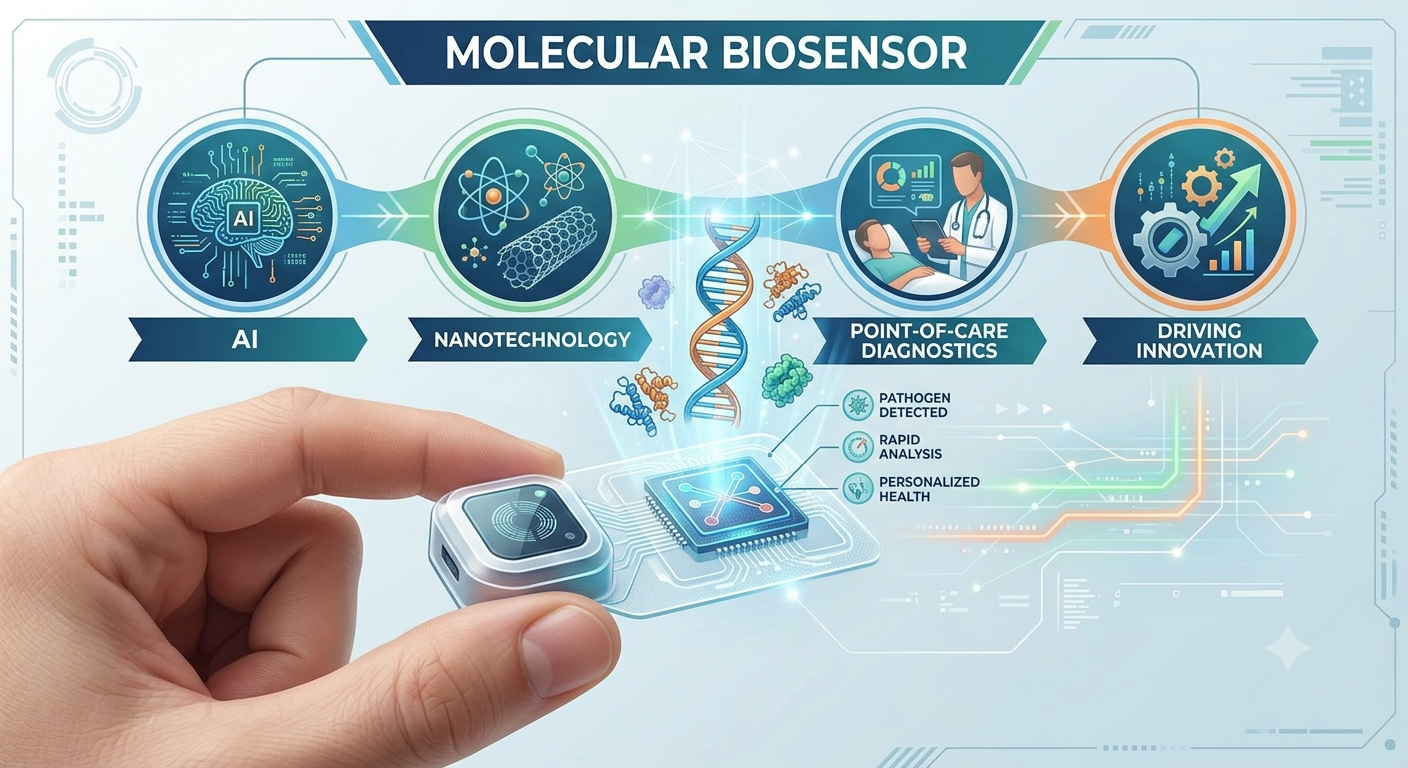
The Molecular Biosensor Market is emerging as an important segment of the broader biosensors industry as healthcare providers, researchers, and technology companies increasingly seek rapid, sensitive, and accurate molecular detection solutions. Molecular biosensors combine biological recognition elements with physicochemical transducers to detect specific biological molecules and convert molecular interactions into measurable signals. Advances in nanotechnology, microfluidics, optical sensing, electrochemical detection, miniaturized electronics, and artificial intelligence are expanding the capabilities of these systems across healthcare and non-healthcare applications.
According to MarketsandMarkets, the global biosensor market size was valued at USD 34.5 billion in 2025 and is projected to reach USD 54.37 billion by 2030, growing at a CAGR of 9.5% from 2025 to 2030. The report identifies technological advances such as miniaturization, nanotechnology, and microfluidics, along with increasing demand for rapid diagnosis and efficient monitoring, as important contributors to market expansion.
Within this broader market environment, the Molecular Biosensor Market is benefiting from demand for precise biomolecular detection, early disease identification, decentralized diagnostics, and continuous monitoring. The convergence of biosensing with AI, IoT, cloud platforms, and connected medical devices is further creating opportunities for intelligent molecular diagnostics.
AI Transforming Molecular Biosensor Technologies
Artificial intelligence is becoming an important technology layer for next-generation molecular biosensing. Traditional biosensors generate signals that must be interpreted to identify and quantify target analytes. AI and machine learning can assist in processing complex sensor outputs, identifying patterns, improving signal interpretation, and supporting automated decision-making.
The integration of AI with biosensors can help improve the interpretation of biological data generated by electrochemical, optical, and other sensing technologies. AI-enabled systems can potentially distinguish relevant molecular signals from background noise and support faster analysis of complex datasets.
For the Molecular Biosensor Market, this convergence is particularly relevant to disease detection, biomarker analysis, drug discovery, personalized healthcare, and remote diagnostics. MarketsandMarkets notes that integration with AI, IoT, and cloud-based platforms is accelerating biosensor development by enabling continuous monitoring and smart diagnostics.
Nanotechnology Driving Molecular Detection
Nanotechnology is one of the major innovation areas influencing the Molecular Biosensor Market. Nanomaterials can provide high surface-area-to-volume ratios and specific electrical, optical, or chemical properties that can enhance biosensor sensitivity and detection capabilities.
Nanotechnology-based biosensors can be designed using materials and structures such as nanoparticles, nanowires, graphene-based materials, and other nanoscale components. These technologies can support the detection of low concentrations of biomolecules and contribute to the development of smaller and more sensitive diagnostic devices.
MarketsandMarkets identifies the emergence of nanotechnology-based biosensors as a significant market driver. The broader biosensors market is also benefiting from advances in miniaturization, microfluidics, and new product development.
For molecular diagnostics, these developments can support faster detection of proteins, nucleic acids, pathogens, biomarkers, and other biological targets.
Download PDF Brochure @ https://www.marketsandmarkets.com/pdfdownloadNew.asp?id=798
Point-of-Care Diagnostics Creating New Opportunities
Point-of-care (POC) diagnostics are becoming a major application area for biosensing technologies. Healthcare systems increasingly require diagnostic solutions that can deliver results rapidly and closer to patients rather than relying exclusively on centralized laboratories.
The Molecular Biosensor Market can benefit from this shift because molecular biosensors can be incorporated into portable and miniaturized platforms designed for rapid detection. Such systems can support applications including infectious disease detection, biomarker analysis, genetic testing, and other diagnostic procedures.
MarketsandMarkets identifies home diagnostics as the fastest-growing biosensor application during the forecast period, supported by developments in healthcare, increasing adoption of new diagnostic methods, and the convenience offered by home-based medical devices.
The growing adoption of POC testing also supports the development of compact systems combining biosensors, microfluidic components, electronics, connectivity, and data analytics.
Microfluidics Supporting Miniaturized Biosensors
Microfluidics is another important technology supporting the evolution of the Molecular Biosensor Market. Microfluidic systems manipulate very small volumes of fluids and can integrate multiple laboratory functions into compact platforms.
Combining microfluidics with molecular biosensors can reduce sample requirements, simplify testing workflows, and support faster analysis. Lab-on-a-chip systems can integrate sample preparation, molecular recognition, sensing, and signal processing into increasingly compact platforms.
MarketsandMarkets identifies microfluidics and miniaturization among the technological developments supporting biosensor market growth.
These technologies are particularly relevant to decentralized diagnostics, infectious disease testing, research laboratories, and personalized medicine.
Optical Biosensors Expanding Molecular Detection Capabilities
Optical biosensors represent another important technology area for molecular detection. According to MarketsandMarkets, the optical biosensors segment is expected to register the highest CAGR during the forecast period.
Optical biosensors are used to analyze biomolecular interactions and can measure affinity and kinetics in real time without necessarily requiring molecular labels. Their applications include drug discovery, target identification, assay development, ligand analysis, and quality control.
This creates substantial opportunities for the Molecular Biosensor Market, particularly in pharmaceutical research and biotechnology. The ability to analyze molecular interactions rapidly can support research workflows where researchers need detailed information about biological binding and interaction mechanisms.
Wearable and Connected Molecular Biosensors
The growing adoption of wearable healthcare technologies is creating another avenue for biosensor innovation. Wearable biosensors can enable continuous monitoring and provide physiological or biochemical information outside conventional healthcare settings.
MarketsandMarkets reports that non-wearable point-of-care products held a larger share in 2024, while wearable biosensors are expected to grow at a higher rate from 2025 to 2030.
For the Molecular Biosensor Market, wearable technologies can create opportunities for continuous biomarker monitoring through patches, smart textiles, and other skin-contact platforms. Connected biosensors can transmit data to smartphones, cloud platforms, or healthcare systems, supporting remote monitoring and personalized healthcare.
Advances in flexible electronics and miniaturized sensors are expected to further support the development of comfortable and portable biosensing solutions.
Molecular Biosensors in Disease Detection
Early disease detection is one of the most important potential applications of molecular biosensing. Detecting specific biological markers can support disease screening, monitoring, and treatment decisions.
Molecular biosensors can be designed to detect nucleic acids, proteins, enzymes, pathogens, and other biological targets. Their potential to deliver rapid and sensitive results makes them relevant to infectious disease diagnostics, cancer research, metabolic disorders, and other healthcare applications.
The broader biosensors market is being supported by increasing incidences of chronic and lifestyle-related diseases, growing demand for rapid diagnosis, and the need for efficient monitoring solutions.
As healthcare systems increasingly emphasize preventive and personalized care, molecular biosensing technologies could become an important component of decentralized and digital diagnostic workflows.
Applications Beyond Healthcare
Although healthcare remains a major application area, the Molecular Biosensor Market also has opportunities across food safety, environmental monitoring, biotechnology, research laboratories, and biodefense.
In the food and beverage industry, biosensors can support contamination detection, quality monitoring, and identification of biological substances. Environmental applications can include monitoring water quality, pollutants, and biological contaminants.
MarketsandMarkets identifies food and beverage and environmental monitoring as high-growth opportunity areas for biosensors.
The ability to provide rapid results and field applicability can make biosensing technologies useful in environments where conventional laboratory testing may be slower or less convenient.
Asia Pacific Creating Growth Opportunities
Regional expansion is an important part of the Molecular Biosensor Market outlook. MarketsandMarkets expects Asia Pacific to experience the highest growth rate in the broader biosensors market during the forecast period.
A large population base, increasing incidence of lifestyle-related diseases, expanding healthcare infrastructure, and growing adoption of advanced diagnostic technologies are supporting biosensor demand across the region.
Countries across Asia Pacific are also increasing investments in healthcare technologies, biotechnology, pharmaceutical research, and digital healthcare. These developments can create opportunities for portable diagnostics, molecular detection systems, wearable biosensors, and connected healthcare devices.
Challenges Facing the Molecular Biosensor Market
Despite strong technological potential, the Molecular Biosensor Market faces several challenges. High research and development costs can increase the investment required to commercialize advanced biosensing technologies. MarketsandMarkets also identifies slow commercialization and reluctance to adopt new treatment practices as restraints affecting the broader biosensors industry.
Regulatory approval is another important consideration, particularly for medical and point-of-care devices. Manufacturers must demonstrate device performance, reliability, safety, and clinical utility before commercialization.
The stability of biological recognition elements can also affect biosensor performance. Enzymes, antibodies, cells, and other biological components may be sensitive to temperature, pH, and environmental conditions. These factors can create technical challenges for long-term operation and commercialization.
Competitive Landscape and Technology Innovation
The broader biosensors market includes established healthcare and life sciences companies such as Abbott Laboratories, F. Hoffmann-La Roche, Medtronic, Bio-Rad Laboratories, and DuPont, along with specialized biosensor companies.
Competition is increasingly focused on sensitivity, accuracy, miniaturization, connectivity, ease of use, and integration with digital healthcare platforms. Companies are investing in product development, strategic partnerships, and new applications to expand their biosensing capabilities.
For the Molecular Biosensor Market, future competition is likely to increasingly center on the integration of sensing hardware with AI algorithms, microfluidics, advanced materials, wireless connectivity, and cloud-based analytics.
Future Outlook for the Molecular Biosensor Market
The future of the Molecular Biosensor Market will be shaped by the convergence of biotechnology, nanotechnology, AI, microfluidics, advanced materials, wearable electronics, and digital healthcare.
The broader biosensors market is projected to grow from USD 34.5 billion in 2025 to USD 54.37 billion by 2030 at a CAGR of 9.5%, providing a strong market environment for molecular detection technologies.
Future molecular biosensing platforms are expected to become increasingly compact, connected, automated, and application-specific. AI can improve data interpretation, nanotechnology can enhance sensing performance, and microfluidics can enable compact diagnostic workflows.
As healthcare providers and consumers increasingly demand rapid, accurate, convenient, and personalized diagnostic solutions, molecular biosensors are positioned to support the evolution of next-generation diagnostics and real-time biological monitoring.
FAQs
1. What is the Molecular Biosensor Market?
The Molecular Biosensor Market encompasses technologies that detect biological molecules using biological recognition elements and physicochemical transducers. Applications include molecular diagnostics, disease detection, research, food safety, and environmental monitoring.
2. What is driving the Molecular Biosensor Market?
Key growth factors include increasing demand for rapid diagnostics, rising chronic and infectious diseases, nanotechnology, microfluidics, miniaturization, wearable healthcare, and the integration of AI and IoT with biosensing systems.
3. How is AI impacting molecular biosensors?
AI can support biosensor data analysis, pattern recognition, signal interpretation, automated diagnostics, and continuous monitoring. Integration with AI, IoT, and cloud platforms is enabling more connected and intelligent biosensing systems.
4. Why are nanotechnology and microfluidics important?
Nanotechnology can improve sensing sensitivity and enable miniaturized detection platforms, while microfluidics can integrate sample handling and analysis into compact systems. Both technologies are supporting the development of portable and point-of-care molecular biosensors.
5. What is the outlook for the broader biosensors market?
MarketsandMarkets projects the global biosensors market to grow from USD 34.5 billion in 2025 to USD 54.37 billion by 2030, at a 9.5% CAGR. Asia Pacific is expected to experience the highest growth rate during the forecast period.
