The Internet of Things (IoT) has become a foundational technology for digital transformation, connecting physical devices, sensors, machines, vehicles, and infrastructure with software platforms and cloud environments. Organizations across industries are increasingly using IoT to collect real-time data, automate processes, improve operational visibility, and support data-driven decision-making. The integration of IoT with artificial intelligence (AI), edge computing, cloud platforms, and 5G connectivity is further expanding the capabilities of connected ecosystems.
According to MarketsandMarkets, The IoT technology market is projected to reach USD 1,148.62 billion by 2030 from USD 959.30 billion in 2025, at a CAGR of 3.7% during the forecast period . The market is being supported by the growing adoption of connected devices, smart homes, industrial IoT, real-time analytics, 5G networks, and cloud computing.
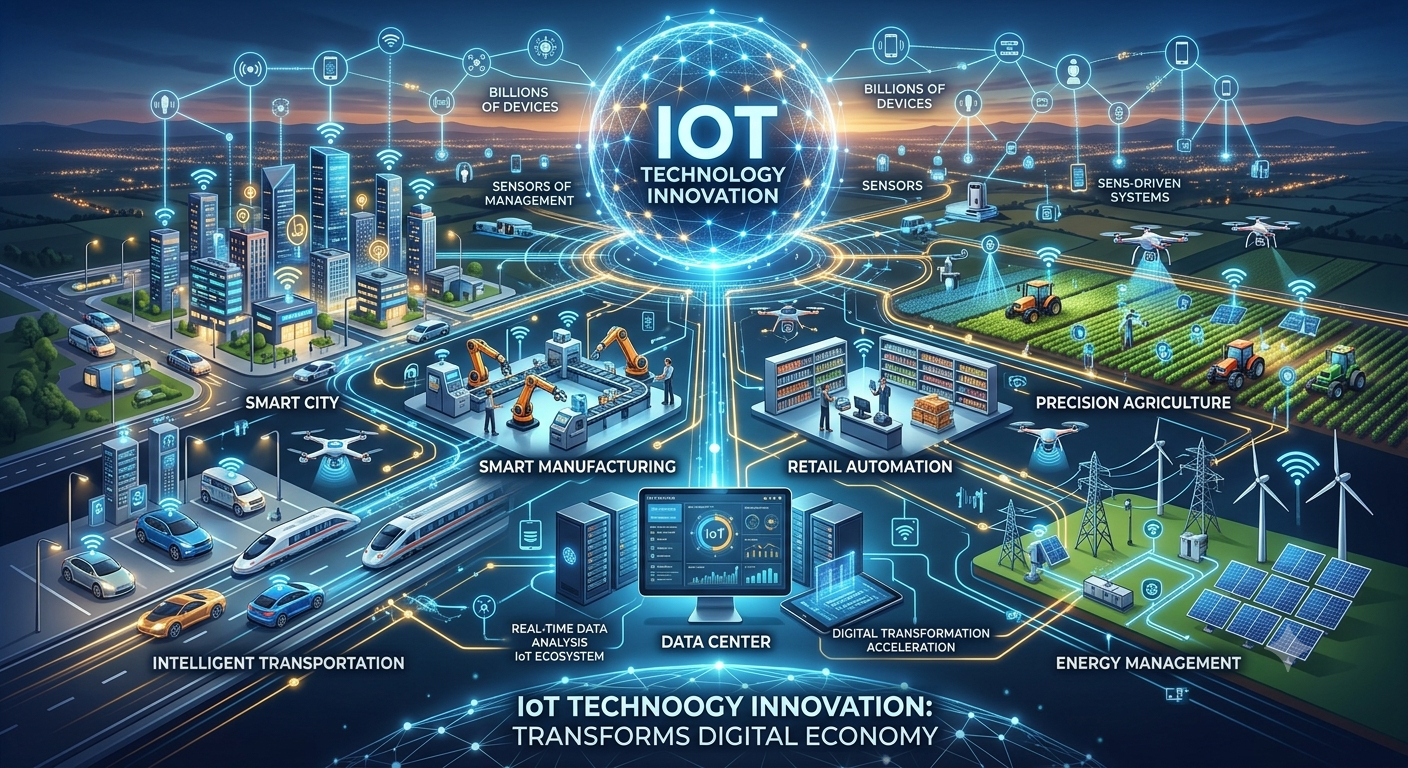
IoT applications now extend far beyond basic connectivity. From smart factories and connected healthcare to intelligent transportation and smart buildings, IoT is enabling organizations to turn physical assets into data-driven and increasingly automated systems. The following eight applications represent important areas where IoT technology is supporting digital transformation.
1. Smart Manufacturing and Industrial IoT
Manufacturing is one of the most significant application areas for IoT technology. Industrial IoT connects machines, production equipment, sensors, robotics, and enterprise systems to provide continuous visibility into manufacturing operations.
IoT-enabled sensors can monitor machine temperature, vibration, pressure, energy consumption, and other operating parameters. This information can be analyzed to identify abnormal conditions and support predictive maintenance. Manufacturers can therefore move from reactive maintenance toward condition-based and predictive approaches.
IoT also supports production optimization by connecting shop-floor equipment with manufacturing execution systems and analytics platforms. Real-time production data can help manufacturers identify bottlenecks, monitor equipment utilization, improve quality control, and reduce unplanned downtime.
The expansion of Industry 4.0 and smart manufacturing is a major growth driver for IoT technology. MarketsandMarkets identifies industrial applications as an important growth area, with enterprises increasingly deploying connected solutions for automation, predictive maintenance, and process optimization.
2. Smart Homes and Building Automation
IoT technology is transforming residential and commercial spaces by connecting lighting systems, thermostats, security devices, appliances, access-control systems, and energy-management equipment.
In smart homes, connected devices can be remotely monitored and controlled through smartphones, voice assistants, and centralized platforms. Smart thermostats can adjust temperature based on occupancy, while connected lighting can be automated according to schedules or environmental conditions.
Building automation extends these capabilities to offices, hotels, hospitals, shopping centers, and other commercial facilities. IoT sensors can monitor occupancy, temperature, air quality, lighting, and energy consumption. Building operators can use this information to improve occupant comfort, optimize energy use, and identify operational inefficiencies.
The growing adoption of smart home devices is specifically identified by MarketsandMarkets as a driver of IoT technology deployment.
3. Connected Healthcare and Remote Patient Monitoring
Healthcare is another major application area for IoT, particularly as providers seek to improve remote monitoring, patient care, and operational efficiency.
Wearable devices and connected medical equipment can collect information such as heart rate, activity levels, blood pressure, glucose levels, and other health-related parameters. This information can be transmitted to healthcare platforms for monitoring and analysis.
Remote patient monitoring can help healthcare providers maintain visibility into patient conditions outside traditional clinical environments. Hospitals can also use IoT for asset tracking, connected medical equipment, environmental monitoring, and facility management.
The combination of IoT, cloud computing, AI, and edge computing is creating opportunities for more responsive healthcare systems. Real-time data can support faster insights while connected devices can improve communication between patients, clinicians, and healthcare infrastructure.
4. Connected Vehicles and Intelligent Transportation
IoT is reshaping transportation by connecting vehicles, infrastructure, drivers, logistics systems, and passengers. Connected vehicle technologies can generate and exchange information about vehicle location, performance, traffic conditions, and driving behavior.
Fleet operators can use IoT-enabled telematics to monitor vehicle utilization, fuel consumption, maintenance requirements, and routes. This can improve fleet visibility and support more efficient logistics operations.
IoT is also becoming increasingly important for intelligent transportation systems. Connected traffic signals, road infrastructure, parking systems, and vehicles can exchange data to improve traffic management and transportation efficiency.
The expansion of 5G is particularly relevant to transportation because higher connectivity capacity and lower latency can support large-scale connected applications. MarketsandMarkets identifies 5G deployment as a key factor supporting IoT applications in transportation, healthcare, and smart cities.
Download PDF Brochure @ https://www.marketsandmarkets.com/pdfdownloadNew.asp?id=258239167
5. Smart Cities and Connected Infrastructure
Smart cities represent one of the broadest application areas for IoT technology. Municipalities are deploying connected sensors and platforms to monitor and manage infrastructure, transportation, utilities, public safety, and environmental conditions.
IoT-enabled streetlights can be remotely monitored and managed, while connected parking systems can provide information about available parking spaces. Sensors can also monitor air quality, traffic patterns, waste levels, water infrastructure, and energy consumption.
The data generated by these systems can help city authorities improve resource allocation and infrastructure management. Integration with AI and analytics can further enable predictive insights and automated responses.
MarketsandMarkets highlights smart cities as a major opportunity for IoT technology, particularly as governments invest in digital infrastructure, 5G, AI, and connected urban systems.
6. Agriculture and Precision Farming
IoT is enabling agriculture to become more data-driven through connected sensors, equipment, weather-monitoring systems, drones, and automated machinery.
Soil sensors can collect information about moisture, temperature, nutrient conditions, and other parameters. Farmers can use this data to optimize irrigation, fertilizer application, and crop-management decisions.
Connected agricultural equipment can also provide information about machine performance and field operations. Combined with analytics and AI, IoT-generated data can support more precise resource management and improve visibility into agricultural processes.
IoT technology is particularly relevant to large-scale farming operations seeking to optimize water, energy, fertilizers, machinery, and labor. The MarketsandMarkets analysis identifies agriculture among the industrial application areas covered by the IoT technology market.
7. Retail and Connected Customer Experiences
Retailers are increasingly using IoT to connect stores, inventory, products, employees, and customers. Connected sensors and RFID technologies can provide greater visibility into inventory movement and product availability.
IoT can support real-time inventory monitoring, automated replenishment, asset tracking, smart shelves, and connected store environments. Retailers can also combine IoT-generated information with analytics and AI to better understand customer behavior and improve store operations.
In warehouses and distribution centers, connected devices can help monitor inventory, equipment, environmental conditions, and logistics processes. These applications contribute to the broader digital transformation of retail supply chains.
As IoT ecosystems mature, the integration of connected devices with cloud platforms and real-time analytics is expected to create additional opportunities for retailers seeking greater operational efficiency and more personalized customer experiences.
8. Energy, Utilities, and Resource Management
IoT technology is also transforming energy and utility operations by enabling real-time monitoring of infrastructure, assets, and consumption.
Smart meters can provide detailed information about electricity or water usage, while connected sensors can monitor equipment and infrastructure across utility networks. Energy companies can use IoT data to identify operational anomalies, improve asset management, and optimize resource utilization.
In commercial and industrial facilities, connected energy-management systems can monitor consumption across equipment and buildings. Organizations can use this information to identify energy-intensive processes and implement efficiency measures.
The combination of IoT, edge computing, AI, and advanced analytics can further support predictive maintenance and intelligent energy management. This creates opportunities for more efficient and responsive infrastructure while supporting broader sustainability objectives.
AI, Edge Computing, and 5G Expand IoT Applications
The future development of IoT applications is increasingly linked to the convergence of IoT with AI, edge computing, cloud computing, and 5G.
AI can analyze large volumes of IoT-generated data and identify patterns, anomalies, and predictive signals. Edge computing allows data to be processed closer to the point where it is generated, which can reduce latency and support real-time decision-making.
Meanwhile, 5G can support large numbers of connected devices and enable applications requiring high connectivity performance. Cloud platforms provide scalable infrastructure for device management, data storage, analytics, and application deployment.
This technology convergence is expanding IoT from simple monitoring toward intelligent automation. MarketsandMarkets identifies AI integration, edge computing, 5G, and cloud platforms as important trends shaping IoT technology adoption.
IoT Software and Data Management Become Increasingly Important
As the number of connected devices increases, organizations must manage increasingly large volumes of IoT-generated data. IoT software therefore plays a critical role in turning raw device information into actionable insights.
MarketsandMarkets identifies the software solution segment as the highest-growth segment of the IoT technology market. This segment includes data management, real-time streaming analytics, network bandwidth management, remote monitoring, and security solutions.
Data management is particularly important because connected devices generate large quantities of structured and unstructured information. Organizations require technologies that can collect, process, store, secure, and analyze this information across heterogeneous IoT environments.
Network management is also essential for provisioning, authentication, configuration, monitoring, routing, and device software management. These capabilities help organizations maintain reliable IoT networks across different device and hardware environments.
Asia Pacific Emerges as a Major IoT Growth Region
Asia Pacific is expected to be the fastest-growing regional market for IoT technology during the forecast period. Rapid digital transformation, investments in 5G, smart city programs, manufacturing expansion, and connected-device adoption are supporting IoT deployment across the region.
According to MarketsandMarkets, the Asia Pacific IoT technology market is projected to increase from USD 260.76 billion in 2025 to USD 351.03 billion by 2030, representing a CAGR of 6.1%. China, India, Japan, and South Korea are among the countries contributing to the region’s IoT ecosystem through investments in digital infrastructure, smart cities, manufacturing, automotive, healthcare, and consumer electronics.
The region’s large manufacturing base and expanding technology ecosystem also create opportunities for industrial IoT, connected vehicles, smart infrastructure, and consumer IoT applications.
Challenges Shaping the IoT Technology Landscape
Despite its growth opportunities, IoT adoption faces several challenges. Data security and privacy remain significant concerns because connected devices continuously exchange potentially sensitive information across networks and platforms.
Interoperability is another challenge. IoT ecosystems often contain devices from multiple vendors using different technologies, protocols, and data structures. Lack of common standards can complicate integration and management.
Organizations also face a shortage of professionals with combined expertise in hardware, software, data analytics, networking, and cybersecurity. MarketsandMarkets identifies interoperability challenges, lack of common standards, and shortages of IoT-related skilled professionals among the challenges affecting the IoT technology market.
Addressing these issues will require stronger security architectures, standardized frameworks, interoperable platforms, and continued investment in IoT skills and infrastructure.
Future Outlook for IoT Technology Applications
The IoT Technology Market is moving toward increasingly intelligent, autonomous, and interconnected ecosystems. As organizations integrate IoT with AI, edge computing, 5G, and cloud platforms, connected devices are evolving from data-collection tools into active components of automated decision-making systems.
The eight application areas—smart manufacturing, smart homes and buildings, connected healthcare, intelligent transportation, smart cities, precision agriculture, connected retail, and energy management—illustrate the broad impact of IoT on digital transformation.
With the global IoT Technology Market projected to reach USD 1,148.62 billion by 2030, IoT is positioned to remain an important technology foundation for connected infrastructure, industrial automation, real-time analytics, and digital business models.
As connectivity becomes more pervasive and AI-driven intelligence moves closer to connected devices, the next phase of IoT adoption will focus increasingly on real-time intelligence, predictive operations, automation, and integrated digital ecosystems.
Frequently Asked Questions
1. What is the size of the IoT Technology Market?
The IoT Technology Market is projected to grow from USD 959.30 billion in 2025 to USD 1,148.62 billion by 2030, at a CAGR of 3.7%.
2. What are the top applications of IoT technology?
The top applications include smart manufacturing, smart homes and buildings, connected healthcare, intelligent transportation, smart cities, precision agriculture, connected retail, and energy and utilities.
3. Which region is expected to grow fastest in the IoT Technology Market?
Asia Pacific is expected to be the fastest-growing region, supported by 5G deployment, smart city initiatives, industrial IoT adoption, and digital transformation investments.
4. What technologies are driving IoT Technology Market growth?
AI, edge computing, 5G, cloud computing, real-time analytics, connected sensors, and advanced IoT software platforms are key technologies driving market growth.
5. What are the major challenges facing IoT adoption?
Data security and privacy concerns, interoperability issues, lack of common standards, and shortages of skilled IoT professionals are among the major challenges affecting IoT adoption.
